Showing posts with label Stolen Bases. Show all posts

Saturday, May 8, 2010

Game 29: Been Caught Stealing

In the very first game of the 2008 season, Jorge Posada injured his shoulder when he slipped on a slick home plate while making a throw. It kept him out of the lineup for a few days, but he eventually returned and attempted to play through it. He landed on the DL from late April through early June, returned, then eventually underwent season ending surgery in mid-July.

While Posada was still trying to grind it out, the Yankees played an early season series at Fenway. In the series finale, the same game in which Phil Hughes turned in the poor start we referenced in yesterday's preview, Posada got the start as the DH. But as the Yankees found themselves trailing in the eighth inning and with an opportunity for a rally at hand, Joe Girardi pinch ran for Jose Molina. When the bottom half of the frame came around, Posada was forced behind the plate for the first time in five days. He was under strict orders not to throw.

It's doubtful that the Red Sox knew that, but it's obvious that they knew that Posada - never blessed with great run-stopping abilities in the first place - was nursing a shoulder issue. Coco Crisp led off with a single, and despite two throws to first, promptly stole second on the first pitch. Later in the inning Dustin Pedroia singled. He too successfully took off for second on the very first pitch. The Sox ran in every opportunity they had in Posada's one inning behind the plate. It was painful to watch.

Last year the Sox continued to run on the Yankees going 16 for 21 in stolen base attempts, including a curtain call inducing swipe of home by Jacoby Ellsbury on April 26th.

The Red Sox have had their own problems controlling the running game in recent years. They've allowed the most steals in the AL this year with 42, 55% more than the second place team, and are next to last in CS%. In 2009 they allowed the most stolen bases in the league, and were dead last again in CS%. The second to last place team was closer to fourth place, percentage wise, than they were to the Red Sox.

Just like the Sox weren't shy about exploiting Posada's weakness to years ago, the Yankees have taken advantage of their opportunities to run on the Sox of late. In the season's opening series they went four for five in stolen base attempts, including a steal of home by Brett Gardner. Last year, they were successful in 19 of 21 attempts against Boston, including a merciless seven for seven against Jason Varitek in a late September game.

The tide of The Series That Shall Not Be Named turned on a stolen base, and in the years since the two clubs have taken virtually every opportunity to run on each other. Why should they, when virtually no one is caught stealing?

Taking the mound today for the Sox is a guy who has been caught stealing, but not on the base paths. Clay Buchholz was notoriously arrested in 2004 for swiping and selling 29 laptops from his town's middle school. After bouncing up and down for parts of three seasons, Buchholz finally established himself in the Sox rotation during the second half of last year. He's pitched well through his first five starts, sporting a 2.97 ERA but his high WHIP (1.42) as well as his FIP (3.11) and xFIP (4.03) suggest he's gotten a bit lucky. His strand rate and BABIP are not out of the ordinary, but his HR/FB of just 3.3% is not something that will hold up over time. Buchholz has made three previous starts against the Yanks, two in 2008 and one last year, and they've touched him up the tune of 18 hits, 2 homers, 9 walks, and 10 runs in 15.2 innings.

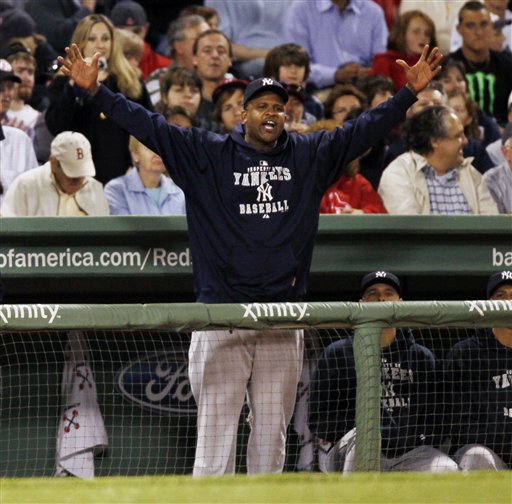
CC Sabathia takes the hill for the Yankees. He has no known history of thievery, but he was a pretty angry guy yesterday. First, he lashed out at his fellow "209" resident Dallas Braden, calling him a clown and saying his argument was tired. Then, as Josh Beckett buzzed batter after batter in the sixth, CC got on the top step of the dugout to make his displeasure known. Sabathia has been excellent through his first six starts, with his only poor outing of the season coming when he allowed five runs through five and a third on Opening Night in Fenway. He's been masterful since then, with a 1.93 ERA over his last 37.1 IP. If there's any blemish on the Big Fella's record so far it's that both his walk and strikeout rates are as poor as they've been since 2003. In his first season as a Yankee, Sabathia posted a 2.22 ERA, 0.81 WHIP, and 31:6 K;BB ratio in 28.1 IP against Boston.

The weather was pretty nasty in Boston earlier today. The tarp came off the field, then was placed back on, but word is the game will start on time as it appears things will be nice enough come game time. What started as miserable morning here in CT has turned into a beautiful afternoon, so perhaps Beantown will have similar luck.

Today's game is on FOX with our friends Joe Buck and Tim McCarver. Perhaps we'll get lucky and someone will steal their microphones. Lastly, in the event this game runs late, Joe West wanted me to tell you all that coverage will switch to FX at 7:30 due to FOX's NASCAR commitment. This happened during that April series two years ago and FOX made the switch without any advanced notice. I was none too pleased about that.

I've been caught stealing once when I was five
I enjoy stealing, it's just as simple as that
Well, it's just a simple fact
When I want something I don't want to pay for it

I walk right through the door
Walk right through the door
Hey all right, if I get by, it's mine.
Mine all mine!
-Lineups-

Yankees:
Where to begin? As speculated this morning, Nick Johnson has been placed on the DL and Kevin Russo has been recalled. Jorge Posada is not in the lineup for the fourth straight day, and the sixth time in the last nine games. Word is he would have played today if not for the potential for a slick field. He's supposed to return tomorrow, but we've been hearing that for a few days now.

Robinson Cano was not in the initial line up, but after taking BP and the team decided he can give it a go. The order is looking pretty weak, so getting Cano back in there is an added bonus. Given his knee he'll DH in place of Marcus Thames, and Ramiro Pena will stay at second base. In Nick Johnson's absence it's Brett Gardner, not Nick Swisher, moving up to the two spot. Part of that is because the order needs Swish's pop in the middle with Posada and Granderson out. Most of it is because of all the stolen base stuff we talked about above. With the lineup a bit weaker than usual today, I expect the Yankees to try to use their legs to make up for some of the missing offense.

Johnson's MRI revealed an inflamed tendon in his wrist. He received a cortisone shot and will be out "several weeks". Commence gnashing of teeth and start the "Bring Up Montero" campaign.
Derek Jeter SS
Brett Gardner CF
Mark Teixeira 1B
Alex Rodriguez 3B
Robinson Cano DH
Nick Swisher RF
Randy Winn LF
Francisco Cervelli C
Ramiro Pena 2B

Red Sox:
This isn't exactly the "A" lineup for the Sox either. With a lefty on the mound, the Artist Formerly Known as Big Papi hits the bench in favor of Mike Lowell. Ditto for Jeremy Hermida, who gives way to Bill Hall in left field.
Marco Scutaro SS
Dustin Pedroia 2B
Victor Martinez C
Fack Youkilis 1B
Mike Lowell DH
J.D. Drew RF
Adrian Beltre 3B
Bill Hall LF
Darnell McDonald CF

Tuesday, January 12, 2010

The Case For Raines

Good morning Fackers. For the most part, the backlash over last week's Hall of Fame voting results has cooled down and everyone has moved on to extracting their pound of flesh from Mark McGwire. But in running down the voting results last week, I made mention that the continued exclusion of Tim Raines and his overall poor showing in the results is the gravest injustice in the ballots. I further stated that the reasons why warranted its own post. This is that post.

Raines, like Bert Blyleven, has become something of rallying cause for the sabermetric community, as he was a tremendously valuable player, for a number of years, whose greatness isn't readily evident when measured by traditional metrics. I think this might be working against Raines. As far as we've come in our understanding of the game, there are still those amongst the voting ranks who have their heads buried in the sand, who are steadfastly against sabermetrics, the blogging community, and anything else that isn't a crusty old remnant of whenever they first cut their teeth in sports writing.

So rather than lay out a bunch of statistical analysis supporting Raines' cause - something that's been done far more eloquently by the likes of Joe Posnanski, Rob Neyer, Jonah Keri, and raines30.com - I'll try to put things in more of a general framework.

Simply put, Tim Raines, with the exception of Rickey Henderson, is the greatest leadoff hitter of all time. He was a machine at getting on base, he was historically successful at stealing bases (both in terms of quantity and success rate), and he scored runs by the boatload. Granted, if Raines was more of a power threat he would have been a three hitter rather than a leadoff hitter. But, batting leadoff is arguably the most important position in the batting order, as it will see the most plate appearances over the course of the season. And Raines' exceptional ability to avoid making outs made him extremely valuable in that role. Furthermore, Raines was not without power. While his home run totals are pedestrian at best, he spent his prime in Olympic Stadium, a very pitcher friendly park. Even so, Raines accumulated lots of doubles and triples - not to mention all the extra bases he stole - and his slugging percentage routinely outpaced the league average.

It's also very important to consider context in which Raines accomplished all of this. Baseball in the 1980s was markedly different than the game we watch today. Cookie-cutter astroturf ballparks permeated the game - particularly in Raines' National League. Power was down - the 49 home runs hit in 1987 both by recent electee Andre Dawson and recent confessor Mark McGwire were the most in baseball between George Foster's 52 in 1977 and Albert Belle's 50 in 1995 Cecil Fielder's 51 in 1990.

The game was built upon speed. Billy Martin's Oakland A's and Whitey Herzog's St. Louis Cardinals attempted steals at will. Herzog's teams, built on speed and defense, were arguably the team of decade, raking in four division titles, three pennants, and a World Series. The style of play permeated the game and players - Raines, Rickey Henderson, Vince Coleman, Willie McGee, Ozzie Smith - ran with reckless abandon.

And that was the problem with that style of play: it was reckless. Teams placed such a premium on speed that human out machines like Alfredo Griffin, Juan Samuel, and Mookie Wilson were given thousands of wasteful plate appearances in the leadoff spot strictly because they were fast. Traces of this philosophy still remain, as Dusty Baker's Reds have spent the last two years getting abyssmal OBP from the leadoff spot just because Corey Patterson and Willie Taveras are fast. When these players did manage to reach base, many of them were caught stealing so frequently that the bushels of stolen bases they accumulated were of little to no value thanks to all the extra outs they cost their teams. But with the right personnel, with the likes of Tim Raines getting on base at a .390 clip and swiping seventy plus bases a year at a jaw dropping 87% success rate, it was a successful and exciting style of play. The problem was, with the exception of Raines' Expos and Henderson's A's and Yankees, teams didn't have the right personnel to make that style of play work.

Baseball, as a game, has changed innumerable times in its 130+ year history. Our understanding of that game has changed and evolved over that time as well. The early Hall of Fame voters were able to understand that the players of the Deadball Era helped their teams win in different ways than the sluggers of the Ruth era. We understand now that top offensive contributions made in the mid to late sixties appear paltry compared to numbers that came before and after, but are no less outstanding when considering the context of the game at the time. We are starting to understand more and more the value of positional adjustments, and how a certain level of offensive production from a player capable of fielding a premium defensive position could be offer more value than a greater level of offensive production from a less important defensive position.

All of these factors come into play when considering Raines' case. Batting leadoff may not be the glamour batting position that the three or four spots are, but it's an extremely important spot. And virtually no one was better at batting in that spot than Tim Raines. Furthermore, he did his damage in an era where the game was placing more focus on the leadoff spot than it ever had before. With any luck, the BBWAA will realize this at some point in the next twelve years.

Wednesday, October 28, 2009

World Series Roster Update

Yesterday, the Yankees announced their World Series roster. Eric Hinske and blog favorite Brian Bruney have been added at the expense of Freddy Guzman and Francisco Cervelli.

The first swap was obvious. With the need for a pinch hitter in the National League park, Hinske became necessary and Guzman, functioning solely as a pinch runner, was the most expendable part. With Hideki Matsui coming off the bench in Philly as well, Hinkse will be the second best pinch hitting option, but still should see some action.

The absence of Guzman probably means that Brett Gardner won't be getting his first postseason start this series as Girardi will most likely keep him on the bench as a pinch running option. Jerry Hairston Jr. is a viable candidate for that role but is hardly a stolen base threat (only 7 for 11 this year) and therefore not much of a weapon.

Given the elimination of Cervelli, we can almost certainly infer that Jorge Posada will be catching A.J. Burnett in Game 2 (and presumably again if necessary), thus making having a third catcher on the roster superfluous. I was in favor of having Molina catch Burnett at the outset of the postseason, but it seems like the right move to let Posada catch him now. Burnett blew up with Molina behind the dish in Game 5 of the ALCS and worked well with Posada after he entered the game as a pinch hitter.

Bruney pitched in the instructional league down in Tampa during the ALDS but hasn't faced Major League hitting since October 2nd. The only frightening aspect of this move is that Girardi might try to use him for a fraction of an inning when it counts instead of relegating him strictly to mop-up duty. With Chad Gaudin unavailable for Games 1 & 2 after throwing an extended bullpen session yesterday, it seems likely that Bruney would be the last man out of the 'pen.

The Phillies made a move and an announcement of their own. Consummate gentleman and class act Brett Myers has been added to the roster - after recovering from a strained lat muscle - at the expense of utility man and former Yankee Miguel Cairo - a move Joe Torre is certainly frowning upon from afar for a couple of reasons. Charlie Manuel also declared that Pedro Martinez will be starting Game 2 at Yankee Stadium.

Pedro was chosen over Cole Hamels, who had an average season at best and has been shaky in 3 postseason starts (14.2 IP, 6.75 ERA). Pedro has pitched once since September 30th, was brilliant against the Dodgers in Game 2 of the NLCS, allowing two hits and no walks in 7 innings. But that was in Southern California in a pitcher's park against a National League line-up.

It will make for a quite the interesting dynamic. I wouldn't be surprised if Pedro was excellent or if he got bounced in the third inning. One way or another the familiar refrain offered by the Yankee Stadium faithful will be chanted ad nauseum when he's on the mound. Should be good theater either way.

Saturday, October 24, 2009

Girardi's Biggest Mistake

Joe Girardi has made some questionable decisions throughout this season and they've occurred at a much higher rate during the postseason. There were several short essays written about his tendencies yesterday over here. Most of of the debate focused on pitching changes and other substitutions, but his (and Brian Cashman's) biggest error may have come in roster construction:
sbarro philly foot sausage 8:31 am
I mentioned this yesterday, but I am still intrigued to hear what everyone thinks.
I have a question: do you all think that maybe Girardi made a mistake in not adding Cody Ransom to the roster?

I had an idea last night, that Cody could potentially be inserted as a pinch runner who could steal home or score in a squeeze play at the plate.

Here’s my thinking: the man can jump from a standing position atop a 60 inch box. When the throw reaches the catcher, the catcher would be in a squatted reach position to tag the runner, in this case, Cody Ransom. But Cody could simply take the catcher by surprise, jump over him and touch the plate.

What do you guys think? I think it would work, and could be one of the most spectacular plays since the 2001 Jeter shovel pass to Posada in the ALDS
The only appropriate response is this.

Thursday, October 22, 2009

Red Light, Green Light

At about the one third mark of this season, I became very vocal here with my belief that Brett Gardner deserved the lion's share of the playing time as the Yankees' centerfielder. His broken thumb in late July pretty much derailed any chance of that becoming a reality.

There was never any doubt that Melky Cabrera would be the starting centerfielder in the post-season, and buoyed by the strength of his ALCS Game Four, Cabrera's small sample size post-season numbers have been good. While some have suggested that Gardner start in place of the slumping Nick Swisher, that shouldn't happen, and I highly doubt it will.

Outside of it flying in the face of conventional wisdom, Joe Girardi seems to be infatuated with the idea of having Brett Gardner available as a pinch running option off the bench. While Hideki Matsui, and to a lesser extent Jorge Posada, make that a desirable option to have, I think the underlying thought process is faulty in something of the same way that the Joba to the bullpen argument is: it doesn't matter how good your late game options are if your early game options don't put you in a place to leverage them. That is, Gardner's speed shouldn't count against him. Don't hold him back because he's fast; if he belongs in the starting line up put him there.

That aside, something unexpected has happened in Gardner's last two pinch running appearances. After being successful in 26 of 31 attempts this year and 39 of 45 in his brief MLB career, Gardner has been caught stealing as a pinch runner in both of the last two games.

At the risk of blowing a small sampling out of proportion, I'm curious about this. Generally speedsters like Gardner have permanent green lights; they're free to go whenever they want so long as they're not given an explicit red light. I would assume that Gardner's operating under those conditions, but the situations in which he's decided to run in the last two games have made me wonder.

In Game Three, Gardner pinch ran for Hideki Matsui in the eighth. He was on first base, with no one out, trailing by a run. After a throw to first, on a 0-1 pitch, Gardner took off for second. Given the situation it was a risky move to begin with, given the count, it was even riskier. The Angels pitched out, Gardner was gunned down at second, and the potential tying run went from on base to the batters box. The Yankees lost 14.3% of win probability in the process, the most costly Yankee out of the game.

In Game Four, Gardner entered again in the eight, again at first, again with no one out. This time at least, the Yankees were up 5-1. After two throws to first, Gardner took off on a 2-0 pitch and got caught again. At least there was no risk of a pitch out that time. Because of the score, this time it only cost the Yankees 1.1% of win probability.

I'm wondering what exactly the thought process is here. Is Gardner perma-greenlighted and going on his own? Is he under express orders to go? As a pinch runner, does he feel like he has to run? In a situation like Game Three's, why is he not given a explicit red light?

I'm not anti-stolen base. In the right situation it is a calculated risk well worth taking. Gardner's SB in the tenth inning of Game Two of the ALDS was a good one. It put him in scoring position as the potential winning run, and his speed later forced an errant pick off throw that put him on third base with just one out. But I'm dubious of the two latest attempts, and not just because of the negative outcomes. I wonder if Gardner's becoming entrenched in his role as pinch runner/defensive replacement and trying to make something happen in each of his limited opportunities.

Thursday, October 15, 2009

Two Thoughts On Game Two

I know Game One isn't even until tomorrow, but here are two thoughts on the two hot button issues from this post-season, both of which affect Game Two (weather permitting).

First, Mike Scioscia's decision to pitch Joe Saunders in Game Two has been widely questioned, and with good reason in my opinion. I understand Scioscia's desire to utilize a lefty in Yankee Stadium in order to neutralize the Yankee lefties and switch hitters, since Yankee Stadia have historically favored lefties.

However, this Yankee Stadium has been a launching pad of historic proportions through its first 85 games. And as I pointed out when Saunders pitched against the Yanks three weeks ago, he is particularly prone to giving up the gopher ball. Saunders surrendered 29 long balls this year, tied for second in the American League despite the fact that an August DL stint limited him to 186 IP on the year. His 1.4 HR/9 also tied for second worst in the AL. Meanwhile, fellow lefty Scott Kazmir has more experience in the new Yankee Stadium, is a better pitcher overall, and allowed just 1.0 HR/9 this year, slightly less than league average.

A further thought regarding Saunders, Yankee batters this year hit .282/.360/.476 against right handed pitching and a slightly better across the board .286/.365/.480 against left handed pitching. There's no discernible platoon advantage there. The Angels would be best off throwing their best available pitcher in Game Two, and that pitcher is not Joe Saunders.

The second issue is whether Jose Molina will again catch A.J. Burnett. The Yankees have yet to announce that decision, though I'm inclined to believe that he will. But, even if he doesn't, I think we may see a bit of Jose Molina in this series anyway. Despite ranking just 11th in the AL in SB%, the Angels ranked third in the league in stolen bases with 148. In an effort to neutralize their running game, I wouldn't be surprised to see Jose Molina behind the plate in the late innings of game if the Yankees are leading.

This happened once already this year, early in the season in this game. Afterwards, Jorge Posada left the park without addressing the media. If this were to happen in the ALCS, the media storm would dwarf the Molina-gate squall that preceded Game Two of the ALDS.

I'm not sure what to make of this one. No one is going to confuse Jorge Posada with vintage Pudge Rodriguez behind the plate. And Posada shouldn't put his ego ahead of the good of the team. But, given that the Angels were below average in SB% and that all Yankee catchers, including Posada, were above league average CS%, it might be to the Yankees' advantage to tempt the Angels to give outs away on the bases.

Furthermore, if you subtract out caught stealings attributed to the pitcher making a pickoff attempt, Jorge Posada's catcher's caught stealing percentage of 21.6% is close to the league average of 21.9% and superior to Jose Molina's 17.9%. In fact, though the sample size is relatively small, the numbers suggest that if the Yankees decide to make a running based defensive substitution behind the plate, the nod should go to Franciso Cervelli who had an off the charts catcher's caught stealing percentage of 38.1% (8 of 21) in the equivalent of about 27 games behind the dish.

Swisher v. Abreu

This morning, Matt did a great job debunking the myth of Bobby Abreu's resurgent season and magical contagious plate discipline out in Anaheim. I also want to chime in on Abreu's production this season, but in relation to his ostensible replacement - another cheap acquisition via trade for the Yankees - Nick Swisher.

Although Xavier Nady was slotted as the starting right fielder and Swisher was supposed to man first base at the time the Yankees declined to offer Abreu arbitration on his $16M 2008 contract, Nady was done for the season by April 14th and Swish ended up getting over 600 plate appearances for the Yanks. Abreu sounded a bit like a spurned lover when talking about the Yankees cutting him loose but the reality is that at the time $16M was far too much to offer a corner outfielder with limited range when the market are held players like Raul Ibanez, Adam Dunn, Milton Bradley and Pat Burrell - even before taking into account the state of the baseball economy.

The decision made itself. The Angels waited out Abreu's attempts at a large, multi-year deal and got great value on highly productive hitter. Meanwhile, the Yankees signed Mark Teixeira and Swish ended up taking Abreu's place in right field of the New Yankee Stadium. They made essentially the same amount of money in 2009, so who got the better player?

Both guys love to work the count and put up solid OBPs, but that's pretty much where their similarities end. Let's take a look at the numbers (bold print represents an advantage):

A cursory look at the basic stats would give the nod to Abreu. His batting average is far higher than Swisher's and he batted in 14 21 more runs while stealing 30 bases.

However, while Abreu complied 41 more hits than Swisher, he actually had 14 fewer go for extra bases. The OBP advantage goes to Abreu, but more importantly, the slugging crown is Swish's by a wide margin. The home run totals are skewed by the New Yankee Stadium (although Swish only hit 8 at home), but not so much that Abreu would have hit twice as many there.

Abreu batted either second or third in the Angels' line up while Swisher was typically hitting somewhere between 6th and 8th for the Yankees, which explains the difference in RBIs. The 30 stolen bases at a 78% success rate do represent a major advantage for Abreu, but adding those 22 net total bases to Abreu's total isn't enough counteract Swisher's advantage in slugging percentage while subtracting the 8 times on base brings with OBPs closer together.

Usually, you would expect the guy who is a better base stealer to have the advantage in fielding as well, but that's not the case in this scenario. Swish didn't even attempt to steal a base all year long but still was better, or should I say "not as bad" as Abreu in right field.

Mainly on the strength of defense and power, Swisher had a higher value for the Yankees this year. Since Abreu hit all the plate appearance-based incentives in his contract this year, it means that Swish was the cheaper option by about $700,000 as well.

Both teams made out very well, but for different reasons. Swisher was cost controlled because of the deal he signed buying out his arbitration years and Abreu's contract was one of the most team-friendly in a historic buyer's market. The Yanks got an average fielding slugger while the Angels got a singles-raking base stealer. And with the teams meeting in the ALCS, I don't think there are too many regrets with how this scenario played out.

Tuesday, October 6, 2009

The Case Of Melky v. Gardner

Aside from debating the merits of Jose Molina catching a playoff game over Jorge Posada, which has already been done pretty extensively, there is really only one other marginal decision that Joe Girardi has to make in terms of configuring his starting line-up. Center field is that one area of debate, where both Melky Cabrera and Brett Gardner have a case to start.

They've both had up and down years and each has skills that the other doesn't. Melky hit 13 home runs this year while Gardner still stole 26 bases despite being on base just over 100 times. His speed also makes Gardner far less likely to ground into double plays. Melky has about twice as many plate apperances but has bounced into five times more twin killings.

Gardner offers much better defense, but Melky is still above average in center. For what it's worth, Melky has shown a penchant for big hits this year even though Gardner has better "clutch" stats. The Melk Man had a decidedly better September/October although that isn't very important either.

If either are left out of the line up and substituted for each other late in the game, Melky can provide the power as a pinch hitter while Gardner can add some speed (and better range in center) as a pinch runner or defensive replacement.

Being a switch-hitter, Melky offers better production against lefties although Gardner's tiny split of 55 PAs with a .356 BABIP doesn't bear that out quite yet. What you might not have expected is that Cabrera also has a better OPS than Brett the Jet against righties (.747 to .708). However, he's better in terms of average and power but is comparable in OBP, which is easily the most important of the three categories, especially over a limited sample.

Each of the three starters the Twins is likely to use in the ALDS is right handed: Kevin Slowey, Carl Pavano, and Scott Baker. Ditto for the Tigers with Justin Verlander, Edwin Jackson and Rick Porcello.

How should Girardi fill the CF slot, and presumably 9 hole in the line up in the games where Jose Molina isn't catching? Gardner brings two assets (speed and defense) to the table which would seem to be valuable in playoff games, but Melky has been a better hitter over the course of the season and has proved it over more at bats.

Considering all of the pitchers the Yankees are facing are right handers, should one guy start every game until further notice? If you figure that one is better than the other, is there a reason to divide the starts? Have they both earned the right to play in the postseason? Should that matter?

[Update 12:50: Greg from Pending Pinstripes has explored this topic in-depth and feels that Gardner is the clear answer. Here are three of his posts... Missing Brett Gardner, Brett Gardner's Off the DL, Should Melky Still Be Starting?, and Melky Cabrera Is Not As Clutch As You Might Think. There's good stuff in all of those entries and it's a slow day for baseball news on the internets, so check them out. If you weren't already leaning towards Gardner, that might be enough to push you over the fence.]

Saturday, September 26, 2009

Yanks Flip The Script On The Sox

After a week of people declaring that the Yankees weren't built for success in the postseason, it was the Red Sox last night who took some hits - both literally and figuratively - to what John Kruk thought was the only team "ready for the playoffs". Now Boston's rotation is under the microscope.

It was a tough night for Jon Lester who was getting hurt by the Yankees even before Melky Cabrera ripped that line drive that hit him just above his knee in the bottom of the third. It was a scary moment for all baseball fans when Lester hit the deck. He was on his back for quite a while, appeared to be in serious pain and had to be helped off the field. However, X-Rays were negative and Terry Francona thinks Lester will make his next start.

Last night was the young lefty's worst outing since May 9th against the Rays, as he allowed 11 baserunners in just 2 1/3 IP, four of whom scored on his own watch and the last who probably would have came to the plate regardless of who was pitching. His post game comments sounded like something Joba Chamberlain might have said: "I felt like I had good stuff tonight, but it was one of those nights where [the Yankees] made it seem like I didn't."

Marc Carig of the Newark Star-Ledger declared early on last night that it was backwards night at the Stadium and instead of his usual routine Chamberlain has decided to pitch well but then rip himself to the media after the game. That latter part didn't come true, but Joba's final line of (6IP, 5H, 3ER, 1BB, 5K) probably undersells his performance last night just a bit. He'd retired every batter he faced until allowing a solo shot to Victor Martinez with two outs in the fourth inning. As Michael Kay endlessly reminded us, the long bottom of the third due in part to Lester's injury delay probably didn't help much.

The other two runs Chamberlain allowed come via an opposite field 2 run homer by David Ortiz with two outs in the 6th, so he very nearly escaped with only one earned run. Even still, Joba needed only 86 pitches to do his work and there was plenty to be encouraged about.

Chamberlain got into trouble in the fifth inning with men on 2nd and third with no one out but squeezed out of the jam without allowing a run by getting Jason Varitek to pop out to third, striking out Alex Gonzalez swinging and inducing a grounder to Jacoby Ellsbury.

Speaking of the Red Sox' Captain, the Yankees ran absolutely wild against him tonight, stealing a season high 7 bases. It started when Derek Jeter singled and immediately took of for 2nd in the bottom of the first, setting the tone for the rest of the game. The inability to prevent runners from stealing could turn out to be a tragic flaw for the Sox when they match up with the Angels in the ALDS. The Yanks did their part to expose that tonight with Robinson Cano even getting in one the action, picking up just his 5th SB of the year.

A-Rod was the biggest thief of the night, swiping three bags but that only begins to describe his contributions. Alex didn't make an out all night, going 3-3 with a HR (off of Lester), a double, two walks and 4 RBIs.

It was an excellent night for the Yankees and a terrible one for the Red Sox. It was a testament to how quickly things can change. Which of these two teams looks primed for the playoffs now, pundits? Let's not get too excited though because things will probably change a little more today when CC and Dice-K take the mound at 4:00.

Wednesday, September 2, 2009

Are Throws To First A Waste Of Time?

You know the scene. The Yankees are on the road, it's late in the game and the opposing team puts a speedster on base. The pitcher throws over to first once, the runner retreats safely. He throws over again and it's not even close this time. The crowd starts to boo. And a third time. The boos get louder.

Even as a fan of the team throwing to first, I sometimes get annoyed with the process. It breaks up the flow of the game, it seemingly never works, and yet teams continually do it. Is it actually effective as a tactic or is it another practice in baseball that's done because it's always been done?

As of late June (can't find more recent stats), both Andy Pettitte and A.J. Burnett were near the top of the league in pick-off attempts. Burnett had a game this year against the Angels in which he threw to first base 24 times in 7 innings. They do get results though, as Pettitte is tied for the AL lead with 8 pickoffs this year while Burnett is not too far behind with 5. However, Burnett has more pickoffs where the runner was tagged out diving back to first base (4) than Pettite (3), probably because runners are more wary of Andy's move. Five of Pettitte's PO's were of the variety that CC Sabathia recorded against Jacoby Ellsbury last Sunday Night in which the runner was going on motion and got caught stealing.

We all know that pickoffs are pretty rare. Pettitte has allowed 178 runners to reach first base this year via single, walk or HBP and has nabbed less than 5% of them, or fewer than one every 3 starts. Much of the time the throws to the base are called from the bench and it's not especially close. You essentially never see a runner picked off the second time the pitches tosses over to first base.

But yet it's still done. Does it have a purpose even if they aren't catching the runners getting too greedy with their lead very often?

John Dewan says yes (h/t BBTF). When looking at data from 2002-2009, they've found that a runner's stolen base percentage actually does decrease when one throw to first base has been made. It goes down slightly with each throw after that, but not significantly. Check out his post for the numbers.

Runners steal at a 65% clip against Pettitte and Burnett which means the league is ineffective by sabermetric standards at swiping with them on the mound. Whether we like it or not, all those throws to to first base do serve a purpose (besides just slowing down the game).

Monday, August 24, 2009

Sabathia 1, Ellsbury 0

Amidst what was universally considered an abysmal performance (on Twitter at least) by a typically poor broadcasting team, there was a moment in the first inning when Jon Miller and Joe Morgan were actually -- insightful. (That sound you hear is Ken Tremendous rolling over in his digital grave.) With CC Sabathia ahead in the count 0-2 against Dustin Pedroia, Miller asked Morgan about Sabathia's move to first base because Jacoby Ellsbury was one steal away from breaking the Red Sox single season record.

Morgan responded by explaining how Sabathia was varying his leg kick in an effort to keep Ellsbury off-balance. Sabathia followed by delivering a pitch with almost no wind up, which would have been almost impossible to steal on. On the ensuing delivery, Sabathia raised his knee as if he were starting a wind up, which was exactly what Ellsbury was waiting to run on. Unfortunately for Ellsbury, Sabathia was one step ahead of him and instead of throwing to the plate, he fired to Mark Teixeira at first, who threw to Derek Jeter just in time to beat Ellsbury to second.

What was great about this sequence was the timing. Miller brought up the point, Morgan was spot on with his analysis and two pitches later, something relevant to their conversation actually happened. They didn't belabor the point incessantly only for it never to happen like so often occurs.

I'm a pretty serious baseball fan but I'll admit that I don't often notice the interplay and mind games that occur between a prolific base stealer and the pitcher trying to keep him at bay. Perhaps it's because aside from Brett Gardner, the Yankees haven't had a truly frightening speed threat in the line up since Rickey Henderson. Tim Raines was in his mid-to-late 30's when he joined the Yanks, Alfonso Soriano wasn't on base enough and Steve Sax and Roberto Kelly had their moments, but none of those guys stole more than 45 in a season wearing pinstripes. And the most recent of that group, Soriano, has been gone for 6 years already.

That moment last night represented what broadcasts are supposed to do and what Miller, Morgan and Phillips fail to do with remarkable consistency: convey things to the people who are watching that they didn't already know or wouldn't typically notice. It's difficult to do in baseball, but it shouldn't be as difficult is the Sunday Night Baseball crew makes it seem.

Wednesday, June 17, 2009

Runnin' On Jorge

Entering this season, before everyone was questioning whether or not Jorge Posada could call a game, the biggest concern was whether or not his shoulder would be healthy enough to throw out potential base stealers. Given that Posada is 38 years old, there was no guarantee that his shoulder would make a full recovery from the surgery he underwent to repair a tear in his rotator cuff and damage to his glenoid labrum. It seems that opposing teams still aren't convinced that he is healthy.

Last year, in 241 innings behind the plate, teams attempted 41 steals against Posada. He was run on in 10.3% of the plate appearances where there was s stolen base opportunity, which was second in the the American League only to Toby Hall (11.2%). Kevin Cash (9.3%) was the only other catcher with significant playing time to be tested more that 8.4% of the time. The attempts against Posada were successful 34/41 times, and of the seven times they were caught, five times the runner was picked off before the pitcher delivered the ball. That left Jorge's percentage of actually throwing out runners at a horrific 5.5%.

This year, one of those trends has reversed dramatically. Teams still are running on Posada, in fact, at an even higher percentage than before. They have attempted to steal in 11.2% of stolen base opportunities, far and away the most in the AL. Jason Varitek has been challenged next most often, but at only 8.5% of the time.

Here is the good news. Despite teams running on Jorge at an even higher rate than last year, they are successful far less often. Would-be thieves have been nabbed in 15 out of 47 attempts, 10 by Posada. That's 32% caught stealing and 21% by Jorge himself. It's still early in the season, but judging by this metric, the results of his surgery appear to be pretty incredible.

Frankie Cervelli gets run on 7.4% of the time (7th among the 21 AL catchers with 200+ SBOs) but has thrown out 31%, and sports a total CS% of 38. Here are the top 10 by Run %.

Theoretically, caught stealing percentage and run percentage would have an inverse relationship because in aggregate, managers should be less likely to test the catchers most likely to throw out the runner (obviously). But a lot of managers still rely on their gut or other instincts as opposed to hard numbers, so the list doesn't really bear that out.

It would seem that opposing managers and speedsters are underestimating Posada pretty drastically. Since a pitcher picking a runner off in the process of trying to steal a base has little to do with who is behind the plate, the best way to determine who gets the least respect for throwing out runners would be to juxtapose Run % with the Catcher's Caught Stealing % (CS% by C above).

Using this method, here are the three most disrespected catchers in the AL, sorted by the differential between the two rankings:

Kenji Johjima has the highest caught stealing and caught stealing by catcher, yet he ranks in the top half in Run % (8th). Talk about No Respect... Kenji is a very low key player, stashed away up in Seattle which must work to his advantage because this is one of the cases where flying under the radar does you a lot of good.

Figure this one out: A.J. Pierzynski only gets run on 5.5% of the time (18th out the 21), but has only thrown out one runner this season. Attention AL Skippers... you might want to start running on A.J. Pierzynski. Navarro and Suzuki are far less egregious cases, but it should be noted that they haven't quite earned the respect they have been given.

Wednesday, February 25, 2009

The Stolen Base: Fallen From Grace

With the advent of the Juiced Era and an emphasis on sabermetrics by front offices around MLB, the stolen base has declined in use around the game.

One of the most telling disadvantages of stealing bases is measured by the run expectation stat. Below is the run expectation chart for the 2003 MLB season (thanks to writer Joe Sheehan at Baseball Prospectus).


Based on this chart, a runner on first with no one out is worth .9116 runs. A successful steal of second base with no one out would bump that to 1.1811 runs, a gain of .2695 expected runs. However, in the unfortunate event that a runner is caught stealing second base, the run expectation stat drops to .2783. This is a loss of nearly 2/3 of a run (2.3 times more than the gain).

Why would managers risk this chance for a run and give up one of 27 precious outs? Unless it is late in the game and there is a need for a tying run, the batter is a ground into double play threat, or there is next to little chance that the batter at the plate cannot drive the runner in from first (i.e. low slugging percentage), it is stupid.

Horrible times to steal bases include early in the game, when you need multiple runs (baserunners are important) and when a big slugger is at the plate.

In his article, Sheehan points out that the belief that running distracts defenses is misplaced or exaggerated. Sheehan correctly states that "a runner on first is more disruptive to a defense, with the first baseman holding and the second baseman cheating towards second for a double play, than a runner on second." He also points out the distraction that running has on the batter. How many times have we seen a batter give up an out by flailing at pitches in the dirt so that the runner can advance? If the batter strikes out and the runner is thrown out, the run expectation goes from .9100 to .1083 in an instant.

Sheehan concludes that break even rate for a stolen base is a 75% success rate. Thus, players with less than a 75% success rate should not even attempt to steal. In fact, if your speed is your only asset and you have less than or barely a 75% success rate, you shouldn't even be on a roster (ahem, Scott Podsednik).

Stealing bases also presents injury risks. Why risk the injury of high-salaried slugger such as an A-Rod, Vladimir Guerrero or Alfonso Soriano? The benefit that these players provide at the dish is immensely higher than their base stealing benefits.

With the decline in Performance Enhancing Drugs and subsequently the decline in the number of home runs, it will be interesting to see if the number of stolen bases returns to 1980s levels when Rickey Henderson, Vince Coleman and Rock Raines ran wild. Having a few .390+ OBP/85+% SB guys can make a team lethal so long as they are in front of a few power hitters. However, as evidenced by the teams mentioned in Sheehan's article, teams shouldn't run just to run.