Showing posts with label Hall of Fame. Show all posts

Thursday, July 1, 2010

New Poll: 30% Of Yankees Fans Know Nothing About Baseball

During the top of the 6th inning, the YES Network revealed the results of their nightly text poll which asked if viewers thought Ken Griffey Jr. would be a first ballot Hall of Famer or not.

It's a really stupid question, right? I mean, he is one of the guys that gets named when you talk about players who people think almost definitely didn't take performance enhancing drugs, probably the most iconic player of his era, played 22 seasons in the Bigs, made the All-Star team in 13 of them, has 630 home runs, won the 1997 AL MVP, has five more top 5 finishes and won 10 straight Gold Gloves while playing a premium defensive position. He has a better chance of becoming the first unanimus HoF inductee in the history of the game than not getting in on the first ballot.


Uh...

Michael Kay and Al Leiter took the results of the vote to task on air, so I'm not exactly breaking new ground here, but I can certainly use more vulgarity than they did.

Seriously, what the fuck? We think HoF voters are clueless, but if the vote was conducted among people who responded to a YES Network text poll, they would have made him wait an entire year (at the least) to get in because... um... they are fucking clueless?

I think there are a few possibilities here:
  • People honestly have no concept of what it takes to get into the HoF and/or Ken Griffey's career because 14 year old kids are the only ones who respond to text polls and they weren't mentally conscious when Griffey was in his prime.

  • It's a small sample size and, as we've delved into before, that sample is badly skewed.

  • They are stupid. No one has ever lost money by underestimating the intelligence of the great masses of the plain people.

  • The respondents are only Yankee fans, as opposed to baseball fans. But even still, if the only time you watched Griffey was when he played the Yankees and listened to the broadcast, there's a good chance that one of the announcers - amid the praise the were lavishing upon him over the clip of the home run he stole from Jesse Barfield - specifically referred to him as a "first ballot Hall of Famer".

  • They just pressed the wrong button.

  • Voters are confusing the term "first ballot" with "unanimous". Maybe people have just enough knowledge about the game to know that no one has ever gotten all the vote in their first year of eligibility but don't know the term or aren't paying close enough attention to the question.
It's probably a combination of all of these and some other things that I couldn't think of but I'm leaning towards the last one. One way or another, the results of the voting either illustrate the stupidity of the question or of the sample. Or both.

Monday, February 15, 2010

2 Days Until Spring Training: Derek Jeter

At this time last year, Derek Jeter was in a vastly different spot than he is in today. During the final season at the Old Yankee Stadium, Jeter had put up his worst wOBA in a full season since he became a regular Major Leaguer in 1996. Scouts and defensive metrics alike had identified him as one of the worst defensive shortstops in the league and with his offensive production slipping dangerously close to league average, his overall value looked to be in sharp decline. Ramiro Pena was supposedly right on his heels to take over at short.

When a 34 year old player has a down year, regardless of how skilled they are, it's tough not to interpret that as a sign of an imminent decline. As the years of an athlete's career add up, it becomes increasingly unlikely that they will rebound from a sub par campaign; even a player as good as Jeter was up until that point has to see their skills erode eventually. Foretelling his impending demise was the obvious conclusion to come to, but luckily, what seems obvious isn't always right.

At a point in his career when player's defensive abilities are only supposed to deteriorate, Jeter posted his best and only significantly positive UZR rating since 2002, which is as far back as the data goes. It might have been the finest season as a fielder of his career. Partly due to an offseason conditioning program that was designed to increase his lateral range and partly because of Mick Kelleher's assistance with Jeter's positioning, the Captain enjoyed a late career defensive renaissance that is all but unheard of in baseball.

Joe Girardi's decision to bat Jeter lead-off coincided with a resurgent offensive year as well. Jeter increased his batting average, on-base percentage and slugging percentage by 34, 44 and 57 points, respectively. He hit 18 home runs, his highest total in 5 years. Granted he hit 11 of those over the short porch in right field at the New Yankee Stadium, but we can't really hold that against him since he'll be playing the same amount of regular season games there in 2010 as he did in 2009.

If we learn any lesson from Jeter's rebound in 2009, it should be that trying to divine a player's career trajectory on a season by season basis as they age is a fool's errand. Jeter's status as a historical outlier makes predicting what the future holds even more unreliable. So just as 2008 didn't foreshadow an imminent demise, nor does 2009 promise a run at Pete Rose's record.

While it's true that few shortstops have ever maintained above average offensive production while playing shortstop in the mid-to-late 30's, it's also true that Jeter is fairly like to do so considering that he was historically elite at age 35. But at the same time, Jeter's closest comparable according to Baseball-Reference, Barry Larkin, had a bad year when he was 35, bounced back when he was 36 and was essentially washed up by age 37.

What happens this year will have tremendous implications on Jeter's impending contract negotiations as well. Tyler Kepner of the New York Times wondered if Jeter will aim for a contract that takes him through his age 42 season like the one the Yankees gave to Alex Rodriguez. Even if Jeter continues to produce at an excellent level, a six year deal seems ridiculous and unnecessary and it would be uncharacteristically petty and selfish of Jeter to make such demands.

If the Yankees are serious about having a budget going forward, they can't afford to commit huge amounts of money to Jeter over the long term, regardless of what they are paying Rodriguez. They should be more concerned with what other teams might be willing to give Jeter. Contracts signed in the past are sunk costs and although there are personalities and egos involved, the bottom line is that money spent on Jeter is money that can't be spent on talent to surround him.

Additionally, the market for aging free agents is changing and Brain Cashman seems well aware of that fact:
The industry the last two free agent markets seems to be going downward and the player's ages are going upward. It makes more sense to be patient. My attitude is if this is the place you want to be, you will make it happen. Johnny Damon professed his love for the Yankees, wanted to be here and was given every chance to be here. He's not here anymore and I don't feel that is the Yankees' fault. They have to reconcile why they are not here, not me.
The comment was aimed at Johnny Damon (and by extension, Scott Boras) but I think it tells you something about the tack he will take with Jeter. Cashman understands the free agent market as well as anyone and although the Yanks might give Jeter more than he's worth on the field, it won't be by much.

The media will surely take Jeter's side regardless of how much he wants from the Yankees but the reality is that he has the power to make the negotiations easy or make them difficult. Ask for 6 year deal and a raise in terms of annual value and it will get ugly. Take 3 years at $20M, the deal is done overnight and the Yanks have more money to use towards building a team that can win World Series, which has always been Jeter's singular focus. But let's not put the cart ahead of the horse. There will be plenty of time to watch this topic get senselessly beaten into the ground over the course of the season.

We've been incredibly lucky to watch Jeter's career unfold and we've been even luckier to watch him continue his excellent production into his mid-30's. Let's hope he goes the way of Honus Wagner or Luke Appling and plays shortstop into his 40's, but even if he doesn't, the Yanks have had their best stretch at the shortstop position in the history of the franchise and one of the very best in baseball. Although it will hurt terribly when Jeter is gone, the Yankees are essentially playing with house money at this point. With any luck, though, we'll be able to see this image a few more times before he goes.

Saturday, February 13, 2010

Glavine And Thomas Call It A Career

Good morning Fackers. While we wait for Johnny Damon and Chien-Ming Wang to officially become former Yankees, two of my favorite non-Yankees of the past twenty years officially became former Major Leaguers over the past two days.

Despite not having played at the Major League level since 2008, neither Frank Thomas nor Tom Glavine had officially announced their retirement. That changed Thursday, as Glavine took an advisory job with the Braves, patching up whatever differences he had with the organization after they callously cut him during his rehab last year.

Later on Thursday, word broke that Frank Thomas, who last played with the A's in 2008, was calling it a career. The Big Hurt confirmed that at a Chicago press conference Friday morning, where the White Sox announced they would retire his number 35, a nice step following his acrimonious departure from the organization after the 2005 season and subsequent pissing match with GM Ken Williams.

Both Glavine and Thomas were excellent all-around athletes. Glavine's fondness for golf has been well documented and for a pitcher, he had some pretty good years with the bat, earning four Silver Slugger awards. He was also a very good hockey player, selected by the Los Angeles Kings in the fourth round of the 1984 NHL Draft, ahead of eventual Hall of Famers Luc Robtaille and Brett Hull.

Thomas, like Bo Jackson before him, was a two sport athlete at Auburn, doubling as a tight end on the Tigers football team before an injury derailed his football career. I, like Aaron Gleeman at Hardball Talk, and Joe Pawlikowski at RAB, was a fan of the Big Hurt despite him not playing for our favorite team. Joe went so far as to imagine what it would have been like had Thomas come up with the Yankees instead. Unfortunately, the closest we ever got to that was his turn as the unnamed rookie in Mr. Baseball, whose emergence prompted the Yankees to ship aging Jack Elliot off to the Land of the Rising Sun.

Both Glavine and Thomas were active off the field as well. Glavine has long been an important and involved member of the Players Association and was one of their central figures in the '94 strike. Thomas was perhaps the most outspoken player when it came to the issues of performance enhancing drugs in baseball, was one of the few witnesses not to embarrass himself at the 2005 Congressional Hearings, and was the only active player to willing cooperate with the Mitchell Report investigation.

But above all, what both will be remembered for is being one of the premier pitchers and premier hitters of the 1990s. Both should be part of what promises to be an outstanding 2014 Hall of Fame class.

Sunday, February 7, 2010

10 Days Until Spring Training: Phil Rizzuto

The 1956 celebration of Old Timer's Day took place on August 25th. At that point, Phil Rizzuto was already a bit of an old timer himself, nearly 40 years old having spent 13 seasons with the Yankees and served 3 years in the Navy during World War II. Scooter had lost his position as everyday shortstop for the Yanks to Jerry Coleman and Willie Miranda starting back in 1954 and had struggled in the plate appearances he was given in '56, hitting only .231/.310/.231. It was clear that his career was nearing its end, but the way that it came to a close blindsided Rizzuto.

Before the game against the White Sox that day, Casey Stengel called Phil into his office. The Yankees had just acquired Enos Slaughter from the Kansas City Athletics off of waivers and Stengel began discussing ways in which he could fit him on the 25 man roster. He had Rizzuto read down the roster and suggest players that could be moved to make way for Slaughter. Scooter would read off a name and Stengel would reject the idea. He kept looking over the roster until it was clear that Stengel was trying to get him to chose his own name. Naturally, Rizzuto was less than pleased with the way the Yankees had gone about this.

Stengel and general manager George Weiss assured Rizzuto that he would be added to the World Series roster as a back up for Gil McDougald should the Yankees make it that far. But adding to the fire, Weiss and Stengel reneged on their offer, eventually choosing Billy Hunter instead. Scooter felt betrayed and that broken promise very nearly ended Rizzuto's relationship with the Yankees. Fortunately for generations of fans of the Bombers, Rizzuto was the bigger man, forgave the team and went on to become one of the most recognizable ambassadors of the franchise for the next 50 years.

Rizzuto's Yankee career began almost twenty years before the infamous Old Timer's Day event and it might not have begun at all if it weren't for Casey Stengel. A Brooklyn native, Rizzuto explained that he grew up rooting for the Dodgers because it was easier to sneak into Ebbets Field than Yankee Stadium. Fresh out of high school, Rizzuto showed up at Ebbets Field to fulfill his childhood dream and try out for the team. The Old Perfessor was managing the Dodgers at the time, took a quick glance and Scooter's 5'6" frame and famously told him to "go get his shinebox" because that was the only way he was going to make a living.

Although dejected by the dismissal, Rizzuto didn't give up. Shortly thereafter, the Yankees invited him to a one week tryout camp. Even at that early age, Scooter was already and adept fielder, bunter and base stealer. Those skills, along with a home run that he hit during one of the scrimmages netted him a deal with the team.

Rizzuto spent the next four years in the minor leagues, jumping from D to B to AA-ball and maintaining an average over .300 wherever he went. During his 1940 season in Kansas City, he hit .347 and was named Sporting News minor league player of the year. He made his major league debut on April 14th, 1941.

As a 24 year old rookie, Scooter started 128 games a shortstop, hit .307 and finished 20th in the MVP voting. The Yankees went on to win the World Series against the Dodgers that year, although Rizzuto only manged 2 hits in 21 plate appearances. He was named to the All-Star team the following year and the Yankees made it back to the World Series but lost to the Cardinals.

In 1943, he was drafted into the Navy. Scooter never saw active duty and instead played on the Navy baseball team alongside Dodger's shortstop Pee Wee Reese, Dom DiMaggio, Don Padgett and Benny McCoy. He served for three years, missing the '43, '44 and '45 MLB seasons.

When he returned to the Yankees, it took Rizzuto a few years to regain his form as a hitter. He struggled through three below average seasons before Casey Stengel took over the reigns as manager. In 1949, Stengel moved Rizzuto from the bottom of the line up to the top, which coincided with a bump in his performance and a second place in the MVP vote behind Ted Williams. More importantly though, the Yankees won their first of 5 consecutive World Series, this one again over Rizzuto's childhood team, the Dodgers.

In 1950, Scooter finally put it all together, hitting .324/.418/.439 and winning the AL MVP. It was especially sweet with Stengel as manager - the most emphatic way possible that Rizzuto could have proved his offhanded dismissal of him at Ebbets Field years before was wrong.

After his MVP campaign, Rizzuto played two more years as the Yankees' full time shortstop before eventually becoming a part time player. While he was never a force offensively, he was better than most shortstops of his time. His career OPS+ was 93, but the a big reason that the Yankees were able to have the success that they did during Rizzuto's time in Pinstripes was that he offered roughly league average production from a premium defensive position. And Scooter's defense was well renowned. His former teammate Vic Raschi once said, "My best pitch is anything the batter grounds, lines or pops in the direction of Rizzuto."

After his unceremonious dismissal from from the Yanks in 1956, Rizzuto considered severing ties with the team. He felt spurned but eventually set his pride aside and joined the organization as a broadcaster the following year.

He was added to a booth with veterans Mel Allen and Red Barber and didn't initially fit in very well. Rizzuto felt that the two resented him for his inexperience. It would be precisely that lack of finish that endeared him to Yankees fans over his 40 year career in the booth.

While Rizzuto was known for his ability to play baseball the right way and lauded for his alertness in the field, his broadcasting style was much of the opposite. He was prone to miss things that happened during the game and interjected the broadcast with moments of personal levity and downright goofiness, such as "Bouncer to third, they'll never get him! No, why don't I just shut up!". He would openly advertise the fact that he was leaving the game early to beat the traffic over the George Washington Bridge and take time to wish friends and family a happy birthday over the air.

Rizzuto's success as a player earned him great respect throughout baseball but his trademark broadcasting style endeared him to generations of Yankees fans in a way his on-the-field play never could have. By narrating tens of thousands of games to people in driving in the cars or sitting in their living rooms, he became a familiar part of their lives. By sharing intimate details about his likes (golf, canolis) and dislikes (spiders, traffic, lightning) he was more than just a disembodied voice coming through the radio and eventually the television set.

The Yankees retired his number and dedicated a plaque in Monument Park to him on August 4th, 1985. He was passed on for the Hall of Fame repeatedly by both the writers (15 times) and the Veteran's committee (11 times) but eventually gained entrance in 1994 partially because of a persuasive speech given by Ted Williams. During it, Williams said that if the Red Sox had Rizzuto, they might have been the ones who won those pennants in the 40's and 50's.

By all accounts, Rizzuto was one of the kindest and friendliest personalities in all of baseball. When he passed away in 2007 at 89 years old after a few years of declining health, the Yankee community lost one of its pillars. He was the oldest living Hall of Famer at the time of his death.

Yogi Berra used to visit Scooter in the nursing home where he lived on a regular basis during the final years of his life. As a tribute to his best friend, he appeared briefly in the broadcast booth that night. It was difficult for Yogi as he was choked up for most of the appearance, but he went through with it as a way to honor all the years that Scooter spent in the booth. Earlier that day, Yogi talked about his lifelong pal during a lengthy media session in the Yankees dugout with Joe Torre at his side:

Saturday, February 6, 2010

11 Days Until Spring Training: Lefty Gomez

Yankee history is teeming with all-time great offensive forces: Ruth, Gehrig, DiMaggio, Berra, Mantle. But its history of hurlers is a little less prolific. There are several former Yankee pitchers in the Hall of Fame, most of them there primarily for what they accomplished in pinstripes. But the Yankee pitchers in the Hall of Fame lack the "inner circle" status of their offensive brethren.

The earliest Yankee pitcher in the Hall is Jack Chesbro. Poached from the Pirates when the Highlanders began play in 1903, Chesbro pitched for the club during their first six seasons of existence. He led the AL with 41 wins, 48 complete games, and 454.2 IP in 1904, but notoriously uncorked a ninth inning wild pitch on the season's final day, costing the Highlanders the back end of a double header against the Boston Pilgrims and handing the pennant to their future arch rivals by a game and a half.

Waite Hoyt and Herb Pennock led the pitching staff through the 1920s, as the team won their first pennants and World Series titles. But both were acquired from other organizations, as was Red Ruffing, a Hall of Famer himself, who joined the club in 1930. For the next thirteen years Ruffing would team the Yankees first homegrown ace to lead the team to seven pennants and six World Series championships.

Vernon Louis Gomez was adorned with the same nickname virtually every southpaw pitcher answered to in that era: "Lefty". Purchased from the San Francisco Seals of the Pacific Coast League in 1929, Gomez followed Tony Lazzeri from the same talent-rich northern California pipeline that the Yankees would later use to acquire Frank Crosetti, Joe DiMaggio, Gil McDougald, and Billy Martin. Gomez was of Mexican descent, but he was fortunate to be fair skinned enough to play in the Majors in the years before integration.

He made his Major League debut early in the 1930 season but also spent part of the year at the Yankees' AA affiliate in St. Paul. His Major League line wasn't pretty, just 2-5 with 5.55 ERA over 60 innings, most of them coming in relief. Gomez rebounded in a big way for his sophomore campaign, becoming the staff ace and leading the club in IP, wins, strikeouts, and ERA. His ERA slipped slightly below league average the following year, but he still led the club in wins and ERA, and finished fifth in MVP voting as the Yankees won their first World Series in four years. In post season play for the first time in his career, Gomez went the distance in Game Two of the Series, allowing just ten baserunners and a lone earned run on the way to a sweep of the Cubs.

Lefty turned in another solid campaign in 1933, again leading the Yankees in wins and ERA, falling just a third of an inning shy of tying Ruffing for the club lead, and leading the AL in strikeouts for the first of three times in his career. He followed that with the best season he would ever have. He led the American League in wins, winning percentage, ERA, ERA+, complete games, shutouts, strikeouts, and WHIP, earning him a third place finish in the MVP voting.

Gomez' record slipped below .500 in 1935, but his peripheral numbers were still excellent as he and Ruffing again fronted the pitching staff. The two would combine to carry the staff to an unprecedented four straight World Series titles from 1936-1939. Gomez went 64-38 (.627) over that stretch, with a 138 ERA+. He led the league in wins, ERA, and strikeouts in '37, marking the second pitching Triple Crown of his career. He also led the League in shutouts in '37 and '38. He won five World Series games over that run, leaving him with 6-0 record and 2,86 ERA in seven starts in the Fall Classic.

Gomez began to fade a bit towards the end of that historic run, falling just under 200 IP for the first time in his career in 1939. He was limited to just nine games in 1940, but rebounded pitch on pennant winners in 1941 and '42. He didn't see any action in those World Series, and was sold to the Braves in early 1943. Gomez never appeared for them, landed in Washington for one last start, and called it a career.

At the time of his retirement, Gomez was likely the best pitcher the Yankees ever had. A seven time All-Star, Gomez got the start in the first three All-Star games in history, five overall, and earned three wins in the Mid-Summer Classic. He had three top ten MVP finishes in the days before the Cy Young Award, and retired second to Ruffing on the Yankees all time wins, innings, strikeouts, games started, complete games, and shutout lists. His ERA+ of 125 bettered Ruffing (119) and still ranks ninth on the team's all-time leaderboard.

Always a quick thinker and quipster during his playing career, Gomez became a favorite on the off-season banquet circuit after his retirement. He remained in the Yankees organization as a manager, skippering the AA Binghamton squad in the late forties. Whitey Ford would go on to replace Gomez and Ruffing as the best pitcher in franchise history. Both Gomez and Ford were honored with plaques in Monument Park in August 1987. Ruffing would join them there in 2004. Gomez was unanimously elected to the Hall of Fame by the Veterans Committee in 1972, five years after Ruffing and two years before Ford.

Tuesday, January 12, 2010

The Case For Raines

Good morning Fackers. For the most part, the backlash over last week's Hall of Fame voting results has cooled down and everyone has moved on to extracting their pound of flesh from Mark McGwire. But in running down the voting results last week, I made mention that the continued exclusion of Tim Raines and his overall poor showing in the results is the gravest injustice in the ballots. I further stated that the reasons why warranted its own post. This is that post.

Raines, like Bert Blyleven, has become something of rallying cause for the sabermetric community, as he was a tremendously valuable player, for a number of years, whose greatness isn't readily evident when measured by traditional metrics. I think this might be working against Raines. As far as we've come in our understanding of the game, there are still those amongst the voting ranks who have their heads buried in the sand, who are steadfastly against sabermetrics, the blogging community, and anything else that isn't a crusty old remnant of whenever they first cut their teeth in sports writing.

So rather than lay out a bunch of statistical analysis supporting Raines' cause - something that's been done far more eloquently by the likes of Joe Posnanski, Rob Neyer, Jonah Keri, and raines30.com - I'll try to put things in more of a general framework.

Simply put, Tim Raines, with the exception of Rickey Henderson, is the greatest leadoff hitter of all time. He was a machine at getting on base, he was historically successful at stealing bases (both in terms of quantity and success rate), and he scored runs by the boatload. Granted, if Raines was more of a power threat he would have been a three hitter rather than a leadoff hitter. But, batting leadoff is arguably the most important position in the batting order, as it will see the most plate appearances over the course of the season. And Raines' exceptional ability to avoid making outs made him extremely valuable in that role. Furthermore, Raines was not without power. While his home run totals are pedestrian at best, he spent his prime in Olympic Stadium, a very pitcher friendly park. Even so, Raines accumulated lots of doubles and triples - not to mention all the extra bases he stole - and his slugging percentage routinely outpaced the league average.

It's also very important to consider context in which Raines accomplished all of this. Baseball in the 1980s was markedly different than the game we watch today. Cookie-cutter astroturf ballparks permeated the game - particularly in Raines' National League. Power was down - the 49 home runs hit in 1987 both by recent electee Andre Dawson and recent confessor Mark McGwire were the most in baseball between George Foster's 52 in 1977 and Albert Belle's 50 in 1995 Cecil Fielder's 51 in 1990.

The game was built upon speed. Billy Martin's Oakland A's and Whitey Herzog's St. Louis Cardinals attempted steals at will. Herzog's teams, built on speed and defense, were arguably the team of decade, raking in four division titles, three pennants, and a World Series. The style of play permeated the game and players - Raines, Rickey Henderson, Vince Coleman, Willie McGee, Ozzie Smith - ran with reckless abandon.

And that was the problem with that style of play: it was reckless. Teams placed such a premium on speed that human out machines like Alfredo Griffin, Juan Samuel, and Mookie Wilson were given thousands of wasteful plate appearances in the leadoff spot strictly because they were fast. Traces of this philosophy still remain, as Dusty Baker's Reds have spent the last two years getting abyssmal OBP from the leadoff spot just because Corey Patterson and Willie Taveras are fast. When these players did manage to reach base, many of them were caught stealing so frequently that the bushels of stolen bases they accumulated were of little to no value thanks to all the extra outs they cost their teams. But with the right personnel, with the likes of Tim Raines getting on base at a .390 clip and swiping seventy plus bases a year at a jaw dropping 87% success rate, it was a successful and exciting style of play. The problem was, with the exception of Raines' Expos and Henderson's A's and Yankees, teams didn't have the right personnel to make that style of play work.

Baseball, as a game, has changed innumerable times in its 130+ year history. Our understanding of that game has changed and evolved over that time as well. The early Hall of Fame voters were able to understand that the players of the Deadball Era helped their teams win in different ways than the sluggers of the Ruth era. We understand now that top offensive contributions made in the mid to late sixties appear paltry compared to numbers that came before and after, but are no less outstanding when considering the context of the game at the time. We are starting to understand more and more the value of positional adjustments, and how a certain level of offensive production from a player capable of fielding a premium defensive position could be offer more value than a greater level of offensive production from a less important defensive position.

All of these factors come into play when considering Raines' case. Batting leadoff may not be the glamour batting position that the three or four spots are, but it's an extremely important spot. And virtually no one was better at batting in that spot than Tim Raines. Furthermore, he did his damage in an era where the game was placing more focus on the leadoff spot than it ever had before. With any luck, the BBWAA will realize this at some point in the next twelve years.

Friday, January 8, 2010

Morning Linkaround

Time to pull together some odds and ends, friends:
It appears that Kevin Towers will be joining the Yankees as a consultant in 2010. Why only a consultant? Because if he had a higher title, he wouldn't be able to continue collecting his salary from the Padres. How's that for revenue sharing, San Diego?

Just like he did last winter with Robinson Cano in the Dominican Repbulic, Kevin Long is already working with players on their swings. Long has already visited Nick Swisher, is working with A-Rod this week and Curtis Granderson in the near future.

The Replacement Level Yankees Weblog compares the 2008 and 2009 Yankees defenses. Hopefully there will be another jump forward in 2010.

In light of David Cone's departure from YES, Larry from the Yankeeist gives his thoughts on the broadcasts and wonders whether we'll ever see a true sabermetrician in the booth.

After covering each team in the AL East individually, the folks at Beyond the Box Score have taken to comparing them using their slick DiamondView graphic. The Yankees lead in both on base ability and power, while the Rays have the best fielding and baserunning. The Red Sox run second in each of those categories, making them the jack of all trades but the master of none. And there's nothing wrong with that.

River Ave. Blues presents their long-awaited Jesus Montero prospect profile.

A-Rod reportedly has a new lady friend, a 25 year old Miami socialite named Elaine Spottswood. Over/Under on this one: 2 Weeks.

Alex Remmington at Big League Stew tells you everything you need to know about UZR.

First up in the BBWAA backlash category, Deadspin lists the worst Hall of Fame voters. You know how I can tell Barry Petchesky isn't really a baseball fan? There are only three on his list and none of them are Dan Shaugnessey or Jon Heyman.

Ken Rosenthal thinks that, in addition to adding web-based writers to the BBWAA, they should be subtracting voters who are out of touch with the game.

Sky Andrecheck half-jokingly suggests 5 things players can do to improve their chances of getting into the Hall of Fame as a way of pointing out the flaws in the voting. Of the 5, there is only one that a player himself could control and it runs contrary to the interests of the team (working fewer walks).

Lots of words have been spilled about the Expos lately, most notably from Jonah Keri. He recounts some personal memories from his youth at Olympic Stadium during an ode to Tim Raines while Tyler Kepner has a column in the Times today about the former stars who came from Montreal.

Thursday, January 7, 2010

Hall Of Fame Triangular Table

If you aren't Hall of Famed out just yet, SportsCenter anchor and former Max Kellerman Show co-host Brain Kenny had Rob Neyer and Joe Sheehan (of Baseball Prospectus) on his radio show to discuss the results of the voting yesterday. They call it a roundtable, but there's only three of them.

It's just a quick 10 minute segment and although all of them are generally grounded in sabermetrics, there isn't any groupthink going on. Although I don't wade too deeply into the HoF discussions, I like the fact that everyone has a slightly different idea of who should be in.

A Look At The HoF Voting Results

Good morning Fackers. Yesterday we took a cursory look at the Hall of Fame voting results, noting Andre Dawson's election and the tantalizing near misses of Bert Blyleven and Roberto Alomar. The entire ballot spanned twenty six players who met the eligibility criteria. Here are some thoughts on those who weren't as lucky as The Hawk.

Byleven (74.2%) - He's a vitrual lock for next year after coming so close this year and seeing an 11.5% jump over last year. He has two more years of eligibility left and the next two classes aren't particularly strong.

Alomar (73.7%) - I'm not a big believer in drawing distinctions between a Hall of Famer and First Ballot Hall of Famer. Even so, I think Alomar's standing relative to the other men who have played his position make him worthy of first ballot induction. Obviously it will have to wait until next year. If waiting a year is Alomar's penance for the Hirschbeck spitting incident then so be it. I realize there are players in the Hall who have done worse, but waiting a year is a small price to pay for what's one of baseball's more despicable moments.

Jack Morris (52.3%) - Morris vs. Blyleven seems to be the next frontier of the old school vs. new school debate. Morris saw an 8.3% jump over last year, the second biggest gainer outside of Blyleven. He still ranks behind where Blyleven was in his 11th year of eligibility. It'll be interesting to see where this one goes in the year's to come. Does anyone remember when Morris nearly joined the '96 Yankees?

Barry Larkin (51.6%) - Larkin deserves enshrinement, but he clearly has a ways to go in the eyes of the voters. Still, it's encouraging to see him start out at 51.6%. For comparisons sake, Alan Trammell, a similar if inferior comparison, garnered just 15.7% of the vote in his first year of eligibility.

Lee Smith (47.3%) - Smith is the highest ranking former Yankee on the ballot. His continued languishing in the sub fifty percent range makes me wonder if the BBWAA is smarter than we give them credit for being. At the time of his retirement, Smith was the all-time leader in saves. He hasn't thrown a pitch in a dozen years, yet he's been passed only by Trevor Hoffman and Mariano Rivera. Normally, that's the sort of thing the writers would eat up: "This guy's the all-time saves leader, he's got to be a Hall of Famer!". Instead, Smith remains far from enshrinement, as he should. I'm just not sure it's because the writers realize the save is a relatively meaningless statistic. More likely, I think Smith serves as an example that the writer's aren't quite sure how to evaluate "closers". The relievers in the Hall - Wilhelm, Fingers, Sutter, Gossage - were "firemen", routinely accumulating 100+ IP per season. Smith accumulated 100 relief IP just twice, in his first two full seasons as a reliever. Smith was at the leading edge of the game-wide transition from firemen to closers. Dennis Eckersley is the only closer in the Hall, and Smith lacks both Eckersley's utter dominance as a closer as well as his years as a successful starter. Smith has seven more ballots for the writers to figure it out.

Edgar Martinez (36.2%) - If the voters don't know what to make of closers, then they have absolutely no idea what to do with designated hitters. The DH has been in existence for 37 seasons now, and it has evolved significantly in that time. What started as place to play the best bench player evolved as a spot to hide defensive liabilities, or to prolong the career of aging veterans, or to protect the health of those too fragile to handle the wear and tear of daily defense. While HoFers like Eddie Murray, George Brett, Rickey Henderson, Paul Molitor, Wade Boggs, Jim Rice, Dave Winfield, Carl Yastrzemski, and Dawson all spent significant time at DH, Martinez is an interesting case in that he's the first worthy candidate to have spent nearly his entire career as a DH. Offensively he has HoF numbers, and I think he's worthy of induction. I'll be interested to see how his candidacy is evaluated over the next several years.

Tim Raines (30.4%) - Far and away the gravest injustice in my opinion. Raines is worthy of his own post, and I hope to have that before the week is out.

Mark McGwire (23.7%) - After taking a slight dip in his percentage last year, McGwire's number returns to where it was in both of his first two years of eligibility - a long, long, long way from induction. Like Smith and Martinez, McGwire is an interesting test case. McGwire is probably the best pure power hitter in baseball history not named Babe Ruth (1st all time in AB/HR, 2nd all time in IsoP), but the problem is that he wasn't all that pure after all. I'm not sure yet how PED users should be judged, but McGwire's four years on the ballot don't bode well for Rafael Palmeiro next year or for Barry Bonds and Roger Clemens in 2013.

Alan Trammell (22.4%) - This was Trammell's ninth year on the ballot and his best showing yet. He's still so far off that it's unlikely he'll ever be elected. As a shortstop, Trammell is Hall of Famer. He's comparable, if slightly inferior, to contemporaries and Hall of Famers Cal Ripken Jr, Robin Yount, and Ozzie Smith. I think the problem for Trammell is that he was overshadowed by those three for most of his career, and in the years since the likes of Alex Rodriguez, Derek Jeter, Nomar Garciaparra, Miguel Tejada, and Hanley Ramirez have completely changed the concept of what a shortstop could do. Had Trammell begun his career 20 or 30 years earlier he'd likely already be in Cooperstown. At this point the Veterans' Committee looks like his best bet.

Fred McGriff (21.5%) - One of the worst trades the Yankees ever made. McGriff was a great player for a long time. But as a first baseman, his numbers don't really separate him from his contemporaries. It doesn't appear that another 7 HR to get to 500 would have made the difference for him either.

Don Mattingly (16.1%) - This is the best showing for our beloved Donnie Baseball since his second year on the ballot back in 2002. But it's still well off from his career best of 28.2%. As much as we'd all like to see it, Mattingly's not going to the Hall nor should he - his career nose dived way too soon. But I hope he continues to get the requisite 5% to stay on the ballot until his 15 years run out.

Dave Parker (15.2%) - The induction of borderline guys Jim Rice and Andre Dawson in back-to-back years lends itself to slippery-slope style arguments. I don't think The Cobra was as good as either one of those guys, but he wasn't off by too much.

Dale Murphy (11.7%) - Much like Mattingly, Murphy went from amongst the best in baseball to done seemingly overnight. Murphy was a contemporary of Dawson, and like Dawson is considered and all-around class act and good guy. The two make for an interesting comparison. Dawson had a longer and better career, and voters seem to favor players who decline gradually, like Dawson, to players who fall off a cliff, like Murphy. But if you look at their primes, Murphy was arguably the better player. And if you look at their peaks, Murphy was clearly the better player.

Harold Baines (6.1%) - The last player that will still be on next year's ballot. With the arrival of Edgar Martinez, Baines is no longer the best DH eligible for enshrinement.

Andres Galarraga (4.1%) - I'm surprised he didn't get the 5% necessary to stay on the ballot. Certainly not a HoFer, but a pretty good player during a rather lengthy career. I wonder if Galarraga dropping off after one year gives any insight as to how the voters will view the Coors Field effect. It'll be interesting to keep in mind as Larry Walker becomes eligibile next year and Todd Helton no fewer than six years from now. At 43 years old and stuck on 398 career HRs, Galarraga signed a minor league deal with the Angels in 2004. He spent a month in AAA and was given a token September call up. In the 160th game of the season, Galarraga pinch hit in the ninth inning of a game the Angels led 9-0. He homered to get to 399, and celebrated waaaaay too much for a player of his stature, particularly considering he was just hanging on to pad his numbers and had just hit a meaningless home run in garbage time of a late season game. I remember seeing the highlight and thinking it was a little below him. The again, Galarraga lost a season to lymphoma during the most productive stretch of his career and had suffered a relapse earlier that same year that may have cost him additional service time, so maybe I'm just a jerk for begrudging him a little celebration.

Robin Ventura (1.3%) - The second lowest ranking former Yankee on the ballot (Todd Zeile didn't get a single vote). In 1999, Nolan Ryan received 98.79% of the vote, the second highest percentage of all time. He was six votes short of being the only unanimous selection in history. Perhaps he'll beat Ventura up again, steal his seven votes, and add them to his own total to give him 100.2% of the vote.

Michael "Mike" Jackson (0.0%) - Listed only to give me an excuse to link to this. It probably wasn't particularly funny then; now it's neither funny nor timely.

Wednesday, January 6, 2010

Congratulations Hawk

This could quite possibly be the final post ever at Fack Youk, as I'm afraid the furor over this afternoon's Hall of Fame voting results will cause the internet to explode some time later today.

Andre Dawson was the sole player elected by the BBWAA, being named on 420 of 539 ballots for 77.9% of the vote. He received just 15 votes more than the necessary 75%.

Even closer to that 75% cutoff were Bert Blyleven and Roberto Alomar. Unfortunately for them they were on the wrong side of 3/4, with Byleven falling an agonizing five votes shy (74.2%) and Alomar just eight votes short (73.7%). The good news for them is that no one has ever failed to be elected after gaining that much support.

In my opinion Blyleven and Alomar are without doubt Hall of Famers, so there will assuredly be some people angry that they're out and Dawson - a borderline candidate - is the one who got in. And that says nothing about other more deserving candidates: Tim Raines, Barry Larkin, Alan Trammell, Edgar Martinez, or even Hawk's comparable contemporaries like Dale Murphy and Dave Parker.

Personally, I don't have a huge problem with Dawson getting in. He's assuredly a borderline candidate, but he had a helluva a career: MVP, Rookie of the Year, 8 time All-Star, 8 Gold Gloves, 4 Silver Sluggers, and some impressive power numbers that have him in the company of baseball's all-time greats. He also spent his best years playing in relatively obscurity in Montreal, where the concrete-like turf punished his knees to the point that he first moved from CF to RF, and then eventually to DH.

On the flip side, Dawson's career OBP is just .323, lower than the league average over the course of his career. There's no way to sugarcoat that. Whether that's enough to outweigh the positive aspects of his career is for you to decide. The writers didn't think so - not this year at least. Your mileage may vary, and probably does.

For now though, congratulations to the Hawk on his induction. We'll have more later on the rest of the ballot, and I'm sure several others elsewhere will have plenty to say about all of this.

Hall Of Fame Day

Good morning Fackers. The Hall of Fame voting results will be announced at 1:30 this afternoon; prepare yourselves for tearing of garments, gnashing of teeth, righteous indignation, some variation of stats vs. scouts, and the like.

Much like post-season awards, I can't get too worked up about the Hall of Fame. I think there are people who are in who shouldn't be. I think there are people who aren't who should be. And I think several members of the BBWAA are morons. But it's a museum for all intents and purposes, and I can't get myself too angry over who is enshrined in a museum meant to honor baseball's history. That said, there is one player up for nomination this year who I believe absolutely should be in, and who I believe likely won't get in (again). And if he doesn't get in later today, I'll likely be compelled to share some thoughts on that.

In the meantime, Joe Posnanski published his ballot at Sports Illustrated yesterday, and I urge you to give it a read. Like virtually everything else he authors, the article is long, insightful, and well thought out. You don't have to agree with all of Joe Pos' decisions - I don't - but it's awfully, awfully hard to argue with him. He clearly put a ton of thought into his choices and he offers compelling arguments for or against all the candidates worth consideration. Have a look, and we'll be back when the results are announced.

Monday, December 7, 2009

HoF Veterans Committee Announces Inductees

We have the first bit of news from the Winter Meetings and it involves the Hall of Fame Veterans Committee inductees. We previewed this back when the ballot was announced last month.

On the manager/umpire ballot former Royals and Cardinals manager, as well as one-time Yankee farmhand, Whitey Herzog was voted in. He's joined by former umpire Doug Harvey. Herzog was named on 15 of 16 ballots, Harvey on 14. Twelve votes were needed for induction.

On the executive side, the voters once again pitched a shutout, shamefully denying former union head Marvin Miller again. Miller was named on seven ballots, with nine needed for induction. Former Tigers owner John Fetzer was closest with eight votes.

Aside from Herzog, all nominees with Yankee connections were shutout: Billy Martin on the manager's ballot, former owner Jacob Ruppert, former GM Gabe Paul, and former announcer Bill White on the executive ballot.

Like post-season awards, I try not to get too worked up over Hall of Fame votes, but it's an absolute sham that Marvin Miller is continually denied induction.

Wednesday, November 18, 2009

He Came Dancing Across The Water

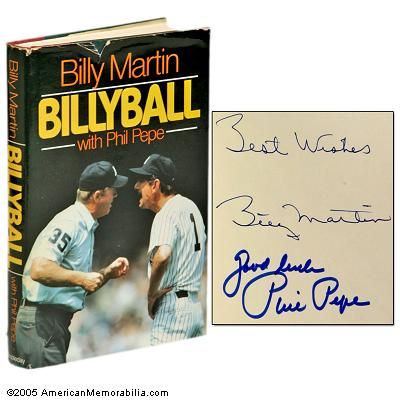
One of my favorite people in Yankee history is Billy Martin. He was serving his fourth stint as Yankee manager when I attended my first Major League game, and was in his fifth and final go-round when I began following the team in earnest. In between, I can recall watching the ceremony on WPIX when the club retired his number. A few years later, after Martin died in a 1989 Christmas Day drunk driving accident, I began devouring books about the Yankees. Three of my favorites were Number 1, Billyball, and The Last Yankee, all Martin biographies.

These days I might dismiss Martin the player as the over-heralded, "scrappy" underdog that David Eckstein is too often made out to be, or Martin the manager as an irrational martinet, too often trying to put his fingerprints on the game, much the same way that Tony LaRussa is often criticized elsewhere or Joe Girardi was here over the course of the season.

But to the twelve year old me, reading those books, Martin was a captivating character. He was the undersized overachiever who fulfilled his dream by playing for the Yankees, elevated his play to another level in the World Series, stopped at nothing to win, and never backed down from a fight. What characterized Martin above all though, and perhaps what most drew me to him, was that more than anything else, he wanted - he almost needed - to be a Yankee.

While that skill set left Martin with a middling career as a journeyman infielder, it primed him for a mangerial career that was as volatile as it was successful, and now has him under consideration for induction to the Hall of Fame as a manager. Despite his well-documented butting of heads with George Steinbrenner and with his own players, Martin's smarts, daring, and insatiable desire to win made him a continually desirable managerial candidate, even in light of his paranoid and perpetually self-destructive behavior. It's also what kept him coming back to the Yankees over and over and over and over and over again.

Steinbrenner was perhaps the only person who could understand - if not commiserate with - Martin's maniacal obsession with winning at all costs. And while Martin enjoyed successful managerial stints with four other clubs, Steinbrenner needed Martin as his manager just as much Martin needed to be a Yankee. It was a bad relationship, but it was also the reason that Martin and Steinbrenner, both intensely proud individuals, repeatedly forgot their past problems in hopes that, this time, it would work.

I bring all this up because The Hardball Times' Chris Jaffe has a book being released in December: Evaluating Baseball's Managers. THT is publishing excerpts over the next several weeks and yesterday they had a lengthy look at Martin: why he was unique, why he was successful, and why his managerial stints necessarily had short shelf lives. It's a highly worthwhile read on a fascinating and complicated subject:
The man most comparable to Billy Martin was not Herzog, but Hernan Cortes, the Spanish conquistador who defeated the Aztecs. In 1519, he landed in Mexico to face the hemisphere’s mightiest warrior nation with only 600 men. Upon arrival, he burnt his boats, giving his men no way to leave. That move was pure Billy Martin. Safe to say, that in the military science version of sabermetrics a general would be poorly regarded for intentionally destroying his communication lines, supply routes and exit strategy. It was possibly even worse than having two men steal home with Killebrew batting.

However, like Martin, Cortes had an underlying rationale. The act was not the important part. All that mattered was the message it sent the men: there was no going back—they needed to win. He cared only about coming out on top and ensured his warriors must think likewise. They might lose and die, but with God as their witness no failure would stem from lack of effort on anyone’s part. That was Billyball, 16th century style.

You could have given me a hundred years and I wouldn't have come up with that comparison. See you tomorrow.

Wednesday, November 11, 2009

Non-Player Hall Of Fame Candidates

Good morning Fackers. We're still a good two months away from the Hall of Fame balloting being announced and the inevitable tearing of garments and indignation that will follow. Yesterday however, the Hall announced a list of twenty former managers, executives, and umpires that will be considered by the Veterans Committee (h/t BBTF).

Just like players, the candidates will need to be named on 75% of the ballots to be inducted. However, rather than being voted upon by the crumudgeonly BBWAA, the non-player candidates will be evaluated by their peers. Historically this has been a path of less resistance for those not elected by the writers, but since being reconstituted in 2001 the Committee has elected no players and only five non-players. Results will be announced at the Winter Meetings on December 7th.

The managers category includes former Mets manager Davey Johnson, former Royals and Cardinals manager (and former Yankee farmhand) Whitey Herzog, and former Yankee player and manager Billy Martin. Other candidates include Gene Mauch, Tom Kelly, Charlie Grimm, Danny Murtaugh, and Steve O'Neill. Umpire candidates are Doug Harvey and Frank O'Day.

The executive category includes longtime Yankee owner Colonel Jacob Ruppert, former Angels owner Gene Autry, former Royals owner Ewing Kauffman, former MLBPA executive director Marvin Miller (one of the five most influential people in baseball history), former Yankee GM Gabe Paul, as well as former National League President and longtime Yankee broadcaster Bill White.

Thursday, September 17, 2009

Could Derek Jeter Get In The HoF Unanimously?


It's been a while, but I don't think there is any other way to approach this than FJM-style. Maybe I was inspired by yesterday at Deadspin. Or maybe there is so much wrong in this post that I tried to react to it using blockquotes but it was impossible without it seeming like I was quoting him out of context.

(Before you tell me in the comments, I have no delusions that I am as brilliant or funny as the FJM fellas, but when you disagree with just about everything in a piece, there aren't too many ways of responding to it other than bolding what they say and reacting in regular font.)

Is Derek Jeter an all-time, all-time, all-time great, a la Mantle, Ruth, Rickey Henderson, Bob Gibson, Sandy Koufax, etc? No.

But he is an all-time great—the shortstop with the most hits, a four-time World Series champ, an undisputed leader and grinder.

Luis Aparicio had the record for hits as a shortstop before Jeter and he received just 84.6% of the vote and it wasn't even his first ballot.

Phil Rizzuto was the Yankee shortstop for 7 World Series titles but had to be elected by the Veterans Committee 38 years after he retired, and unlike Jeter, he won an MVP.

Lots of people disputed Jeter's leadership when he didn't stand up for A-Rod. Others have said that Jorge Posada was the real, fiery leader in the Yankee clubhouse.

And "grinder" is a nebulous, bullshit term that has been used to describe the least talented player on every high school team ever assembled.

That’s why, I truly believe, Jeter may way become the first unanimous Hall of Same selection.

I really do.


All of those things in combination are pretty impressive, but none of those guys who you named as being better than Jeter were elected unanimously.

I know… I know—some moron voter will make a stand by voting NO; his chance to say, “If Ruth wasn’t unanimous, Jeter shouldn’t be.”

You really don't think he'll get in unanimously, then. So what was the point of this article again?

But Jeter, well, Jeter is perfect. First, look at his lifetime statistics. Second, look at the three Gold Gloves (yes, his defense isn’t what it once was. But, in 2009, it’s been very good). Third, look at the four titles. Fifth, look at the captaincy. Sixth, look at the clutch situations—especially The Flip against Oakland. Seventh, look at the dignified way he carries himself.

Okay, since you brought them up, let's actually look at these things instead of just listing them offhandedly, shall we Jeff:


Yes his statistics are very good, particularly his batting average and OBP, especially when you consider that he plays shortstop. I'm with you.

Second, look at the three Gold Gloves (yes, his defense isn’t what it once was. But, in 2009, it’s been very good)

It's not that his defense wasn't what it once was, it's that there are very smart people who contend that it was never very good to begin with. Derek Jeter isn't going to the HoF for his defense.

Third, look at the four titles.

Those four championships came in his first 5 years and he hasn't won one since then despite playing on the team with the highest payroll in the league every year during that time even though Jeter has been great all along. Which kind of goes to show that championships are a pretty terrible way of measuring individual performance.

[Fourth...]
- Apparently because you used "four titles" in your 3rd point, you didn't include a #4. Clever.

Fifth, look at the captaincy.

Mmmkay, I'm looking. And I see Jason Varitek, who is the captain of the Red Sox, and the only way he's getting into Cooperstown is by driving down Interstate 88 and ponying up the $16.50 entry fee. I also see Thurman Munson who, despite winning a Rookie of the Year (like Jeter), and MVP (unlike Jeter) was not inducted because his career was tragically cut short. It's about the numbers not the "captaincy".

Sixth, look at the clutch situations—especially The Flip against Oakland.

Let's disregard the flip play that you mentioned because he has done something like that exactly one fucking time in his career on which Jeremy Giambi might have been safe anyway. If we are basing Hall of Fame voting on fluke plays in the playoffs, let's add Mookie Wilson and Aaron Boone while we're at it. But let's focus on the larger point; his performance in clutch situations in general.

If you had actually looked at his career numbers on B-R like you told everyone else to in point #1, you would know that Jeter's OPS in the regular season is .846. How about in late and close situations during the regular season? .811.

His OPS in the postseason is exactly the same as the regular season right now, .846. He's been great in the ALDS at .957. In the ALCS, though? .743, pretty close to leage average. In the World Series, the clutchiest of all baseball gaming situations? .809. There's something to be said for staying close to his great career norms under intense pressure, which is more than most can claim. But let's not pretend that Jeter has delivered transcendent "clutch" performances throughout his career whenever the pressure rises. Because no one does that. Because "clutch" comes and goes.

Seventh, look at the dignified way he carries himself.

Amazingly, this might be the most salient point of them all. He hasn't done anything to offend the people voting for him and he won't lose any votes to vindictive writers like many others have. But recent inductees Cal Ripken and Tony Gywnn carried themselves with the same level of class and still came up 8 and 13 votes short, respectively.

I'll add one thing of my own, which I mentioned above... #8 - He's never won an MVP. I personally don't think that should keep him off the first ballot, but that might have been the difference between the 5 voters who went for Ripken but not Gywnn. Or maybe they were racists. In which case 2 or 3 of them should vote for Jeter.

I thought it utterly insane that Rickey Henderson had a handful of voters who didn’t support his Hall bid, but the Rickster was, factually, arrogant and a wee-bit selfish. He didn’t deserve any Nays, but he didn’t always carry himself with professionalism.

And that handful will be the same people who, in defense of Babe Ruth, Ty Cobb, Christy Matthewson and Honus Wagner, won't vote for Derek Jeter.

Jeter is, for lack of a better word, perfect.

You already said that. Putting in a one sentence paragraph doesn't make it a better point.

To vote against the man would be illogical. And downright stupid.

The BBWAA doing something illogical? Or stupid? I refuse to believe it.

Derek Jeter is a surefire first ballot Hall of Famer is he never records another hit. He's the greatest Yankee shortstop of all time and like Tim Marchman said, he's as winning a winner as ever won. But there are going to be at least a few complete assholes out there who, instead of individually deciding whether or not they they he belongs in the Hall of Fame, will take it into their own hands to block his unanimous induction. It's ridiculous but it's reality.

However, had Pearlman made his case with actual facts or sound logic, we could have saved ourselves a lot of time.

Thursday, September 10, 2009

Some Perspective On Jeter And Gehrig

Today is Thursday and the Yankees are off, as they will be every Thursday for the remainder of the regular season. As such, news is hard to come by, so we will be given more and more of the Jeter/Gehrig Story.

While the mainstream media continues to beat that drum, in the Yankee blogosphere the narrative has turned to the coverage overkill by the mainstream media. It's a warranted criticism, perhaps best summarized by Bronx Banter's Cliff Corcoran.

Jay and I have both been guilty of giving this story more legs that it doesn't need. However, much like our friend Jason at IIATMS, Fack Youk is trying to supply a little perspective on this achievement. The mainstream media is making this out to be a little bit more than it is. The inevitable backlash from elsewhere is probably selling it a little bit short. As usual, the truth likely lies somewhere between.

Keith Olbermann had blog post earlier this week lamenting Gehrig once again being knocked from the record books, and fearing that the Iron Horse might some day be forgotten. I can appreciate Olbermann's sentiments, but I can't agree with them. As I stated this morning, Gehrig is amongst the best baseball players ever. Period. His peers are Ruth, Williams, Bonds, Aaron, Musial, Mays, Cobb, Mantle - the best ever to play the game. If Gehrig were ever to be forgotten, it certainly wouldn't be because Jeter passed him on a leaderboard that while glamorous because it belongs to the most celebrated franchise in the game, is relatively meaningless in the big picture of baseball history. If anything, perhaps the recent media storm will actually increase the profile of this all-time great.

Jeter's latest accomplishment is something to be recognized and is as good a reason as any to celebrate his remarkable career that has been at times both over and under rated. But lest we lose sight of just how incredible Lou Gehrig was, let's take a look at what Jeter and Gehrig did with their 2,721 career hits:


The point isn't to say that Derek Jeter isn't the slugger that Gehrig was. They are two very different players in that regard. The point is to illustrate that while Jeter will soon surpass Gehrig in total number of hits, the New York Yankees franchise will have received far more value out of Lou Gehrig's 2,721 hits than they did out of Jeter's 2,722.

Gehrig still sits comfortably atop the Yankees all-time double and triple lists, and is safely third on the all-time home run list. He sits behind only the imcomparable Babe Ruth on the franchise's total bases leaderboard. Jeter is fifth, within five total bases of Joe DiMaggio in fourth, but a good two seasons behind Mickey Mantle in third, and light years behind Ruth and Gehrig. Consider this: Derek Jeter has 718 career extra base hits. Lou Gehrig has 697 combined doubles and triples before even counting his 493 home runs.

Of course, the object of baseball is to score runs, and they key to scoring runs is reaching base safely. While hits are the most valuable way to do that, it's just one of three ways to reach base safely. Here's a look at the franchise's all-time leaderboard in times on base:


Jeter will likely sit atop this list one day as well, but it will take him a good two and half to three more years to get there. And that doesn't take into account his on base percentage, which is currently 7th amongst all Yankees with at least 4,000 career plate appearances. And as Steve Goldman pointed out earlier this week, Jeter's OBP will likely begin to fall as he enters the decline phase of his career.

None of this is meant to discredit what Derek Jeter has done over the past fourteen seasons, has done this week, or will do this weekend and over the remainder of his career. He is sure fire first ballot Hall of Famer and is undoubtedly the greatest Yankee shortstop ever. Lou Gehrig is amongst the select few members of the Hall of Fame who are deserving of their own wing. Jeter is on the shortlist of the greatest players in Yankee history. Gehrig is amongst the best players in baseball history.

Though people of my generation have been treated to all-time Yankee greats like Jorge Posada, Mariano Rivera, Andy Pettitte, and less recently Bernie Williams and Don Mattingly, more than any of them, Derek Jeter is the name in recent Yankee history. This milestone, and all the others Jeter will reach before his career is over, will be deservedly trumpeted. However, next time someone waxes nostalgic about Gehrig losing another record, or next time someone in the paper or on TV gets overly hyperbolic about Jeter setting this record, please try to remember the context.