Showing posts with label managers. Show all posts

Sunday, October 10, 2010

162 > 3: In Defense Of Ron Gardenhire

Postseason baseball can be a thrilling month-long adventure, or it could be a terrible trip that lasts less than a week. A six month season will be judged on what happens to a team against top-tier competition under pressure-packed conditions in what can be as few as three games. Some players who have a terrible year can totally redeem themselves with a few big hits in a postseason series while others who have done yeoman's work since April can turn into a goat because of a split-second reaction in the outfield, one pitch left over the plate or a feeble at-bat with runners in scoring position.

The same goes for managers. A skipper can be viewed as a genius or a dummy after the fact, based on how he aligned his rotation, filled out his lineup card or inserted his relievers into a game. Or in this case, just the end results of three games against a superior team.

Take it away, David Pinto:
FIRE RON GARDENHIRE

Ron Gardenhire has now lost 12 straight playoff games. He’s been swept by the Yankees two years in a row. If he were the Yankees manager, he would have been fired last season. I really don’t care how well the team has done under him.
I believe what Pinto is trying to get at here is that he doesn't care how they've done during the regular season under Gardenhire, which of course is incredibly stupid. Regardless of how much you think a manager can influence a baseball game, 162 of them tells you a whole lot more about someone's abilities as a manager than three nights in October do.

Managers just don't have the ability to affect games over the short term, unless they want to pick a pitcher from High-A ball to start Game 1 of the series, pencil players into the wrong defensive positions and order them to bat from the opposite side of the plate they are accustomed to. Good managers are skilled at steering the ship over a interminable season and making good decisions that will work out well in the long run, but simply can't exert much pressure in the span of three games without trying to throw the series.

I'm sure losing 12 straight playoff games absolutely sucks for the Twins' organization and their fanbase, but what does the 2004 ALDS have to do with the series that concluded last night? Do you know how many players started games for the Twins in both series? Two. Michael Cuddyer, and Jason Kubel, and they might actually be the same person.

Pinto's not done yet:
The Twins team is good, but they need to be sent a message that getting swept every year is unacceptable. Firing Gardenhire will send that message.
I'm pretty sure that the Twins are aware that getting swept every year in unacceptable. Does this look like a bunch of dudes who are thrilled to be starting their offseason already?

What exactly has Gardenhire done to deserve being fired? What thing that was under his control did he screw up? Did he start someone that deserved to be benched? Was it the way he set up the starting rotation? A boneheaded bullpen move?

It's not any of those, of course. Pinto is just judging Gardy in black and white terms, which is something that a casual fan or George Steinbrenner at his most impulsive would do, not someone who goes by the Twitter handle @StatsGuru.

It's not like Gardenhire has some "Marty Ball" scheme and manages differently in the playoffs. It's not as if he has a pregame ritual wherein he runs around the clubhouse wearing only an unbuttoned Harmon Killebrew jersey screaming at the top of his lungs, which renders his pitching staff incapable of holding a lead.
The Twins, however, need someone ruthless in the playoffs who can find a way to win not only a game, but a series.
What "ruthless" mystery manager is going to be able to lead the Twins to postseason glory and by what means? Should we exhume John McGraw so he can get into a fistfight with an umpire? Perhaps an undead Gus Schmeltz would be willing to whip every fielder who makes an error with a riding crop and force the team to take batting practice using a lead pipe and jagged rocks.

Because THAT would send a message, goddammit. And that message would read, "The Minnesota Twins don't understand the concept of small sample sizes or the role that luck can play in a short playoff series, so they fired one of the best managers in baseball in favor of a sadistic zombie. Muthaphuckkkazzz1!!!!!"

Thursday, July 22, 2010

Ralph Houk: 1919-2010

He was nowhere near the mythical figure of George Steinbrenner or the constantly stately presence of Bob Sheppard, but yesterday, just a few weeks shy of his 91st birthday, former Yankee catcher, manager, and general manager Ralph Houk passed away in his home in Winter Haven, Florida.

Drafted by the Yankees in 1939, Houk played three years of minor league ball before voluntarily enlisting with the Army Rangers. He attended Officer Candidate School at Fort Riley in Kentucky and eventually participated in the invasion of Normandy and The Battle of the Bulge. After being shot in the calf during the latter, he returned to the battlefield immediately after he had the wound bandaged.

Later in that same battle, Houk disappeared for three days after he was sent him out to doing some scouting of enemy troops, his commanding officer recalled:
When he turned up he had a three-day growth of beard and hand grenades hanging all over him. He was back of the enemy lines the entire time. I know he must have enjoyed himself. He had a hole in one side of his helmet, and a hole in the other where the bullet left. When I told him about his helmet, he said 'I could have swore I heard a ricochet.' We marked him 'absent without leave' but were glad to have him back alive.
Houk returned from the war decorated with a Silver Star, a Bronze Star with an oak leaf cluster and a Purple Heart and earned the nickname The Major.

When he rejoined the Yankees in 1946, he started in AA and made the jump to AAA mid-way through the season. When the '47 season rolled around, he found himself serving as Yogi Berra's back up for the Big League club and went 3 for 3 with a double and a walk in his debut on April 26th. He only made it to the plate 104 times in that season, and it would turn out to be a career high, never amassing more than 14 in the remainder of his eight years with the Yankees. During all that downtime, he talked with the pitchers out int he bullpen and started collecting an impressive amount of knowledge about all angles of the game.

He began his career as a manager before he even hung up his cleats. The Yankees named him manager of their AAA team at the time, the Denver Bears, and he strapped on his gear and took a couple of hacks at the plate in 1955 before deciding his days as a player were over. In 1958, he left Denver to serve as Casey Stengel's first base coach, where he remained for three years.

The experiences The Major had in the army ended up coming in handy when he took over for the ousted Stengel before the 1961 season, as he said in an interview with Time Magazine:
Being in the war probably helped my managing. It made me understand the problems young men have and the pressures they go through not only in a war but in baseball.
By most accounts, Houk was a "player's manager" but possessed a fierce temper which he would occasionally direct towards the umpiring crew. He wouldn't throw one of his men under the bus to the media, but he would unload on them behind closed doors if he perceived a lack of effort.

Houk would arrive to the ballpark four hours early - something that wasn't nearly as common is those days as it is now - to begin preparing for the day's game. He spent that time looking over line up cards and strategizing with his coaches and scouts about the opponent to see if he could "pick up one or two little things".

His disciplined preparation - along with an incredibly loaded roster - brought the Yankees two World Series titles in his first two seasons at the helm and an AL Pennant in the third. After the 1963 season, however, Houk became general manager and asked Yogi Berra to be his skipper. The Yanks lost in the Fall Classic again in 1964 and Houk (unpopularly) fired Berra and replaced him with Jonny Keane.

After Keane led the team to a 77-85 record in 1965 (good for just 6th place in the AL after five consecutive pennants) and began the '66 season 4-16, Houk took over as manager once again. The Yanks finished in last place that, 9th out of 10 the following season, and had descended into mediocrity. Houk's final season as the Yanks' skipper was in 1973, the last year that the team was still owned by CBS. George Steinbrenner asked Houk to return, promising to bring him talent and restore the once-great franchise but demoralized by the fans' constant booing, Houk decided to move on.

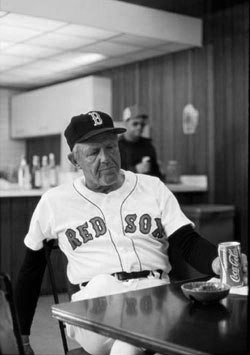
From New York, The Major went to Detroit, managing the Tigers through five marginal seasons from '74 to '78. He also skippered the Red Sox from 1981 to 1984 but had no division titles to show for his efforts in either stop. He became vice president of the Twins in 1986 and held that post in 1989, when he decided to retire for good.

Despite spending the end of his career with other organizations, Houk is best remembered as a Yankee. Although he wasn't a big part of it, the Yankees won six World Series in his eight years as a player. His managerial career started with the legendary summer of '61 and ended just before George Steinbrenner took over the team in 1973. He was a great solidier and baseball man who lived a long, proud life. Rest in peace, Major.

Tuesday, July 20, 2010

Bud “Contract Year” Black Cashes In

In case you've been concerned in regards to the whereabout of the authors of this blog, fear not, we have not died in a boating accident or absconded the with considerable fortunes accrued from maintaining this site to search for traces of the last expedition of Colonel Percy Harrison Fawcett in the jungles of the Amazon.

However, Matt is at a conference for work and I have been tied up with some obligations of my own during the work week that have been keeping me away from the computer. And when the weekends roll around, both of us have been trying to enjoy our respective summers to the fullest, which leaves little time for writing things on the internet. We'll be back pretty soon, but the content is going to be a little sparse for the next couple of days.

Luckily, a long time commenter who would like to be identified simply as "Marmaduke Ramirez Washington" was kind enough to submit a guest post. It's not about the Yankees, but I think you'll still enjoy it. Take it away, 'Duke:

Following in the steps Vernon Wells, Kevin Brown and every other player that happened to have the best season of their life in their contract year, Bud Black received a 3 year extension to manage the San Diego Padres on Monday. After 2 years of leading his team to winning percentages of .389 and .463, Black has the Padres 17 games over .500 and in first place in the NL West.

Obviously he is putting a lot more effort into his managerial duties this year as opposed to the 2 previous seasons. The question is, “Why didn’t he try harder to make San Diego a winning franchise in 2008 and 2009?” Some baseball insiders think that Black saw a wide open free agent market for managers during the 2010 off-season prompting him to take his position as a manager much more seriously this year.

While not confirmed, rumors have been surfacing that Black took courses in “Advanced Statistics 101” and “Manage a Winning Sports Franchise on a Shoestring Budget 1a and 1b” at San Diego’s Mesa College during the winter. Other sources indicate that he attended a National League managers' convention during the offseason, which included a two day seminar on the double switch, because there’s obviously much more to it than checking who recently batted, moving the new pitcher to that spot in the order while inserting a new position player into the previous pitcher’s spot in the order.

One unemployed manager who wishes to remain anonymous is also questioning whether or not Black is taking performance enhancing drugs to gain an edge over other managers in the NL West. “How many 53 year old mangers have taken a team that has perpetually been in the bottom of the National League under his own watch and now, all of a sudden, they have the best record in the league? I’m telling you, that kind of improvement out of nowhere can only be the results of using copious amounts of PEDs - HGH, hGC, Adderall, Ritalin, whatever it is.”

He also added, “Have you seen the size of his head?” [Ed. note: The source may have been confusing Black with the previous Padres, and current Giants manager Bruce Bochy who reportedly wears a size 8 ¾ hat.]

Some people inside the game feel that Black has finally come into his own as a manager after years of limited success and is really stepping it up when the money is on the line. But is there more to his success than meets the eye?

Tuesday, June 8, 2010

Game 58: Changing Of The Guards

It's been only five days and three games since the Yankees and O's last met but, for the Orioles at least, much has changed in that time. After getting swept by the Yankees last Thursday night, Baltimore returned home and fired manager Dave Trembley Friday morning. It was hardly a surprise; rumors of Trembley's impending termination had circulated for weeks. In fact, in many ways, it was probably a relief to Trembley, who by all accounts is a good baseball man, but also clearly wasn't getting it done and seemed to have run out of answers.

Juan Samuel took over for Trembley on an interim basis, becoming the third consecutive Orioles manager to take the helm mid-season. He lost his first two games to run the O's losing streak to ten in row, 12 of 13, 14 of 16, and 17 of 20, before recording his first managerial victory with an extra inning decision over Boston on Sunday. He had yesterday's off day to bask in the glow of his win, but things won't be getting any easier for him with the Yankees in town for three before kicking off two weeks of interleague play.

Not only is Samuel the third consecutive mid-season hire for Baltimore, following Trembley and Sam Perlozzo, but he's also the fourth consecutive Oriole hire with no prior Big League managerial experience, a trend that started when the O's hired then-Yankee coach Lee Mazzilli following the 2003 season.

Going with a rookie manager four times in a row hasn't brought much success for the Orioles, but it's not as if they were tremendously successful under previous retreads Mike Hargrove and Ray Miller. The truth of the matter is, the Orioles haven't been worth a damn since 1997, when they went 98-64, won the AL East, and advanced to the ALCS. After that season manager Davey Johnson resigned, and the O's haven't had a winning season since.

Johnson made a cameo at the draft last night, serving as one of the Washington Nationals representatives as the Orioles' Beltway rivals selected super-hyped phenom Bryce Harper with the top pick in the draft. Tonight, just down I-295, those same Nationals will host the Pirates in the most anticipated game of the season, in front of a sold out house, as last year's top overall super-hyped pick Stephen Strasburg makes his Major League debut. Meanwhile, even with the Yankees in town, Baltimore will fail to fill their park, which was once one of the hottest tickets in the Majors.

While Washington had to suffer through two consecutive seasons of having the Major's worst record in order to secure those coveted young talents, it is now the Orioles who occupy the MLB basement. Typical of their recent luck, they're on pace to have the top pick in next year's draft - the first draft in three years that doesn't figure to have a once-in-a-generation type talent sitting at the top of the heap.

In the history of mid-Atlantic baseball, tonight could mark a turning point. After arriving in Baltimore from St. Louis in 1954, the Orioles quickly established themselves as a model franchise. "The Oriole Way" became a shining example of how to run an organization, leading to World Series titles in 1966, 1970, and 1983, AL Pennants in 1969, 1971, and 1979, and ALCS losses in four other years. It generated Hall of Famers in Earl Weaver, Jim Palmer, Brooks Robinson, Frank Robinson, Eddie Murray, and Cal Ripken Jr.

The strength and proximity of the O's made it was easier for the region to stomach the original Senators leaving Washington after the 1960 season, and then the expansion franchise leaving after the 1971 season. The Orioles extended run of quality play softened the blow of the Nation's Capital being without a Big League team for the next thirty three seasons.

But tonight, with Strasburg debuting, with Harper soon to be in tow, with another mid-season interim rookie manager in the Baltimore dugout, and with Baltimore staring down their thirteenth consecutive losing season, we might just be witnessing a changing of the guards in metro-D.C. baseball.


Gentlemen, he said,
I don't need your organization, I've shined your shoes,
I've moved your mountains and marked your cards
But Eden is burning, either brace yourself for elimination
Or else your hearts must have the courage for the changing of the guards.
[Song Notes: Another epic tale from Dylan. The video quality isn't great, but the options are limited as the song has rarely been played live.]

-Lineups-

Yankees:
Not much to say here. This is what passes for the regular lineup right now. Perhaps the comforts of home can help Mark Teixeira snap out of his season-long funk. Phil Hughes faces Baltimore for his second consecutive start and third time this year.
Derek Jeter SS
Nick Swisher RF
Mark Teixeira 1B
Alex Rodriguez 3B
Robinson Cano 2B
Jorge Posada DH
Curtis Granderson CF
Francisco Cervelli C
Brett Gardner LF

RHP Phil Hughes

Orioles:
Julio Lugo 2B
Miguel Tejada 3B
Nick Markakis RF
Ty Wigginton 1B
Luke Scott DH
Not Pacman Jones CF
Matt Wieters C
Lou Montanez LF
Cesar Izturis SS

RHP Kevin Millwood

Tuesday, February 16, 2010

1 Day Until Spring Training: Billy Martin

There are 741 billion different ways to arrange a 25 man roster into a 9 slot line-up. Once you select the 9 best players that number drops to 362,880. Surprisingly, at least according to countless computer simulations, the way a manager chooses to arrange those 9 players from there doesn't have that much of an impact on the amount of runs the line up produces.

There are only so many ways a manager can impact the outcome of a game. Most of the decisions a manager has to make, like removing a starting pitcher, pinch hitting, or intentionally walking a hitter are technically possible at all times. However, no reasonable observer would advocate going to the bullpen in the first inning unless there was an injury or a complete melt down by the pitcher. No one would suggest intentionally walking a batter to lead off the 7th in a tie game. Like batting order, once you narrow the moves a manager can make down to a fairly reasonable set of options, the decision amongst them isn't statistically likely to make much of a difference.

So how is it that Billy Martin is universally remembered as "a genius who could turn almost any kind of team into a winner"? How could he have been so influential when even the best decisions could only have a limited impact on the field?

Martin spent 11 seasons as a player in the major leagues, six and a half with the Yankees. A second baseman by trade, Billy put in some time at third and short, allowing Casey Stengel some of the flexibility that he so cherished. In his playing days, Martin was scrappy and gritty and all of those terms that people use to describe players that appeared to be trying hard but weren't particularly good. He could play defense but couldn't really hit for average. Or power. Or get on-base. Or steal bases once he got on. But Stengel was Martin's most fervent advocate, so the Yanks kept him around.

During his time with the Bombers, he was part of four World Series winning teams (1951, 1952, 1953 & 1956). It was more a matter of great timing than his production. He played alongside Mickey Mantle, Phil Rizzuto, Yogi Berra, Gil McDougald, Moose Skowron, and Elston Howard and behind Whitey Ford, Allie Reynolds, Vic Raschi and Eddie Lopat.

In 1953 - one of his finer seasons with the Yanks - he was
the only person on the team to appear in more than 60 games and have an OPS+ of less than 100. However, over the 28 World Series games in which he appeared, he hit .333, well above his career mark of .257.

It might have been this success in the World Series that endeared him to superstar teammates
Mickey Mantle and Whitey Ford. The trio were legendary for their after hours gallivanting throughout New York City and on the road. The fact that he involved Mantle and Ford in his partying was what got him traded in the middle of the 1957 season following the legendary brawl at the Copacabana.

Yankees General Manager George Weiss viewed Martin as a bad influence on the team's stars and dealt him to the Kansas City Athletics in a seven player deal shortly after the fight. After the '57 season, he was traded from KC to Detroit, then to Cleveland, Cincinnati, Milwaukee, and Minnesota, never spending more than a season with any organization as a player. He did stay with Minnesota after his hung up his cleats, however.

After Billy retired, he worked as a scout in the Twins' organization for three years, then was asked to serve as third base coach under his former manager, Sam Mele. Martin enjoyed his time as a scout and had no real aspirations to ascend the coaching ladder but agreed to come on board because he respected Mele. During that time, he mentored a left handed Rod Carew and was one of the few voices that insisted Carew was ready for the Major Leagues in 1967 when he took home Rookie of the Year honors.

It was during the 1967 that Sam Mele was fired by the Twins. The club had got off to a sluggish 25-25 start and rumors abounded that Martin would be Mele's successor. However, Billy had yet to actually manage a team and Twins' owner Calvin Griffith chose veteran skipper Cal Ermer instead. The following May, Martin took over as manager for Minnesota's AAA affiliate in Denver, an assignment he was afraid would be his "one way ticket to oblivion". In hindsight, it was just the opposite.

In his first season as manager of the Denver Bears, Martin took over a team that started 7-22 and led them to a winning season. Graig Nettles was one of the players on the Bears that year and although he didn't much care for Martin at first, he eventually came around:
When I saw the results, I stopped hating Billy Martin and began to see him for what he was: an extraordinary leader.
The two would later win a World Series together with the Yankees.

Twins ownership eventually saw Martin for what he was as well. After one more year in Denver, Martin was promoted to Major League Skipper, replacing Ermer. In his first season at the helm, he guided the team to 97 wins and a Division Championship. Griffith was no doubt impressed with the 14 win improvement from the previous year, but fired Martin in part because he beat up pitcher Dave Boswell and left him unconscious in an alleyway behind a bar called A.C. Lindell's in Detroit.

Martin had always been combative. He grew up in one the poorer areas near Berkley, California - East Bay City and was surrounded by gangs and street violence for much of his early life. His mother sent his philandering father packing before he was even born. Martin didn't lay eyes on him until he was 15, at which point Billy told him he never wanted to see him again.

Despite Martin's violent episode with the Twins, he landed another managerial gig in Detroit just a year later (where the fight with Boswell occurred, of all places). In his first season in Motown, the Tigers won
91 games, an 11 game increase from the year before, but finished second to Baltimore in the AL East. The following year they won only 86 games but edged the Red Sox by one game to win the division and went on to lose to the A's in the ALCS.

Martin was fired 134 games into the '73 season, this time for ordering his pitchers to retaliate for the spitballs Gaylord Perry was throwing on August 30th.

Despite his building reputation as a loose cannon, he landed on his feet
in Texas before the season was over. In 1974, Martin presided over a 23 game advance, taking a Rangers team that had won just 57 games the year before up to 84 victories and a second place finish in the AL West. Martin was fired once again by Texas in 1975, after the team started to fade midway through the season. Within a week, he was hired by the Yankees and finished out the last 56 games of the season with them.

Amazingly, in his first full year in the Bronx, Martin again steered a team to a double digit rise in wins, from
84 to 97. The Yankees won the AL East that season and advanced to the World Series but were swept by the Reds.

During the subsequent offseason, despite the fact the team just won their first pennant in 12 years, George Steinbrenner, fresh off his suspension for illegal campaign contributions, started making moves. Chief among those was the acquisition of Reggie Jackson. Martin wasn't in favor of acquiring the Orioles' slugger. With the team in need of shortstop, Martin instead lobbied for signing the Orioles' Bobby Grich, one of the best second basemen in the game, who had experience at shortstop as well. Per usual, Steinbrenner got his way. Reggie came to the Bronx, the Yankees used their other free agent spot to sign pitcher Don Gullett, and Grich went to the Angels. Jackson made Oscar Gamble expendable, and he was flipped to the White Sox for shortstop Bucky Dent.

Martin wasn't fond of Jackson, and when Reggie's infamous "straw that stirs the drink" story published in Sport Magazine in May, it only increased divisions in an already fractured clubhouse. Tensions came to a head during the '77 season when Billy pulled Jackson from a nationally televised game at Fenway Park on June 18th for failing to hustle out a fly ball in right field in the bottom of the 6th. When Reggie got back to the dugout, tempers flared and they both had to be restrained. Despite the drama swirling around in the clubhouse (the Bronx Zoo), the Yankees won 100 games that year, topped the Royals in the ALCS, and beat the Dodgers in 6 games in the World Series. It was the only World Series victory of Martin's managing career.

The madness didn't subside in 1978. Midway through the season Jackson ignored signs from Martin and bunted when it wasn't called for. This sent Martin over the edge. He told the press later that day about Jackson and Steinbrenner, respectively, "The two of them deserve each other - one's a born liar, the other's convicted."

It would prove to be his undoing as Yankee Manager (for the time being) and he resigned a few days later. Less than a week after resigning, Martin was the final player introduced at Old Timers Day. There, it was announced that Martin would return as manager for the 1980 season, with his replacement, Bob Lemon, moving to the front office. Steinbrenner couldn't wait that long, firing Lemon less than halfway through the 1979 season, with Martin taking over for the final 95 games. The team had a winning record under his guidance, but finished 4th. That tenure ended after Martin bloodied a marshmallow salesman by the name of Joseph Cooper in a barroom fight in a Minnesota hotel.

But back to the original question. What made Billy Martin so good as a manager?

Out of 25 guys, there should be fifteen who would run through a wall for you, two or three who don't like you at all, five who are indifferent and maybe three undecided. My job is to keep the last two groups from going the wrong way.
He also employed daring tactics that may not have agreed with conventional wisdom, but seemed to work out for him. One of the things he taught Rod Carew was how to steal home, and as a result 7 of Carew's 20 stolen bases in 1969 were of home plate.

He also
used some odd tactics, like asking pitchers to hit and play other defensive positions. He had pitcher Fergie Jenkins DH in the 6th inning in a game in 1974, breaking up a no-hitter with a single to center, and later tried the same tactic with pitcher Rick Rhoden in 1988. He had Ron Guidry in center field and Don Mattingly at second when the Pine Tar Game was resumed in 1983. He had lefty swinging Mike Pagliarulo bat right handed in 1985. He literally drew the Yankees line-up out of a hat on April 21st, 1977 against the Blue Jays, a game which they won 8-6. In Oakland from 1980-1982 he employed "Billy Ball" - a combination of hit and runs, squeeze plays and stolen bases - despite the fact that his teams lead the AL in HRs.

Could his strategies alone possibly be the only reason that every team he managed got significantly better as soom as he got there? Some of those things, like DH'ing Rhoden or Jenkins, while creative, couldn't have possibly created a positive win expectancy. But sometimes you can make a low percentage play and have it still work out. He seemed to go all-in with a straight draw and hit it on the turn more than his fair share of times.

It's probably difficult to accept for the most statistically-inclined, but the historical consensus is that Martin's true genius was in his personality. He was intense, cantankerous and blunt but also had an incredibly thorough knowledge of the game. Mike Pagliarulo said:
He was the kind of guy who wasn’t afraid to tell you what he thought of you. If I got one hit in a game and hit a couple other balls well, but they were caught, what he’d say to me was, “You dumb-ass dago, you can’t get more than one hit.” Billy was very honest.
But then added:
Billy could see the field so completely; he knew what everybody was doing.
Martin also had a penchant for riding his players, especially pitchers. He once sat down and explained his managing philosophy to Leonard Koppett:
A lot of the time, you have to make a player do something he doesn't want to do, for the good of the team, or to push him harder that he thinks he should be pushed. You can't do it if the player thinks "Why should I listen to him? He's not the boss. He may be gone next year. I'll do it my way" When that attitude takes hold, teams don't win.

Managing is teaching, first of all. That's even more important than winning itself. When you get a player whose potenital you can see, and show him things that can make him better, and show him the things that can make him win, and then you can see him later realizing those things - it's like a graduation. It makes you feel satisfied even if he's no longer your player.

For a team to win, a manager has to find ways to motivate different individuals. He has to judge correctly each man's abilities and weaknesses, and find the right ways and the right times to use them.

But the enjoyment comes from the things I put in.... The victory at the end is only proof that you succeded, and nobody can take that away from you once you've won. But the fun and the rewards are in what you do getting there.
This also lends some insight as to why Martin never lasted as manager for more than three full, consecutive seasons with any team. After managing near his hometown in Oakland from 1980-82, twice winning Manager of the Year and making the playoffs in '81, he returned to the Yankees in 1983 and won 91 games.

He was fired that offseason and re-hired in 1985 when he won 91 games again, except this time he replaced Yogi Berra after 16 games and accomplished the feat in only 145
. That September, Martin got in a fight with Ed Whitson in a hotel bar. Having lost his legendary brawling skills, Billy suffered a broken arm and two fractured ribs in the fight. As they often do of drunken brawls, accounts of the night vary, but the New York Times cited an unnamed source that said an official investigation by the Yankees indicated Martin was the instigator.

The team retired his number and gave him a plaque in Monument Park in 1986. He spent the '86 and '87 doing occasional TV work on WPIX Yankee telecasts.

During his final stint with the Yankees in 1988, Billy was more unorthodox than ever. Dave Righetti was deployed for two and three innings at a time, resulting in five blown saves, four of which came in a row. He used a seven man rotation at one point, and had Rick Rhoden DH despite his ailing back. Billy started out 40-28 and had the team in the thick of the division race. But there was a three game suspension for throwing dirt at an umpire and yet another brawl, this one at a Dallas area strip club. It left Martin with bruises, forty stitches in his up ear, and for the fifth and final time, as the former manager of the New York Yankees. He was replaced by Lou Piniella.

All told, Martin only won two pennants and one World Series. His 1253 wins as a manager is good for 32nd on the all-time list, and his .553 winning percentage and 240 wins over .500 place him at 21st and 20th, respectively. But many see him as one of the greatest managers - at least over the short term - of all time. For what it's worth, if I had to pick a manager to win one game for me, it would be Martin.

In 1989, Billy was brought back to the Yankees as a special consultant. It was rumored he had been asked to manage the team in 1990 and had already assembled a coaching staff to come with him.

On Christmas day, he was riding in his longtime friend William Reedy's pick-up truck and both had been drinking but neither was wearing a seatbelt. They were approaching Billy's house in Fenton, NY, just outside of Binghamton, when the truck skidded off the icy road and down a 300 foot embankment, ending up at the foot of Martin's driveway. Reedy was left in serious condition, but Martin was not so lucky. He was taken to Wilson Memorial Hospital in Johnson City. Attempts at reviving him were unsuccessful. He was 61.

Billy Martin was notoriously hard on his players but he was probably harder on himself. He was a heavy drinker throughout almost all of his adult life. He was a fixture in hotel bars when the Yankees were on the road - as evidenced by his many fights that took place in them - and would often be seated on a barstool soon after he left Yankee Stadium as well. Martin forged a lot of friendships because of his fondness for the drink, but also made a lot of enemies that way too. In the end it was directly responsible for his demise.

"I may not have been the greatest Yankee to put on the uniform,
but I was the proudest"

Tuesday, February 9, 2010

8 Days Until Spring Training: Yogi Berra

Like his good friend Phil Rizzuto, Lawrence Peter Berra had a formative experience as a young man with a respected Major League figure who told him that he would never become a professional baseball player. In 1942, Yogi was 17 years old and playing minor league ball when he was approached by Branch Rickey, then the general manager of the Cardinals. Rickey offered him $250 to sign with the Cards but Berra refused. When he did, Rickey supposedly said, "He'll never make anything more than a Triple A ballplayer at best".

Yogi held out for $500 from the Yankees and was assigned to their club in Newport, Virginia. In some ways, you can understand why Rickey wasn't willing to shell out the extra $250. Berra never looked the part of a baseball player (or athlete of any kind, for that matter). He was 5'8" and a sturdy 190-something pounds in his playing days, but his fire plug build made him perfectly suited for catching. They don't call Berra's kind of built "squat" for nothing.

When Yogi turned 18, the year was 1943 and World War II was kicking into high gear. Instead of waiting to being drafted into the armed services, he set aside his dream to play professional baseball and enlisted in the Navy himself. Unlike many established Major Leaguers who were part of the military, Berra spent his years in active duty and participated in the D-Day invasion as a gunner's mate on a rocket-launching craft. After Normandy, he was stationed in North Africa and Italy but suffered a hand injury and was sent back across the Atlantic.

When he got back to the States, Berra was stationed at the submarine base in Groton, Connecticut. After he was discharged from the Navy, he began playing for the Yankees' affiliate in New London. According to lore, Giants manager Mel Ott saw Yogi play in New London and offered the Yankees $50,000 for him. Yanks GM Andy MacPhail wasn't familiar with Berra but was pretty sure that if Ott wanted him that badly, he was worth hanging onto. The following year, Yogi spent half of the season with the AAA Newark Bears before being called up to the Yankees.

Growing up in St. Louis, the only time Berra had seen Yankee Stadium and said he was rendered speechless because it was so much bigger and grander than Sportsman's Park where he had watched the Cardinals as a boy.

It took Berra two seasons to take the starting catcher's job from Aaron Robinson and once he did, he never looked back. The 1948 season began a stretch of 15 uninterrupted All-Star game appearances which included three MVPs and four more top 5 finishes. Yogi's career also encompassed fourteen World Series appearances and ten championships, both of which are Major League records. In addition to those, he also holds the records for World Series games (75), at-bats (259), hits (71), doubles (10), singles (49), games caught (63), and catcher putouts (457).

Between 1949 and 1955, on a team filled with offensive studs including Mickey Mantle and Joe DiMaggio, it was Berra who batted clean-up and led the Yankees in RBI for seven consecutive seasons. Yogi was famously excellent at hitting poor pitches. Despite swinging at balls in the dirt and those over his small frame, Berra had nearly as many career home runs (358) as strikeouts (414). In 1950, Berra whiffed only twelve times in 656 plate appearances. When asked about swinging at bad pitches, Berra was reported to say, "If I can hit it, it's a good pitch."

As a fielder, Berra second to none. Under the tutelage of Bill Dickey, he blossomed to one of the better defensive catchers in the league. He was spry and cat-like in his crouch, leading Casey Stengel to say "he springs on bunts like it's another dollar". He led all American League catchers eight times in games caught and chances accepted and left the game with the AL records for catcher putouts (8,723) and chances accepted (9,520).

Yogi was also well-renowned for his ability to handle a pitching staff. He handled pitchers differently depending on their disposition, alternatively coaxing or prodding hurlers based on who he felt needed what. Casey Stengel got a lot of credit for how he deployed his pitching staff during the dynasty of the 50's and 60's, but Berra played a large part in that success as well, displaying a knack for what pitches to call and when. He caught both of Allie Reynolds no-hitters in 1951 along with Don Larsen's perfect World Series game in 1956.

Yogi was also remarkably tough and durable. He averaged 118 games behind the plate from 1949-1959 and caught more than 133 games every year from 1950-1956. In June 1962, at the age of 37, Berra caught an entire 22-inning, seven-hour game against the Tigers.

He was a part of the Yankees until 1963 and even in his last season he was productive, punching up a 138 OPS+ in 164 plate appearances. The following year, he served his first stint as Yankee manager. Despite leading the Yanks to 99 wins and a World Series appearance against his hometown St. Louis Cardinals, Berra was fired and replaced with Cards' manager Johnny Keane.

He resurfaced across town with Mets in 1965 as a player-coach. He put in two games behind the plate and two more as a pinch hitter in May, picking up 2 hits in 9 at-bats but soon decided that he was finished as a player. His coaching career, however, would go on. He stayed with the Mets for the next 8 seasons as an assistant manager under at first under Casey Stengel. He eventually took over as manager in 1972 after the sudden death of Gil Hodges. That same year, he was elected to the Hall of Fame along with Sandy Koufax and Early Wynn.

In 1973, he led the Mets to the World Series and in so doing, became only the second manager to win a pennant in both leagues, following only Joe McCarthy. He had also completed the feat in only 3 seasons as a skipper.

After two more years as manager for the Mets, he rejoined the Yanks as a coach and the team won its first of three consecutive AL titles. This uncanny ability to bring about good luck was not unnoticed. Stengel once said of him, "He'd fall in a sewer and come up with a gold watch." Berra was eventually elevated to Yankee manager before the 1984 season. The team won 87 games but finished a disappointing 3rd place in the AL East.

Berra agreed to stay with the job for 1985 after receiving assurances from George Steinbrenner that he would not be fired. However, the notoriously impatient Boss axed him after a 6-10 start to the season. Instead of notifying Yogi personally, Steinbrenner dispatched GM Clyde King to deliver the news for him. This caused a rift between the two men that would not be mended for almost 15 years. Yogi's replacement? If you guessed Billy Martin, you may or may not be a baseball historian.

On August 22, 1988, Berra and his predecessor Dickey were honored with plaques to be hung in Monument Park at Yankee Stadium. Berra's plaque calls him "A Legendary Yankee" and cites his most frequent quote, "It ain't over till it's over." However, the honor was not enough to cure the relationship between Steinbrenner and Yogi. That would not happen until January of 1999 when Steinbrenner publicly apologized to Berra. According to Steinbrenner at the time, "It's the worst mistake I ever made in baseball." The power broker behind the meeting? Suzyn Waldman.

Armed with only an 8th grade education, an unenviable physique and an uncanny wit, Berra became on of the most famous people in the world. Yogi has been featured in advertisements for Yoohoo, AFLAC, Entenmann's, and Stovetop Stuffing. Although he wasn't especially fond of being called "Yogi Bear", he did have the honor of having a Hanna Barbera cartoon named after him.

Of all the Yankee legends still with us, Yogi is undoubtedly the greatest character. Eighty four years young and still active with the franchise, today's Yankee fans are incredibly lucky to have him around. He currently operates the Yogi Berra Museum & Learning Center in Montclair, New Jersey. He spends a lot of time at the facility so if you make a trip out to the Museum, you just might have the privilege of chatting with the man himself.

Wednesday, February 3, 2010

14 Days Until Spring Training: Lou Piniella

Before he even arrived in the Bronx, Lou Piniella had lived something close to a full life in baseball. He signed with the Cleveland Indians as a soon-to-be nineteen year old in June 1962. Five months later, he was drafted away by the Washington Senators, under the old first year draft system. Nearly two years later, the Senators traded him to Baltimore. That September he made his Major League debut, appearing in four games and going hitless in his only at bat. It would be a long time before Sweet Lou would see the Majors again, but not too long before he'd need his suitcase again.

After spending all of 1965 in the minors, the Orioles shipped him back to Cleveland, the organization with which he originally signed, prior to the 1966 season. He languished in their system for three more years, finally returning to the Bigs with five more hitless at bats in six September 1968 games. By the end of the season Piniella was 25 years old, had spent seven seasons in professional baseball, had changed organizations four times, and had all of seven Major League plate appearances to his credit. And he still wasn't done stamping his passport.

The Seattle Pilots selected him in the expansion draft following the '68 season. With Major League baseball adding four new teams for the 1969 season, the number of Big League jobs available had increased by twenty percent. Yet Piniella couldn't even stick with the Pilots, and on the eve of the season the Pilots flipped him to a fellow expansion club, the Kansas City Royals. Finally given a chance to play, Piniella made good on the opportunity by capturing Rookie of the Year honors. He was a regular with the Royals for five seasons, posting solid if unspectacular numbers, making an All-Star team, and leading the AL in doubles in 1972.

Following his poor 1973 season, the Yankees dealt for the 30 year old outfielder. He spent the next eleven years as a corner outfielder and designated hitter, winning five division titles, four pennants, and two World Series in the process. Though he didn't walk much, and he wasn't much a power threat, Lou could hit. He was totally dedicated to his craft as a hitter, obsessing over his stance and his swing, which produced a .295 batting average over his time in pinstripes. He also batted .305 over his 44 post-season games with the club.

While not noted for his defense, Piniella made a critical play in the 1978 AL East playoff game against the Red Sox. The Yankees clung to a one run lead in the bottom of the ninth. With one out and Rick Burleson on first, Jerry Remy came to the plate with the potent combination of Jim Rice and Carl Yastrzemski waiting behind him. The early autumn sun hung low in the late afternoon sky, bathing right field in a blinding sunlight. Facing Yankee fireman Goose Gossage, Remy lined a single to Piniella in right. Unable to pick up the ball and catch it on the fly, Piniella still managed to successfully deke Burleson, feigning that he had a bead on it. As a result, Burleson held up. By the time it was clear that the ball fell in, Burleson had to hold at second. Piniella managed to keep the tying run from reaching third with less than two outs. When Jim Rice followed by flying out to deep right, Burleson managed only to advance to third, rather than score the tying run. The rest is history.

As Piniella's career wound down, he began to function as an unofficial hitting coach for the club. When he retired two and a half months into the 1984 season, the team officially added him to the coaching staff. He spent the next year and a half learning under managers Yogi Berra and Billy Martin, and took the helm for the 1986 season. He spent the next two seasons as Yankee manager, going 179-145, finishing in second place in 1986 and fourth the following year. Even in those early years, Piniella showed flashes of the temper that has made him a highlight reel favorite over his twenty two seasons managing in the Big Leagues.

Typical of the Yankees during that time, there was a major shake up following the 1987 season. Billy Martin was brought back for a fifth and final go-round as Yankee skipper and Piniella was promoted to General Manager. As GM, Piniella managed to re-sign Dave Righetti and signed free agents Jack Clark and John Candelaria, both of whom were key contributors to the 1988 team. In attempt to bolster the pitching staff he acquired veteran Rich Dotson from the White Sox. Dotson was a disaster in New York, and came at the price of decent young outfielder Dan Pasqua, whose left handed swing was tailor made for Yankee Stadium.

Piniella was not responsible for the disastrous and infamous Jay Buhner for Ken Phelps trade executed that July. By the end of May, unhappy with his role as GM, Piniella resigned, staying on in a scouting and advisory capacity. Less than four weeks later he would be back in the dugout as Martin's self destructive behavior drove him from the job he loved for the final time. Piniella took over a team that was 40-28 and just 2.5 games out of first. They went just 45-48 the rest of the way, finishing only 3.5 games out of first but in fifth place. As was too often the case in the eighties, the Yankees just didn't have enough pitching to get it done. Piniella was let go for the second time in as many seasons.

He spent 1989 as a broadcaster during the team's first season on MSG Network, then took a job as the Cincinnati Reds manager, winning the World Series in his first season. After three years in Cincy, Piniella moved on to Seattle. In his first year he led them to their first winning season in the their seventeen year history. Two years later he led them to their first playoff berth, bouncing the Yankees in the 1995 ALDS and earning Manager of the Year honors. He captured another division title in 1997, the Wild Card berth in 2000, and led his club to a Major League record 116 victories in 2001, snagging him his second Manager of the Year award. His club was eliminated from post-season play by the Yankees in both 2000 and 2001.

After finishing his tenth season as M's manager, it was time for a change. Piniella returned to his native Tampa to manage the Devil Rays. Because he was still under contract to Seattle they were entitled to compensation. As a result the Rays shipped newly minted Yankee Randy Winn to Seattle for a minor leaguer. The nicest that can be said of Lou's tenure in TB was that they didn't finish last in 2004, the first time in franchise history that happened. Unhappy that ownership wasn't investing money in the team as they had promised him, Piniella departed after the 2005 season. He spent the next year working for FOX, then became manager of the Cubs, winning division titles in 2007 and 2008, and earning his third Manager of the Year award.

Lou Piniella has had a full life in the game, with 2010 marking his 49th year in professional baseball. Just as we saw with Gene Michael, Piniella has served the Yankees as a player, coach, manager, general manager, advisor, and announcer. Though its been more than twenty years since he was a part of the organization, his Yankee career may not be over yet. It was rumored that the Yankees chose the Cubs to play Yankee Stadium's initial exhibition games to remind Piniella of his ties to the organization. Hank Steinbrenner has said that he wants to hire Piniella as an advisor when his managerial career wraps. It shouldn't be too long before that happens as Piniella is nearly 67 and under contract only through the end of the 2010 season.

Sunday, January 31, 2010

17 Days Until Spring Training: Gene Michael

Gene "Stick" Michael has spent virtually all of the past forty years in the Yankees organization, serving the club as a player, coach, manager, general manager, scout, director of scouting, and in his current role as a vice president and special advisor.

Born in Ohio, Michael attended Kent State University, where the baseball field was later named in his honor. He signed with the Pittsburgh Pirates in 1959, but didn't make his Major League debut until age 28 in 1966. Traded to the Dodgers for Maury Wills after the season, Stick spent a year in LA before being purchased by the Yankees after the 1967 season. He spent the next seven years with the Yankees, serving as their starting shortstop from 1969 through 1973. He had a pretty good offensive season in 1969, but was otherwise regarded as a good glove no stick shortstop with a knack for pulling off the hidden ball trick.

Released prior to the 1975 season, Michael latched on with the Tigers for one more year. When he failed to make the Red Sox in 1976 he retired, and immediately rejoined the Yankees. He served on the Major League coaching staff in 1976 and 1978, managed the AAA Columbus Clippers to the International League Championship in 1979, and took over as Yankees General Manager for the 1980 season.

When manager Dick Howser departed the team after the 1980 season, Michael returned to the dugout, this time as the Yankee skipper. He had the Yankees on top of the AL East at 34-22 when the strike hit on June 12th. When play resumed on August 10th, the Yankees stuggled, going 14-12. Despite being guaranteed a post-season berth as the first half division champions, George Steinbrenner saw fit for a change, and replaced Michael with Bob Lemon on September 6th. It was Lemon who shepherded the Yankees through the first ever Division Series, and the ALCS, before falling to the Dodgers in the World Series.

Michael then replaced Lemon at the helm just 14 games into the 1982 season. After going 44-42, Michael was canned again, this time replaced by Clyde King. He returned to the coaching staff in 1984, and served there into the 1986 season. On June 14th he took over as manager of the Chicago Cubs, his first time out of the Yankees organization since early 1976. He lasted in that job until late 1987, going 114 and 124.

He returned to the Yankees the following year, serving on the 1988 and 1989 coaching staffs. He began 1990 in a scouting capacity, and then, in George Steinbrenner's final move before serving his suspension, was named General Manager on August 20th. It was in this position, which he held through the conclusion of the 1995 season, that Michael did his greatest work. As General Manager, Michael hired Buck Showalter as manager, oversaw the drafting of Derek Jeter, signed Mike Stanley, Wade Boggs, and Jimmy Key, traded for Paul O'Neill and David Cone, and managed to oversee the development and prevent the trading of homegrown talent like Bernie Williams, Andy Pettitte, Mariano Rivera, and Jorge Posada.

Michael's stewardship during Steinbrenner's absence was the single biggest factor in turning the Yankees from the worst team in baseball - both on the field and in the front office - to a model franchise that enjoyed a dynastic run in the late nineties and early aughts. Though he stepped down as GM following the 1995 season, Stick has continued to serve the Yankees in an advisory role and remains one of the most trusted voices in the organization. He has spent nearly the entirety of his adult life in the employ of the Yankees, and the organization has benefited greatly from his service.

Wednesday, November 11, 2009

Non-Player Hall Of Fame Candidates

Good morning Fackers. We're still a good two months away from the Hall of Fame balloting being announced and the inevitable tearing of garments and indignation that will follow. Yesterday however, the Hall announced a list of twenty former managers, executives, and umpires that will be considered by the Veterans Committee (h/t BBTF).

Just like players, the candidates will need to be named on 75% of the ballots to be inducted. However, rather than being voted upon by the crumudgeonly BBWAA, the non-player candidates will be evaluated by their peers. Historically this has been a path of less resistance for those not elected by the writers, but since being reconstituted in 2001 the Committee has elected no players and only five non-players. Results will be announced at the Winter Meetings on December 7th.

The managers category includes former Mets manager Davey Johnson, former Royals and Cardinals manager (and former Yankee farmhand) Whitey Herzog, and former Yankee player and manager Billy Martin. Other candidates include Gene Mauch, Tom Kelly, Charlie Grimm, Danny Murtaugh, and Steve O'Neill. Umpire candidates are Doug Harvey and Frank O'Day.

The executive category includes longtime Yankee owner Colonel Jacob Ruppert, former Angels owner Gene Autry, former Royals owner Ewing Kauffman, former MLBPA executive director Marvin Miller (one of the five most influential people in baseball history), former Yankee GM Gabe Paul, as well as former National League President and longtime Yankee broadcaster Bill White.

Thursday, October 15, 2009

Pulling For Joe?

Great news, my fellow baseball fans, our long national (pastime's) nightmare is over. Those were a couple very cold and lonely nights without baseball gracing our television screens. As Yankee fans, we were eased into this break with Game 4 of the Phillies vs. Rockies series on Monday and we'll be eased out of it with Game 1 of the NLCS at 8:07 tonight.

You may be familiar with the manager of the Los Angeles Dodgers - his name is Joe Torre. He worked for the Yankees for a couple of nondescript years in a low profile position a while back. Anyway, Peter Gammons was on Michael Kay's radio show yesterday and insinuated that Mr. Torre, despite his affinity for wheatgrass, is not enjoying his time in the City of Angels (link via BBTF):
Kay asked Gammons if he agreed that Joe Torre would only stay on as the Dodgers' manager through the 2010 season, when his contract ends.

"Yes, I do buy that," said Gammons. " ... I wouldn't be surprised and I think a lot of things will probably come out here in the next few months but I think (Torre's) life with the Dodgers is pretty much a living hell."

Kay: "Really!?"

Gammons: "Oh, yeah."

Kay: "So he thought he had it bad in New York and it's worse there?"

Gammons: "Oh, yeah ... Oh, yeah. There'll be a lot that comes out in time with Dodger ownership, but that is a mess [link added], and I don't think anyone wants to have to put up with it too long."
This may give some of you a bit of satisfaction since the reason that Torre ended up in LA in the first place was because he was "insulted" by an offer from the Yankees that would have made his the highest paying manager in the Major Leagues before any of the incentives involved with the deal kicked in. Or others who thought it was a little hypocritical to compare Michael Kay to Rhona Barrett to gain respect from his players when he first arrived on the scene and then write a tell-all book with Tom Verducci called "The Yankee Years" after he left.

Torre responded to comments, sounding a bit like your ex-girlfriend who broke up with you only to find out that what you had wasn't so bad, saying, “My relationship is fine here”and forcing a smile.

I never held it against Torre that he turned down the Yankees offer, probably because I thought it was time for a new manager anyway. My old roommate and I were actually at Mickey Mantle's on Central Park South the day that he flew down to Tampa to inform the Yanks of his decision. We were interviewed by one of the local news stations who sent a crew to the bar and I said something about it being "time to turn over the chain of command to someone a bit younger who can handle the pitching staff better" or something like that, except even more unintelligible since it was in front of the camera.

Oddly enough, Torre is now being lauded for his bullpen management after he brought in his closer, Jonathan Broxton in the 8th inning to face the heart of the Cardinals' order despite being down a run. Torre knew that Broxton would likely have to be removed for a pinch hitter if the Dodgers got anyone on base in the home half of the inning (which they did), but he still chose his best pitcher for the highest leverage situation, something that sabermetricians have been suggesting for years. Pretty crazy, huh?

Are you rooting for the Dodgers in this series? I don't think there's an appreciable difference in match-ups should the Yankees fulfill their end of the bargain which would be the first consideration, so it probably just comes down to preference. I'll admit that last year, since the Yanks did terribly, I wanted the Dodgers to get bounced as early as possible so that Torre's decision to spurn the Yanks wouldn't be vindicated (by the media anyway).

This year? Not so much. When you're happy with your own situation, it's a lot easier to pull for others.

[Update: Awesome gallery of old school Torre from Big League Stew]