Showing posts with label armed forces. Show all posts

Thursday, July 22, 2010

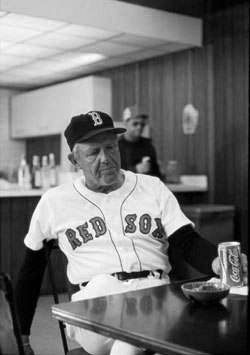
Ralph Houk: 1919-2010

He was nowhere near the mythical figure of George Steinbrenner or the constantly stately presence of Bob Sheppard, but yesterday, just a few weeks shy of his 91st birthday, former Yankee catcher, manager, and general manager Ralph Houk passed away in his home in Winter Haven, Florida.

Drafted by the Yankees in 1939, Houk played three years of minor league ball before voluntarily enlisting with the Army Rangers. He attended Officer Candidate School at Fort Riley in Kentucky and eventually participated in the invasion of Normandy and The Battle of the Bulge. After being shot in the calf during the latter, he returned to the battlefield immediately after he had the wound bandaged.

Later in that same battle, Houk disappeared for three days after he was sent him out to doing some scouting of enemy troops, his commanding officer recalled:
When he turned up he had a three-day growth of beard and hand grenades hanging all over him. He was back of the enemy lines the entire time. I know he must have enjoyed himself. He had a hole in one side of his helmet, and a hole in the other where the bullet left. When I told him about his helmet, he said 'I could have swore I heard a ricochet.' We marked him 'absent without leave' but were glad to have him back alive.
Houk returned from the war decorated with a Silver Star, a Bronze Star with an oak leaf cluster and a Purple Heart and earned the nickname The Major.

When he rejoined the Yankees in 1946, he started in AA and made the jump to AAA mid-way through the season. When the '47 season rolled around, he found himself serving as Yogi Berra's back up for the Big League club and went 3 for 3 with a double and a walk in his debut on April 26th. He only made it to the plate 104 times in that season, and it would turn out to be a career high, never amassing more than 14 in the remainder of his eight years with the Yankees. During all that downtime, he talked with the pitchers out int he bullpen and started collecting an impressive amount of knowledge about all angles of the game.

He began his career as a manager before he even hung up his cleats. The Yankees named him manager of their AAA team at the time, the Denver Bears, and he strapped on his gear and took a couple of hacks at the plate in 1955 before deciding his days as a player were over. In 1958, he left Denver to serve as Casey Stengel's first base coach, where he remained for three years.

The experiences The Major had in the army ended up coming in handy when he took over for the ousted Stengel before the 1961 season, as he said in an interview with Time Magazine:
Being in the war probably helped my managing. It made me understand the problems young men have and the pressures they go through not only in a war but in baseball.
By most accounts, Houk was a "player's manager" but possessed a fierce temper which he would occasionally direct towards the umpiring crew. He wouldn't throw one of his men under the bus to the media, but he would unload on them behind closed doors if he perceived a lack of effort.

Houk would arrive to the ballpark four hours early - something that wasn't nearly as common is those days as it is now - to begin preparing for the day's game. He spent that time looking over line up cards and strategizing with his coaches and scouts about the opponent to see if he could "pick up one or two little things".

His disciplined preparation - along with an incredibly loaded roster - brought the Yankees two World Series titles in his first two seasons at the helm and an AL Pennant in the third. After the 1963 season, however, Houk became general manager and asked Yogi Berra to be his skipper. The Yanks lost in the Fall Classic again in 1964 and Houk (unpopularly) fired Berra and replaced him with Jonny Keane.

After Keane led the team to a 77-85 record in 1965 (good for just 6th place in the AL after five consecutive pennants) and began the '66 season 4-16, Houk took over as manager once again. The Yanks finished in last place that, 9th out of 10 the following season, and had descended into mediocrity. Houk's final season as the Yanks' skipper was in 1973, the last year that the team was still owned by CBS. George Steinbrenner asked Houk to return, promising to bring him talent and restore the once-great franchise but demoralized by the fans' constant booing, Houk decided to move on.

From New York, The Major went to Detroit, managing the Tigers through five marginal seasons from '74 to '78. He also skippered the Red Sox from 1981 to 1984 but had no division titles to show for his efforts in either stop. He became vice president of the Twins in 1986 and held that post in 1989, when he decided to retire for good.

Despite spending the end of his career with other organizations, Houk is best remembered as a Yankee. Although he wasn't a big part of it, the Yankees won six World Series in his eight years as a player. His managerial career started with the legendary summer of '61 and ended just before George Steinbrenner took over the team in 1973. He was a great solidier and baseball man who lived a long, proud life. Rest in peace, Major.

Wednesday, November 11, 2009

Life During Wartime

The United States military has spent the past seven plus years involved in military operations in both Afghanistan and Iraq. Thanks largely to the abolition of the draft in 1973, not a single day of Major League service time was lost by players serving in the military. As we have explored here today, there was a time when that was not the case.

World War I was the first major military event to involve Major League players. Hundreds of former, current, or future Major Leaguers served, including Hall of Famers Pete Alexander, Eddie Collins, Tris Speaker, and Ty Cobb; eventual Yankees Waite Hoyt, Herb Pennock, and Casey Stengel; as well as future Yankee outfielder and eventual Chicago Bears owner George Halas.

Though retired, Christy Mathewson - a member of the Hall of Fame's innuagural class of 1936 - enlisted as part of the Chemical Service. He developed tuberculosis as a result of accidental exposure to mustard gas, leading to his early death in 1925. The continued enlistment of players in 1918 forced MLB to reduce their schedule to less than 130 games, down from the usual 154, finishing the regular season on Labor Day weekend and wrapping the World Series before mid-September.

Yet all of that pales in comparison to the impact World War II had on MLB. More than 500 Major Leaguers served. Despite that, President Roosevelt asked baseball to carry on, to provide some needed leisure to the war focused nation.

With rosters depleted, baseball was hardpressed to find players. Aging veterans held on longer than they would have otherwise; players like future Hall of Famer Ted Lyons and Hod Lisenbee finished their military tours of duty and temporarily ended years long retirements to help round out rosters. Joe Nuxhall debuted as a 15 year old pitcher for the Reds. The St. Louis Browns employed a one armed outfielder named Pete Gray. All time greats like Bob Feller, Stan Musial, Joe DiMaggio, and Ted Williams missed prime years of their careers.

Between his service time in WWII and the Korean War, the Splendid Splinter missed nearly five full years of his career, potentially costing him a shot at Babe Ruth's home run record. Though MLB had far fewer players involved in Korea, several of them still missed time due to military service, including Whitey Ford, Jerry Coleman, and Billy Martin. Major League players would continue to serve in the military until the end of the abolition of the draft in 1973, Tony Kubek, Thurman Munson, and Bobby Murcer amongst them.

Thankfully, our nation's volunteer forces have been sufficient for the past 35 years that conscription hasn't been needed. I'm certain that - God forbid - if the need were ever again to arise for a major military operation that baseball and the rest of us would step up as in the past. But for now, as far as MLB is concerned, life during wartime is far different than it was nearly seventy years ago.

Once again, thanks to all our nation's armed forces. Happy Veterans Day. We'll see you tomorrow.


The Green Light Letter & The Dawn Of Night Baseball

According to Census data, roughly 16.1 million Americans served in World War II. The entire population of the US at the time President Roosevelt passed the Selective Training and Service Act was about 133 million, meaning that better than 12 percent of the country aided with some part of the war. Which means that almost a quarter of males of any age were enlisted and a much, much higher portion of those who were able-bodied served the country.

This is a way of saying that the 500 major league and approximately 5,000 minor league baseball players that put their lives on hold to join the Armed Forces were only a small part of a much larger event. World War II occurred on such a grandiose scale and altered the industries in our country so dramatically, that it's difficult even to imagine for someone my age who has only lived through the Gulf War and recent conflicts in Iraq in Afghanistan.

Now, we selfishly couldn't accept our favorite athletes going to war, and because of the current nature of international conflict of the level of weapons technology, we don't have to imagine ourselves shipping out hostile areas on the other side of the Earth unless we choose to. During World War II, kids probably dreamed of being drafted into the Army and fighting the Nazis or in the Pacific. Now it's more likely they go to sleep thinking about being drafted by their favorite sports franchise and fighting against their opposition.

The one document that inextricably links baseball and World War II was the "Green Light Letter" sent from President Roosevelt to Commisioner Kenesaw Mountain Landis. It was a response to this letter to the President written by Landis, asking if baseball should continue to operate during the war. It's hard to imagine now, but it was a very serious question at the time as World War I shortened the 1918 Major League schedule and the 1919 season might not have been played at all if not for the Armistice that today celebrates.

The draft was certain to significantly drain the talent pool, but baseball provided employment and entertainment fair beyond just the players. In his response to Landis, FDR gave his blessings for baseball to continue, saying in part:
I honestly feel that it would be best for the country to keep baseball going. There will be fewer people unemployed and everybody will work longer hours and harder than ever before.

And that means that they ought to have a chance for recreation and for taking their minds off their work even more than before.

Baseball provides a recreation which does not last over two hours or two hours and a half, and which can be got for very little cost. And, incidentally, I hope that night games can be extended because it gives an opportunity to the day shift to see a game occasionally.
This last sentence gave way to the increased popularity of night games, although it still had to be settled between the owners and Landis. Some owners, like Clark Griffith, who controlled the Washington Senators, saw night games as a tremendous opportunity to open the game up to a new market. On the other hand, Ed Barrow who was then an executive for the Yankees opposed the measure out of a concern for security. He cautioned:
If I were a club president, I would not want the responsibility of luring enemy planes with a brightly lighted park too many nights a week.
Thankfully, Griffith turned out to be right and Barrow looks paranoid in hindsight.

Perhaps it would have happened eventually, but Roosevelt's nudge towards moving the games to a time when they would be more accessible to fans was a major step forward along baseball's trip to becoming as popular and profitable as it is today.

Happy Veterans' Day


When I first started watching baseball in the late eighties and the announcers would refer to someone as a "veteran player" I thought that meant the guy was an actual war veteran. At seven or eight years old I didn't have a full grasp on recent American history, but I knew from repeated watchings of First Blood and First Blood Part II that it had been been awhile since the Vietnam War had ended. I kept thinking, "how old are these guys"?

Childhood misconceptions aside, there's a big difference between a veteran ballplayer and actual veteran. While the former get the attention and the adulation, today is a day to honor latter, a group that makes far bigger sacrifices and gets far less credit for what they do.

Veterans Day falls on November 11th because of Armistice Day, which initially commemorated the cessation of fighting on the Western front in the first World War "on the eleventh hour of the eleventh day of the eleventh month" - hence our 11:00 AM post this morning.

We all know someone who is or was in the military: family, friends, former classmates. I'm sure we have some military personnel amongst our readership here as well. So from Fack Youk to all military past and present, thank you.

Monday, May 25, 2009

Game 45: Memories Live

First and foremost, it is Memorial Day. Although I know we all understand what the day signifies, it must be noted as we barbecue, sit on the beach, play golf, throw lawn darts or otherwise, that this holiday honors those who gave their lives for the country. Or rather, had their lives taken from them. These weren't Kamikaze pilots or suicide bombers. They were mostly people my age or younger who had previously assumed they were coming home. No one ever thinks it's going to happen to them. I'm guessing there are some active military members in our readership, perhaps some who are deployed overseas. Much respect to you folks as well. 

-----

It's also sort of fitting that today, Phil Hughes makes his first return to the Ballpark at Arlington, the scene of Yankees' fans fondest memory of the youngster. We refer back to it as Hughes' high point, although we've already seen the heartbreaking ending. The date was May 1st, 2007, and the highly touted 20 year old rookie was making his second ever Major League start. In his first, he gave up four runs in 4 1/3 IP but struck out 5, giving fans brief glimpses of his nasty curveball and reason to be optimistic.

I still remember this game quite vividly. Well, Hughes' halves of the innings anyway. He was finding Jorge Posada's glove with nearly every pitch, when he didn't Posada would stand up and attempt to reassure Phil as he threw the ball back. 

Hughes issued three walks that night, but erased two of them with double plays. He had faced only one batter over the minimum once he retired Michael Young to start the seventh inning. He got ahead on future teammate Mark Teixeira 0-2 when it happened. Hughes awkwardly rolled his ankle and came up clutching his left hamstring and was immediately taken off the mound, no-hitter still intact.

I remember watching it and thinking it was basically the worst thing that could have occurred within the context of the game. It wasn't the injury that bothered me so much, although that was certainly disheartening. I just wished he had given up a hit or not. The game was left in suspended animation and we were all left to ponder "what if". It was like the ending to the Sopranos before David Chase told us all to fuck ourselves in cinematic form. 

Part of what's great about watching sports is that we get definitive answers. I don't watch sports whose games end in ties. The Yankees were already up 9-0, so we knew what the outcome of the contest was going to be. Since about the fourth or fifth inning, the only question left to be determined was whether Hughes could complete the no-hitter. 

It's been over two years, and thanks to guys like Clay Buchholz and Anibal Sanchez, we know that early no-hitters aren't surefire indicators of impending Major League success. That night though, it wouldn't have mattered. 


In my lifetime, ain't too many things better,
than watching your first son put his sentences together,
Yo, it kinda make me think of way back when,
I was the portrait of the artist as a young man.

Sunday, May 24, 2009

Lonn Trost Does Not Acknowledge The Third Ammendment

Notice the all of the white-covered Navy hats populating the Legends seats. Sam Borden acknowledged that the Yankees were giving these tickets away for Fleet Week from Thursday through today. I have absolutely no problem with the Yankees opening up these seats for members of the armed forces, children's hospitals, in exchange for donations to charity, to people who volunteer in their community, etc... I'm not asking for one. 

But that is the reason you shouldn't say something like "Well, if you purchase a suite, do you want somebody in your suite? If you purchase a home, do you want somebody in your home?", Lonn Trost. Of all the dumb shit that has been said about the Stadium, I think that quote really stands out like a sore middle finger. So now you are quartering soldiers in people's homes, Lonn? 

By trying to preserve those seats as exclusive and Legendary (TM), even when the Yankees are trying to do something good, they open themselves up for bad PR. If everyone in the Yanks' front office was like Felix Lopez, who has acknowledged that there are things wrong with the Stadium, I wouldn't take nearly as much perverse pleasure in pointing out when they are off-base.

The building itself is beautiful. The only things wrong with it are fixable - the ticket prices, the exclusionary policies, the on-field dimensions, (the urinal dividers). If you agree with this and you aren't already, start reading New Stadium Insider. Ross and the guys over there have done a great job of keeping the Yankees honest and actually trying to get them to change some of their flawed policies. It's a blog, so it doesn't get acknowledged nearly as much as it should, but NSI has certainly been the first to publicly point out many of the now-familiar gripes with the new joint.