Showing posts with label 1961. Show all posts

Thursday, July 22, 2010

Ralph Houk: 1919-2010

He was nowhere near the mythical figure of George Steinbrenner or the constantly stately presence of Bob Sheppard, but yesterday, just a few weeks shy of his 91st birthday, former Yankee catcher, manager, and general manager Ralph Houk passed away in his home in Winter Haven, Florida.

Drafted by the Yankees in 1939, Houk played three years of minor league ball before voluntarily enlisting with the Army Rangers. He attended Officer Candidate School at Fort Riley in Kentucky and eventually participated in the invasion of Normandy and The Battle of the Bulge. After being shot in the calf during the latter, he returned to the battlefield immediately after he had the wound bandaged.

Later in that same battle, Houk disappeared for three days after he was sent him out to doing some scouting of enemy troops, his commanding officer recalled:
When he turned up he had a three-day growth of beard and hand grenades hanging all over him. He was back of the enemy lines the entire time. I know he must have enjoyed himself. He had a hole in one side of his helmet, and a hole in the other where the bullet left. When I told him about his helmet, he said 'I could have swore I heard a ricochet.' We marked him 'absent without leave' but were glad to have him back alive.
Houk returned from the war decorated with a Silver Star, a Bronze Star with an oak leaf cluster and a Purple Heart and earned the nickname The Major.

When he rejoined the Yankees in 1946, he started in AA and made the jump to AAA mid-way through the season. When the '47 season rolled around, he found himself serving as Yogi Berra's back up for the Big League club and went 3 for 3 with a double and a walk in his debut on April 26th. He only made it to the plate 104 times in that season, and it would turn out to be a career high, never amassing more than 14 in the remainder of his eight years with the Yankees. During all that downtime, he talked with the pitchers out int he bullpen and started collecting an impressive amount of knowledge about all angles of the game.

He began his career as a manager before he even hung up his cleats. The Yankees named him manager of their AAA team at the time, the Denver Bears, and he strapped on his gear and took a couple of hacks at the plate in 1955 before deciding his days as a player were over. In 1958, he left Denver to serve as Casey Stengel's first base coach, where he remained for three years.

The experiences The Major had in the army ended up coming in handy when he took over for the ousted Stengel before the 1961 season, as he said in an interview with Time Magazine:
Being in the war probably helped my managing. It made me understand the problems young men have and the pressures they go through not only in a war but in baseball.
By most accounts, Houk was a "player's manager" but possessed a fierce temper which he would occasionally direct towards the umpiring crew. He wouldn't throw one of his men under the bus to the media, but he would unload on them behind closed doors if he perceived a lack of effort.

Houk would arrive to the ballpark four hours early - something that wasn't nearly as common is those days as it is now - to begin preparing for the day's game. He spent that time looking over line up cards and strategizing with his coaches and scouts about the opponent to see if he could "pick up one or two little things".

His disciplined preparation - along with an incredibly loaded roster - brought the Yankees two World Series titles in his first two seasons at the helm and an AL Pennant in the third. After the 1963 season, however, Houk became general manager and asked Yogi Berra to be his skipper. The Yanks lost in the Fall Classic again in 1964 and Houk (unpopularly) fired Berra and replaced him with Jonny Keane.

After Keane led the team to a 77-85 record in 1965 (good for just 6th place in the AL after five consecutive pennants) and began the '66 season 4-16, Houk took over as manager once again. The Yanks finished in last place that, 9th out of 10 the following season, and had descended into mediocrity. Houk's final season as the Yanks' skipper was in 1973, the last year that the team was still owned by CBS. George Steinbrenner asked Houk to return, promising to bring him talent and restore the once-great franchise but demoralized by the fans' constant booing, Houk decided to move on.

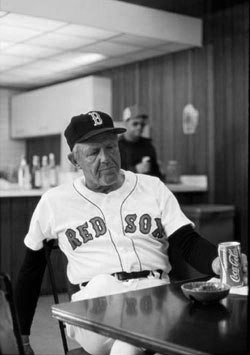
From New York, The Major went to Detroit, managing the Tigers through five marginal seasons from '74 to '78. He also skippered the Red Sox from 1981 to 1984 but had no division titles to show for his efforts in either stop. He became vice president of the Twins in 1986 and held that post in 1989, when he decided to retire for good.

Despite spending the end of his career with other organizations, Houk is best remembered as a Yankee. Although he wasn't a big part of it, the Yankees won six World Series in his eight years as a player. His managerial career started with the legendary summer of '61 and ended just before George Steinbrenner took over the team in 1973. He was a great solidier and baseball man who lived a long, proud life. Rest in peace, Major.

Monday, February 8, 2010

9 Days Until Spring Training: Roger Maris

In a perfect world, Mantle would have been the one to break Babe Ruth's single season home run record. Instead it was an aloof North Dakota native named Roger Maris who didn't come up with the Yankees, wasn't comfortable in New York, didn't get along with the media, and was never fully embraced by the fans.

Maris was signed by the Indians in 1953 for $5,000 and chose the path of professional baseball over a standing offer for a scholarship to Oklahoma State. In his first full season as a minor leaguer, Maris was assigned to the B-level Keokuk Kernels of the Illinois-Indiana-Iowa league. It was there that manager Jo Jo White taught him how to pull the ball and transformed from a solid hitter for average to a bona fide home run threat. That year, Maris hit 32 round trippers in 134 games and made his first significant strides towards becoming a Big Leaguer.

He made his debut on Opening Day 1957 for the Indians and hit the ground running with a 3 for 5 effort against the White Sox. The following day, he hit his first Major League home run, a go-ahead grand slam in the top of the 11th inning.

Maris was the starting center fielder for Indians in '57 but played all three OF positions, appearing in 116 games in total. He left his high batting averages in the minor leagues, hitting only .235 but his 14 home runs helped him to be a better than league average hitter (105 OPS+).

During the 1958 season, Maris was dealt to the A's for, among others, the immortal Woodie Held. Maris doubled his home run output from the previous year to 28 but hit only 19 doubles, saw his on base percentage dip below .300 and his OPS+ drop to 97. In 1959 he was transitioned to right field and began to put it all together at the plate, hitting .273/.359/.464 (123 OPS+) and was rewarded with a selection to the All-Star team.

The Yankees were tantalized by Maris' left handed power and were looking to give their team a boost after a third place finish in '59. They sent World Series hero Don Larsen, their two starting corner outfielders from the previous season, Hank Bauer and Norm Siebern along with 25 year old first baseman Marv Thornberry to Kansas City in exchange for Maris, Joe DeMaestri and Ken Hadley.

As he did in his first game in Cleveland, Maris made a great first impression as a Yankee, smacking two homers and a double in his debut against the Red Sox. He went on to win the AL MVP that season, nudging out Mickey Mantle by a scant 3 points in the voting. They had similar years at the plate but Maris, batting behind Mantle, drove in 18 more runs in 66 fewer plate appearances.

While the writers were willing to recognize Maris' accomplishments, many fans refused to embrace him as a True Yankee®. The Bombers were still very much Mickey Mantle's team and Maris' icy relationship with the New York media only served to further extend that perception.

While some still hold Maris' single season record up as the all-time mark, 1961 was far from a normal year in baseball and comes with it's own share of caveats.

Before 'the 61 season began, the AL expanded from eight to ten teams, adding the Los Angeles Angels and the Washington Senators by way of an expansion draft. Both teams selected Yankees with their first picks; the Angels took Eli Grba and the Senators claimed Bobby Shantz. The Yanks also lost Duke Maas, Dale Long, Bob Cerv, Ken Hunt, Bud Zipfel. The expansion draft weakened the overall talent pool in the league fairly significantly, but despite the pillaging, the Yankees were among the teams least affected.

That same season, the schedule was lengthened from 154 to 162 games. Commissioner Ford C. Frick, initially announced that in order to break Babe Ruth's record, it would have to be done in 154 games. He said:
Any player who hit more than sixty home runs during his club’s first 154 games would be recognized as having established a new record. However, if the player does not hit more than sixty until after his club has played 154 games, there would have to be some distinctive mark in the record books to show that Babe Ruth’s record was set under a 154 game schedule and the total of more than sixty was compiled while a 162 game schedule was in effect.
This was met with strong media backlash. The Sporting News placed it at #15 of the "most shameful acts in baseball history" and columnist Leonard Koppett called the decision "a remarkably foolish thing".

The prevailing wisdom at the time said the decision was prompted by Frick's loyalty to Ruth which could be traced back to Frick's days as a newspaper man. Frick had ghostwritten for Ruth in the past, allowing Ruth to "cover" every world series from 1921-1936 and wrote glowing columns about Ruth during his time with the New York Evening Journal.

Regardless of his perceived bias, Frick was making a logical choice. The tag of single season is rather arbitrary and it was clearly easier to reach 60 home runs given 8 extra games to say nothing of the substantially thinner pitching that resulted from expansion. Frick was stuck with two difficult choices: keep two separate rule books for each season length or give all players who came after 1961 an unfair advantage in breaking counting stat records. It was popular at the time, but his choice of the latter allowed one of the most hallowed records in sports to fall under dubious circumstances.

Maris' pursuit of the record wasn't especially popular with some living legends of the game either. Legendary second baseman Rogers Hornsby said at the time, "It would be a disappointment if Ruth's home run record were bested by a .270 hitter."

Partially because of the controversy surrounding his quest for 61, Maris was heckled and even had objects thrown at him on the field. He received hate mail, death threats and claimed his hair fell out "in clumps" as the season progressed. He had 59 HR after 154 games and hit his 61st on the last day of the season in the home half of the fourth inning against the Red Sox.

Maris spent five more seasons with the Yankees but his peak had decidedly past. While he was an above average hitter each of those five years, Maris never hit more than 33 home runs in a season and missed large chunks of 1963 and 1965 with injuries. He was ultimately traded after the 1966 season to the Cardinals in exchange for Charley Smith.

Despite breaking one of the most hallowed sports records of all time, Maris remained sour about the experience. During an interview at the 1980 All-Star game, he said:

They acted as though I was doing something wrong, poisoning the record books or something. Do you know what I have to show for 61 home runs? Nothing. Exactly nothing.

He passed away 5 years later from Hodgkin's Lymphoma at the age of 51.

Maris was a victim of our casting. Despite the fact that sports are unscripted, we still expect the right characters to come out on top. Mickey Mantle was the former farmhand, Yankee legend, the Hall of Famer, the rags to riches story from Oklahoma. He partied with the rat pack, Joe D. and Marylin Monroe, and had the key to the city. He was supposed to be the one to break Babe Ruth's record. Maris was the ostracized Kansas City transplant, who should have came up short. But that's not the way life works and while Maris' peak was far too short to earn him a spot in Cooperstown, he has a place in Monument Park.

Wednesday, February 4, 2009

Number of Days Until Spring Training: Roger Maris (#9)


It wasn't supposed to be Roger Maris. He didn't come up through the Yankees system, as he was acquired in the trade that sent Don Larsen to the Kansas City A's in 1959. He didn't get along with the New York media, and was considered surly.

Even though Maris won the AL MVP in his first year with the Yankees, they were still considered Mickey Mantle's team in 1961. Maris was an outsider and not considered a True Yankee(TM). In a perfect world, Mantle would have been the one to break Babe Ruth's single season home run record. Fate did not agree and Mantle suffered a leg infection late in the season that hindered him from topping the mark. He ended up with 54HR.

Before the 1961 season, the AL expanded from eight to ten teams, adding the Los Angeles Angels and the Washington Senators by way of an expansion draft. Both teams selected Yankees with their first picks; the Angels took Eli Grba and the Senators claimed Bobby Shantz. The Yanks also lost Duke Maas, Dale Long, Bob Cerv, Ken Hunt, Bud Zipfel. The expansion draft weakened the overall talent pool in the league fairly significantly, but despite the pillaging, the Yankees were among the teams least affected.

That same season, the schedule was lengthened from 154 to 162 games. Commissioner Ford C. Frick, initially announced that in order to break Babe Ruth's record, it would have to be done in 154 games. He said:

Any player who hit more than sixty home runs during his club’s first 154 games would be recognized as having established a new record. However, if the player does not hit more than sixty until after his club has played 154 games, there would have to be some distinctive mark in the record books to show that Babe Ruth’s record was set under a 154 game schedule and the total of more than sixty was compiled while a 162 game schedule was in effect.
This was met with strong media backlash. The Sporting News placed it at #15 of the most shameful acts in baseball history and columnist Leonard Koppett called the decision "a remarkably foolish thing". The negative reaction was certainly magnified by the fact that this was occurring in the first year of the extended schedule and the first year after the expansion.

The prevailing wisdom at the time said the decision was prompted by Frick's loyalty to Ruth which could be traced back to Frick's days as a newspaper man. Frick had ghostwritten for Ruth in the past, allowing Ruth to "cover" every world series from 1921-1936 and wrote glowing columns about him in the New York Evening Journal.

[Ed. Note: I leaned pretty heavily on an artcile by John Carvalho called "Haunted by the Babe: Frick's Columns About Ruth". The above links don't do it justice, so you can access the PDF here.]

Personally, I can't understand why this was such a big deal. Babe Ruth hit 60 home runs in 154 games. The tag of "single season" is arbitrary. It should have to be broken in the same amount of games. I guess people at the time felt like by keeping two separate sets of records, baseball was divorcing itself from it's storied past.

The alternative they chose, however, diluted the Babe's most prized record, and allowed for it to be broken during a longer season against weaker competition.

Aside from his boorish persona, Maris just wasn't a truly great player (see to the right). He had an extremely sharp career peak, winning back to back AL MVPs with the Yankees, but only made two All-Star games outside of those two seasons. Legendary second baseman Rogers Hornsby said at the time, "It would be a disappointment if Ruth's home run record were bested by a .270 hitter."

Maris had 59 HR after 154 games and hit his 61st on the last day of the season in the home half of the fourth inning against the Red Sox.

Due in no small way to the controversey surrounding his quest for 61, Maris was heckled and even had objects thrown at hit on the field. He said he received hate mail, death threats and claimed his hair fell out "in clumps" as the season progressed.

Despite breaking one of the most hallowed sports records of all time, Maris remained sour about the experience. During an interview at the 1980 All-Star game, he said:

They acted as though I was doing something wrong, poisoning the record books or something. Do you know what I have to show for 61 home runs? Nothing. Exactly nothing.

Maris was a victim of our casting. Despite the fact that sports are unscripted, we still expect the right characters to come out on top. Mickey Mantle was the former farmhand, Yankee legend, the Hall of Famer, the rags to riches story from Oklahoma. He partied with the rat pack, Joe D. and Marylin Monroe, and had the key to the city. Maris was the ostracized Kansas City transplant, but primarily on the strength on his 1961 season, Maris has his spot in Monument Park as well.

[Ed Note: 61* is a pretty good movie despite having Billy Crystal's annoying fingerprints all over it.]