Showing posts with label BBWAA. Show all posts

Friday, February 12, 2010

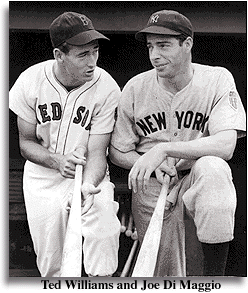
5 Days Until Spring Training: Joe DiMaggio

The son of Sicilian immigrants, Joe DiMaggio's given name was actually Guiseppe. He grew up in San Francisco where his father made a living as a fisherman, manning a boat that wasn't quite large enough for crabbing but was sufficiently sizable to make a living on during the 1920's in the rich waters of the San Francisco Bay. DiMaggio's father, also named Guiseppe, came from a long line of Sicilian fisherman as did the fathers of most of the boys Joe D. used to play baseball with on North Beach playground.

Naturally, the elder Guiseppe wanted all five of his sons to become fisherman, but he didn't understand that by immigrating to America, he had opened up their options far beyond anything they could have conceived back on Isola delle Femmine. They weren't consigned to the sea like he had been at their age. Only the two oldest DiMaggios became fisherman. The youngest three all went on to play Major League baseball.

Dom and Vince both had pretty decent careers. Each player over a decade and both brothers retired with OPS+ around 110. Not bad, but Joe was clearly head and shoulders above his kin.

Vince was actually the one who got Joe back into baseball after he briefly lost interest in his mid teens. Vince asked his manager with the San Francisco Seals to let his kid brother to fill in at shortstop for three games at the end of the 1932 season while the incumbent Augie Galan was barnstorming in Hawaii. In 1933, Joe officially became part of the team.

During his rookie season, just 18 years old, DiMaggio started the season on the bench. Eventually he took the place of a slumping right fielder and began his inexorable march to superstardom. Starting on May 27th, DiMaggio recorded a hit in 61 straight games, shattering the previous Pacific Coast League record. It was then he truly became hooked on baseball:
Baseball didn't really get into my blood until I knocked off that hitting streak. Getting a daily hit became more important to me than eating, drinking or sleeping. Overnight I became a personality.
DiMaggio had a unique minor league baseball experience. Instead of being drafted by an franchise and assigned to one of their teams thousands of miles from where he grew up, he played all of his minor league ball for his hometown Seals. He later explained:
I had the good luck to spend my entire minor league career in the Pacific Coast League, in which all travel and accommodations were first-class, and with my hometown team, the San Francisco Seals, at that. Playing on my hometown team meant when the club played its home stands I could live with my parents, occupy my own room.
The Yankees originally wanted to purchase DiMaggio at the beginning of the 1935 season but Charley Graham, owner of the Seals, drove a hard bargain. He agreed to give up Joltin' Joe, but only after he completed the '35 season in San Francisco. Additionally, the Yankees had to send three players to the Seals before the '35 season began. This made the Seals a heavy favorite in the PCL that year, and they took full advantage.

DiMaggio hit .398 with 100 extra base hits and 173 RBIs. The Seals captured their first Pacific Coast League title in 4 years and Joe was named League MVP. After the season ended, the Yankees sent $75,000 and completed the deal. DiMaggio made the long trip from California to Spring Training in St. Petersburg with fellow Italians and Bay Area natives Tony Lazzeri and Frank Crosetti, the latter of whom was bought from the Seals in 1931.

DiMaggio's personality didn't seem fit for the Big Apple. The Daily News called him "timid" and referred to his as Dead Pan Joe when he first arrived. Later in his career Hank Greenberg noted that if DiMaggio said "hello" to you, that was a long conversation by his standards. He was hyped endlessly by the New York papers and billed as the "Babe Ruth's successor", but in terms of disposition, he was much more like Lou Gehrig than Ruth.

Joe hit .323/.352/.576 with 29 HRs and 125 RBIs in his first year in the Bronx, made the All-Star team and finished 8th in the MVP vote. Had there been a Rookie of the Year award then, he surely would have won it. His sophomore campaign was even better, with a line of .346/.412/.673 and a whopping 46 home runs despite hitting right handed in Yankee Stadium for half of his games.

Over the course of his career, DiMaggio his 148 homers in the Bronx compared to 213 on the road. Left-center field at Yankee Stadium was 460 feet away during his playing days and straight away center was 490. It was a short 281 feet down the line, but the 45 degrees directly ahead of DiMaggio ranged from 430 feed in left field to 406 in right. It suffices to say that the Yankee Clipper lost a fair amount of home runs to Death Valley.

If anything, the extra square footage in the Yankee outfield help Joltin' Joe hit for average. With more ground for the outfielders to cover, there were more places for DiMaggio's hits to fall. On May 14th, 1941, he began his legendary 56 game hitting streak which lasted until July 17th in Cleveland. That day, three great defensive plays - two by third baseman Ken Keltner and one by shortstop Lou Boudreau - kept Joltin' Joe hitless. Undeterred, DiMaggio hit safely in 16 straight games immediately, collecting a hit in 72 of 73.

That year, primarily on the strength of his hitting streak (and maybe aided by the fact that he only struck out 13 times in 621 PAs), the Yankee Clipper stole the MVP from Teddy Ballgame, who hit .406 and roundly trounced him in every other significant batting category, save for runs batted in.

From 1936-1942, DiMaggio hit .339/.403/.607 (159 OPS+), averaged 31 home runs and 133 RBIs and won two AL MVPs. He homered more often that he struck out and played excellent defense.

DiMaggio was known for his long strides that allowed him to cover wide swaths of Yankee Stadium's expansive center field. According to Tiger slugger Hank Greenberg, the only way to get a hit against the Yankees was "to hit 'em where Joe wasn't." He developed his nickname "The Yankee Clipper" because as he patrolled center field he looked as smooth and graceful as the popular 19th century clipper sailing ships known for their speed and ability to cut through wavy waters.

After 7 excellent seasons for the Yanks, DiMaggio went to war in 1943. Well, more correctly, the was drafted into the Army Air Force. He traded in his $43,750 salary from the Yanks for a $50/month wage from the Army, but he continued playing baseball. He became a part of the 7th AAF and was stationed in Santa Ana, California. Joe spent most of his time in the service as a physical education instructor and playing baseball on the Santa Ana team. By contrast, Ted Williams was a fighter pilot.

While his time in the Army was a relative walk in the park, his parents were not so lucky. Since they were Italian immigrants, they were classified as "enemy aliens" and forced to carry identification cards on them at all times. They were not allowed to go beyond five miles from their home with out a government-issued permit. DiMaggio's father was banned from fishing in San Francisco Bay, where he had made a living over the previous 30 years.

The Yankee Clipper lost three full seasons to WWII. When he returned to the Yankees, he was 31 years old and it took him a bit to regain him form, hitting only .290 in his first year back. He hit for a lower average and with less power in his final six seasons than he did in his first seven but still managed a 150 OPS+ over that span. He picked up his third and final MVP in 1947, nudging out Ted Williams by one point despite on-base and slugging percentages over 100 points lower than the Splendid Splinter's, not to mention significantly fewer homers, RBIs and runs scored. It probably helped that the Yanks made it to the World Series and the Sox finished 3rd in the AL.

Williams and DiMaggio were almost swapped for each other in 1949. Boston Red Sox owner Tom Yawkey and Yankees GM Larry MacPhail verbally agreed to a trade, however it fell apart when McPhail balked at Yawkey asked for a young catcher by the name of Yogi Berra. It seemed at the time that the two principles of the trade were stuck in the wrong parks - the left handed Williams in Fenway and the righty DiMaggio in Yankee Stadium. However, they made out pretty well despite their inhospitable home parks. Berra, it turns out, would have been a much bigger loss for the Yanks because DiMaggio was done as a player only two seasons later.

Helped greatly by his hitting streak, DiMaggio became a central figure in American pop culture. Although he was an incredibly great player, his fame outpaced his talents. He was referenced in countless songs such as John Fogarty's Center Field, We Didn't Start the Fire by Billy Joel and Mrs. Robinson by Simon and Garfunkel. He was mentioned on I Love Lucy, Seinfeld, and Star Trek: Deep Space Nine. Hemingway even mentioned him in The Old Man and the Sea.

The Yankee Clipper accomplished an awful lot despite playing in only 13 seasons in the Big Leauges. He was a 9-time World Champion, 3-time AL MVP, 2 time batting champion, and a 13-time All-Star (the only player to be selected for the All-Star Game in every season he played). His career line was .325/.398/.579 BA and he tallied 361 HRs, 1537 RBI.

Joltin' Joe was a private man. He never seemed to be interested in the trappings of fame despite being one of the most famous people in the country for much of his life. He married Marilyn Monroe in 1954, of course, but the marriage lasted less than a year, due in part to Joe's jealousy and public nature of her character. They reunited seven years later and Joe asked her to marry him just four days before she died on August 5th, 1962. Joe had roses delivered to her grave three times a week for twenty years after she passed away. He never married again.

DiMaggio lived a full and long life which ended when he was 84 years old. He spend the last 100 days of his life in a hospital battling lung cancer and passed away on March 8th, 1999. The Yankees wore a black #5 patch on their uniforms to commemorate his life that season which culminated with a World Series victory over the Braves.

Mostly due to the length of his career, it took 3 ballots for DiMaggio to enter the Hall of Fame but he gained admittance to Cooperstown in 1955 and lived more than half of his life as a member of the Hall of Fame. He was to Yankees fans what Ruth was before him and Mantle and Jeter have been after: larger than life legends both on and off the field.

Tuesday, January 12, 2010

The Case For Raines

Good morning Fackers. For the most part, the backlash over last week's Hall of Fame voting results has cooled down and everyone has moved on to extracting their pound of flesh from Mark McGwire. But in running down the voting results last week, I made mention that the continued exclusion of Tim Raines and his overall poor showing in the results is the gravest injustice in the ballots. I further stated that the reasons why warranted its own post. This is that post.

Raines, like Bert Blyleven, has become something of rallying cause for the sabermetric community, as he was a tremendously valuable player, for a number of years, whose greatness isn't readily evident when measured by traditional metrics. I think this might be working against Raines. As far as we've come in our understanding of the game, there are still those amongst the voting ranks who have their heads buried in the sand, who are steadfastly against sabermetrics, the blogging community, and anything else that isn't a crusty old remnant of whenever they first cut their teeth in sports writing.

So rather than lay out a bunch of statistical analysis supporting Raines' cause - something that's been done far more eloquently by the likes of Joe Posnanski, Rob Neyer, Jonah Keri, and raines30.com - I'll try to put things in more of a general framework.

Simply put, Tim Raines, with the exception of Rickey Henderson, is the greatest leadoff hitter of all time. He was a machine at getting on base, he was historically successful at stealing bases (both in terms of quantity and success rate), and he scored runs by the boatload. Granted, if Raines was more of a power threat he would have been a three hitter rather than a leadoff hitter. But, batting leadoff is arguably the most important position in the batting order, as it will see the most plate appearances over the course of the season. And Raines' exceptional ability to avoid making outs made him extremely valuable in that role. Furthermore, Raines was not without power. While his home run totals are pedestrian at best, he spent his prime in Olympic Stadium, a very pitcher friendly park. Even so, Raines accumulated lots of doubles and triples - not to mention all the extra bases he stole - and his slugging percentage routinely outpaced the league average.

It's also very important to consider context in which Raines accomplished all of this. Baseball in the 1980s was markedly different than the game we watch today. Cookie-cutter astroturf ballparks permeated the game - particularly in Raines' National League. Power was down - the 49 home runs hit in 1987 both by recent electee Andre Dawson and recent confessor Mark McGwire were the most in baseball between George Foster's 52 in 1977 and Albert Belle's 50 in 1995 Cecil Fielder's 51 in 1990.

The game was built upon speed. Billy Martin's Oakland A's and Whitey Herzog's St. Louis Cardinals attempted steals at will. Herzog's teams, built on speed and defense, were arguably the team of decade, raking in four division titles, three pennants, and a World Series. The style of play permeated the game and players - Raines, Rickey Henderson, Vince Coleman, Willie McGee, Ozzie Smith - ran with reckless abandon.

And that was the problem with that style of play: it was reckless. Teams placed such a premium on speed that human out machines like Alfredo Griffin, Juan Samuel, and Mookie Wilson were given thousands of wasteful plate appearances in the leadoff spot strictly because they were fast. Traces of this philosophy still remain, as Dusty Baker's Reds have spent the last two years getting abyssmal OBP from the leadoff spot just because Corey Patterson and Willie Taveras are fast. When these players did manage to reach base, many of them were caught stealing so frequently that the bushels of stolen bases they accumulated were of little to no value thanks to all the extra outs they cost their teams. But with the right personnel, with the likes of Tim Raines getting on base at a .390 clip and swiping seventy plus bases a year at a jaw dropping 87% success rate, it was a successful and exciting style of play. The problem was, with the exception of Raines' Expos and Henderson's A's and Yankees, teams didn't have the right personnel to make that style of play work.

Baseball, as a game, has changed innumerable times in its 130+ year history. Our understanding of that game has changed and evolved over that time as well. The early Hall of Fame voters were able to understand that the players of the Deadball Era helped their teams win in different ways than the sluggers of the Ruth era. We understand now that top offensive contributions made in the mid to late sixties appear paltry compared to numbers that came before and after, but are no less outstanding when considering the context of the game at the time. We are starting to understand more and more the value of positional adjustments, and how a certain level of offensive production from a player capable of fielding a premium defensive position could be offer more value than a greater level of offensive production from a less important defensive position.

All of these factors come into play when considering Raines' case. Batting leadoff may not be the glamour batting position that the three or four spots are, but it's an extremely important spot. And virtually no one was better at batting in that spot than Tim Raines. Furthermore, he did his damage in an era where the game was placing more focus on the leadoff spot than it ever had before. With any luck, the BBWAA will realize this at some point in the next twelve years.

Thursday, January 7, 2010

A Look At The HoF Voting Results

Good morning Fackers. Yesterday we took a cursory look at the Hall of Fame voting results, noting Andre Dawson's election and the tantalizing near misses of Bert Blyleven and Roberto Alomar. The entire ballot spanned twenty six players who met the eligibility criteria. Here are some thoughts on those who weren't as lucky as The Hawk.

Byleven (74.2%) - He's a vitrual lock for next year after coming so close this year and seeing an 11.5% jump over last year. He has two more years of eligibility left and the next two classes aren't particularly strong.

Alomar (73.7%) - I'm not a big believer in drawing distinctions between a Hall of Famer and First Ballot Hall of Famer. Even so, I think Alomar's standing relative to the other men who have played his position make him worthy of first ballot induction. Obviously it will have to wait until next year. If waiting a year is Alomar's penance for the Hirschbeck spitting incident then so be it. I realize there are players in the Hall who have done worse, but waiting a year is a small price to pay for what's one of baseball's more despicable moments.

Jack Morris (52.3%) - Morris vs. Blyleven seems to be the next frontier of the old school vs. new school debate. Morris saw an 8.3% jump over last year, the second biggest gainer outside of Blyleven. He still ranks behind where Blyleven was in his 11th year of eligibility. It'll be interesting to see where this one goes in the year's to come. Does anyone remember when Morris nearly joined the '96 Yankees?

Barry Larkin (51.6%) - Larkin deserves enshrinement, but he clearly has a ways to go in the eyes of the voters. Still, it's encouraging to see him start out at 51.6%. For comparisons sake, Alan Trammell, a similar if inferior comparison, garnered just 15.7% of the vote in his first year of eligibility.

Lee Smith (47.3%) - Smith is the highest ranking former Yankee on the ballot. His continued languishing in the sub fifty percent range makes me wonder if the BBWAA is smarter than we give them credit for being. At the time of his retirement, Smith was the all-time leader in saves. He hasn't thrown a pitch in a dozen years, yet he's been passed only by Trevor Hoffman and Mariano Rivera. Normally, that's the sort of thing the writers would eat up: "This guy's the all-time saves leader, he's got to be a Hall of Famer!". Instead, Smith remains far from enshrinement, as he should. I'm just not sure it's because the writers realize the save is a relatively meaningless statistic. More likely, I think Smith serves as an example that the writer's aren't quite sure how to evaluate "closers". The relievers in the Hall - Wilhelm, Fingers, Sutter, Gossage - were "firemen", routinely accumulating 100+ IP per season. Smith accumulated 100 relief IP just twice, in his first two full seasons as a reliever. Smith was at the leading edge of the game-wide transition from firemen to closers. Dennis Eckersley is the only closer in the Hall, and Smith lacks both Eckersley's utter dominance as a closer as well as his years as a successful starter. Smith has seven more ballots for the writers to figure it out.

Edgar Martinez (36.2%) - If the voters don't know what to make of closers, then they have absolutely no idea what to do with designated hitters. The DH has been in existence for 37 seasons now, and it has evolved significantly in that time. What started as place to play the best bench player evolved as a spot to hide defensive liabilities, or to prolong the career of aging veterans, or to protect the health of those too fragile to handle the wear and tear of daily defense. While HoFers like Eddie Murray, George Brett, Rickey Henderson, Paul Molitor, Wade Boggs, Jim Rice, Dave Winfield, Carl Yastrzemski, and Dawson all spent significant time at DH, Martinez is an interesting case in that he's the first worthy candidate to have spent nearly his entire career as a DH. Offensively he has HoF numbers, and I think he's worthy of induction. I'll be interested to see how his candidacy is evaluated over the next several years.

Tim Raines (30.4%) - Far and away the gravest injustice in my opinion. Raines is worthy of his own post, and I hope to have that before the week is out.

Mark McGwire (23.7%) - After taking a slight dip in his percentage last year, McGwire's number returns to where it was in both of his first two years of eligibility - a long, long, long way from induction. Like Smith and Martinez, McGwire is an interesting test case. McGwire is probably the best pure power hitter in baseball history not named Babe Ruth (1st all time in AB/HR, 2nd all time in IsoP), but the problem is that he wasn't all that pure after all. I'm not sure yet how PED users should be judged, but McGwire's four years on the ballot don't bode well for Rafael Palmeiro next year or for Barry Bonds and Roger Clemens in 2013.

Alan Trammell (22.4%) - This was Trammell's ninth year on the ballot and his best showing yet. He's still so far off that it's unlikely he'll ever be elected. As a shortstop, Trammell is Hall of Famer. He's comparable, if slightly inferior, to contemporaries and Hall of Famers Cal Ripken Jr, Robin Yount, and Ozzie Smith. I think the problem for Trammell is that he was overshadowed by those three for most of his career, and in the years since the likes of Alex Rodriguez, Derek Jeter, Nomar Garciaparra, Miguel Tejada, and Hanley Ramirez have completely changed the concept of what a shortstop could do. Had Trammell begun his career 20 or 30 years earlier he'd likely already be in Cooperstown. At this point the Veterans' Committee looks like his best bet.

Fred McGriff (21.5%) - One of the worst trades the Yankees ever made. McGriff was a great player for a long time. But as a first baseman, his numbers don't really separate him from his contemporaries. It doesn't appear that another 7 HR to get to 500 would have made the difference for him either.

Don Mattingly (16.1%) - This is the best showing for our beloved Donnie Baseball since his second year on the ballot back in 2002. But it's still well off from his career best of 28.2%. As much as we'd all like to see it, Mattingly's not going to the Hall nor should he - his career nose dived way too soon. But I hope he continues to get the requisite 5% to stay on the ballot until his 15 years run out.

Dave Parker (15.2%) - The induction of borderline guys Jim Rice and Andre Dawson in back-to-back years lends itself to slippery-slope style arguments. I don't think The Cobra was as good as either one of those guys, but he wasn't off by too much.

Dale Murphy (11.7%) - Much like Mattingly, Murphy went from amongst the best in baseball to done seemingly overnight. Murphy was a contemporary of Dawson, and like Dawson is considered and all-around class act and good guy. The two make for an interesting comparison. Dawson had a longer and better career, and voters seem to favor players who decline gradually, like Dawson, to players who fall off a cliff, like Murphy. But if you look at their primes, Murphy was arguably the better player. And if you look at their peaks, Murphy was clearly the better player.

Harold Baines (6.1%) - The last player that will still be on next year's ballot. With the arrival of Edgar Martinez, Baines is no longer the best DH eligible for enshrinement.

Andres Galarraga (4.1%) - I'm surprised he didn't get the 5% necessary to stay on the ballot. Certainly not a HoFer, but a pretty good player during a rather lengthy career. I wonder if Galarraga dropping off after one year gives any insight as to how the voters will view the Coors Field effect. It'll be interesting to keep in mind as Larry Walker becomes eligibile next year and Todd Helton no fewer than six years from now. At 43 years old and stuck on 398 career HRs, Galarraga signed a minor league deal with the Angels in 2004. He spent a month in AAA and was given a token September call up. In the 160th game of the season, Galarraga pinch hit in the ninth inning of a game the Angels led 9-0. He homered to get to 399, and celebrated waaaaay too much for a player of his stature, particularly considering he was just hanging on to pad his numbers and had just hit a meaningless home run in garbage time of a late season game. I remember seeing the highlight and thinking it was a little below him. The again, Galarraga lost a season to lymphoma during the most productive stretch of his career and had suffered a relapse earlier that same year that may have cost him additional service time, so maybe I'm just a jerk for begrudging him a little celebration.

Robin Ventura (1.3%) - The second lowest ranking former Yankee on the ballot (Todd Zeile didn't get a single vote). In 1999, Nolan Ryan received 98.79% of the vote, the second highest percentage of all time. He was six votes short of being the only unanimous selection in history. Perhaps he'll beat Ventura up again, steal his seven votes, and add them to his own total to give him 100.2% of the vote.

Michael "Mike" Jackson (0.0%) - Listed only to give me an excuse to link to this. It probably wasn't particularly funny then; now it's neither funny nor timely.

Wednesday, January 6, 2010

Congratulations Hawk

This could quite possibly be the final post ever at Fack Youk, as I'm afraid the furor over this afternoon's Hall of Fame voting results will cause the internet to explode some time later today.

Andre Dawson was the sole player elected by the BBWAA, being named on 420 of 539 ballots for 77.9% of the vote. He received just 15 votes more than the necessary 75%.

Even closer to that 75% cutoff were Bert Blyleven and Roberto Alomar. Unfortunately for them they were on the wrong side of 3/4, with Byleven falling an agonizing five votes shy (74.2%) and Alomar just eight votes short (73.7%). The good news for them is that no one has ever failed to be elected after gaining that much support.

In my opinion Blyleven and Alomar are without doubt Hall of Famers, so there will assuredly be some people angry that they're out and Dawson - a borderline candidate - is the one who got in. And that says nothing about other more deserving candidates: Tim Raines, Barry Larkin, Alan Trammell, Edgar Martinez, or even Hawk's comparable contemporaries like Dale Murphy and Dave Parker.

Personally, I don't have a huge problem with Dawson getting in. He's assuredly a borderline candidate, but he had a helluva a career: MVP, Rookie of the Year, 8 time All-Star, 8 Gold Gloves, 4 Silver Sluggers, and some impressive power numbers that have him in the company of baseball's all-time greats. He also spent his best years playing in relatively obscurity in Montreal, where the concrete-like turf punished his knees to the point that he first moved from CF to RF, and then eventually to DH.

On the flip side, Dawson's career OBP is just .323, lower than the league average over the course of his career. There's no way to sugarcoat that. Whether that's enough to outweigh the positive aspects of his career is for you to decide. The writers didn't think so - not this year at least. Your mileage may vary, and probably does.

For now though, congratulations to the Hawk on his induction. We'll have more later on the rest of the ballot, and I'm sure several others elsewhere will have plenty to say about all of this.

Hall Of Fame Day

Good morning Fackers. The Hall of Fame voting results will be announced at 1:30 this afternoon; prepare yourselves for tearing of garments, gnashing of teeth, righteous indignation, some variation of stats vs. scouts, and the like.

Much like post-season awards, I can't get too worked up about the Hall of Fame. I think there are people who are in who shouldn't be. I think there are people who aren't who should be. And I think several members of the BBWAA are morons. But it's a museum for all intents and purposes, and I can't get myself too angry over who is enshrined in a museum meant to honor baseball's history. That said, there is one player up for nomination this year who I believe absolutely should be in, and who I believe likely won't get in (again). And if he doesn't get in later today, I'll likely be compelled to share some thoughts on that.

In the meantime, Joe Posnanski published his ballot at Sports Illustrated yesterday, and I urge you to give it a read. Like virtually everything else he authors, the article is long, insightful, and well thought out. You don't have to agree with all of Joe Pos' decisions - I don't - but it's awfully, awfully hard to argue with him. He clearly put a ton of thought into his choices and he offers compelling arguments for or against all the candidates worth consideration. Have a look, and we'll be back when the results are announced.

Tuesday, November 24, 2009

Parsing The AL MVP Vote

Good morning, Fackers. To the surprise of essentially no one who followed the 2009 Major League Baseball season, Joe Mauer won the A.L. MVP yesterday. He led the league in batting average, on base percentage, slugging percentage, runs created, wOBA, wRAA, VORP and would have in WAR if Ben Zobrist's UZR's wasn't propped up by small sample sizes or the stat gave any credit for a catcher's defense behind the plate.

With the exception of one writer from a Japanese newspaper based in Seattle (who inexplicably voted for Miguel Cabrera), Mauer was the unanimous choice. He didn't have 30 HR or 100 RBI, but the man from Minnesota was close on both counts. He didn't play in a game until May 1st, but at bat for at bat, he was the best hitter in the American League by a country mile.

While credit should go to the BBWAA for another award winner properly selected, the reality is that, even if you don't understand the concept of positional adjustment, there's no one else that had a legitimate case. And judging by the respective finishes of Derek Jeter and Mark Teixeira, it's apparent that many writers still don't grasp that concept.

Teixeira received 15 second place votes with only 3 voters ranking him lower than 4th. Nine voters ranked Jeter second, 16 others placed him between 3rd and 6th with the remaining three identifying him as the 8th, 9th or 10th most valuable player in the league. In other words, the general consensus was that Teix was a notch above Jeter.

According to Weighted On Base Average or wOBA, the statistic that most accurately measures a hitter's ability to get on base and hit for power, Teixeira (.402) led Jeter (.390) by fairly slim margin. However, wOBA doesn't take into account that Jeter played a much more difficult defensive position and, at least according to UZR, had a much better year in the field.

Perhaps UZR is selling Teixeira short, which most observers would argue is the case. Maybe Teixeira even saved Jeter a few errors by scooping balls in the dirt, although John Dewan's research doesn't seem to indicate that. But even if you grant both of those assumptions, it's unlikely they close the gap from Teixeira's 5.1 wins to Jeter's 7.4.

Of course, most voters don't care about players' wOBA or WAR. The biggest reason that Jeter finished lower than Teixeira on the majority of the ballots was that he only drove in 66 runs while Teix led the AL with 122. Runs Batted In are to the MVP vote what pitcher's wins are to the Cy Young: a context-driven, luck-determinant counting stat that depends largely on the production of one's teammates.

What was the biggest reason that Teixeira was able to drive in 122 runs despite a batting average (.264) and a slugging percentage (.471) with runners in scoring position well below his season marks (.292 & .565)? Derek Jeter and Johnny Damon's on base percentages of .406 and .365, respectively. The same thing happened to Mauer in 2006 when his .429 OBP teed up Justin Morneau for a huge amount of his 130 RBIs. That total was second in the league to David Ortiz and Morneau won the MVP award but Mauer ended up finishing 6th and was behind his teammate on every single ballot.

There were some other oddities within the voting aside from Miguel Cabrera getting a vote for first place but 3 votes for 10th and Teix topping Jeter. Mariano Rivera placed ahead of Zack Greinke although he didn't receive one Cy Young vote and Greinke won the award. Robinson Cano got three votes - all for 7th place. A-Rod netted a third place vote despite being left off 3/4 of the ballots all together.

A commenter over at BBTF took the liberty of compiling a "bizarro ballot", made up of actual selections writers submitted:
1. Miguel Cabrera
2. Kevin Youkilis
3. Alex Rodriguez
4. Jason Bay
5. Aaron Hill
6. Chone Figgins
7. Jason Kubel
8. Michael Cuddyer
9. Placido Polanco
10. Ian Kinsler
Sure, I'm nitpicking a little bit here. The writers have thus far got the 3 major award winners right, but with the exception of Tim Lincecum, they have been absolute no-brainers. When people have to list out 10 players, there are going to be some perceived sleights, but how many of those 10 actual placements do you think you could legitimately justify with statistical evidence?

Maybe we're not quite as far along the road to statistical enlightenment as we thought after Lincecum won the NL Cy Young. Perhaps, as Moshe Mandel from The Yankee Universe contends, we aren't seeing the voters wise up but the ability of sabermetricians (or at least those who are stat savvy) to influence the "buzz" surrounding players. And make no mistake, this is in large part due to the increasing influence of the internet which has given people like Rob Neyer and Joe Posnanski a national voice.

Is anyone going to remember who finished second or third in the voting when next year rolls around? Probably not. But that doesn't negate the fact that many voters (ostensibly "journalists") who have the privilege of voting for these awards are so severely lacking in objective analytical skills when that is one of the most important parts of their job description.

Monday, November 23, 2009

Mauer Wins MVP, Teixeira Second, Jeter Third

Joe Mauer convincingly and deservedly won the AL MVP this afternoon. He was named first on 27 of 28 ballots, and second on the other. He finished with 387 points.

The remaining first place vote went to Detroit's Miguel Cabrera. Cabrera received only one second place vote, but was as low as tenth on three ballots and finished fourth overall. Coincidentally, the only AL Cy Young first place vote that didn't go to Zack Greinke or Felix Hernandez went to Detroit's Justin Verlander, who didn't finish higher than third on any other ballot. Looks like someone in Detroit should have his voting privileges revoked.

[UPDATE 4:30 PM: The Cabrera vote did not come from a Detroit writer, but from a member of the Seattle chapter, Keizo Konishi of Kyodo News. Whouda thunk it?]

For the Yankees, Mark Teixeira finished second, 162 points behind Mauer with 225. His 15 second place votes were the most cast, and his six third place votes were the second highest total. He was named on all 28 ballots and finished no lower than eighth on any of them.

Derek Jeter finished third, with 193 points. His nine second place votes were the second most cast, and his five third place votes tied for third most cast. He too was named on all 28 ballots, finishing 6th or higher on all but three of them.

Alex Rodriguez finished tied for tenth with 31 points. He was named on seven ballots, with highest vote being a single one for third place.

Mariano Rivera was named on four ballots, with two sixth place votes, and one each for seventh and eighth, finishing with 17 points. Robinson Cano received three seventh place votes, CC Sabathia a single seventh place vote. No other Yankees were named on any ballots.

Blog favorite Kevin Youkilis finished sixth. He was named on 25 ballots and received two votes for second place. Full results are available here.

For all the grunting and groaning all year about who should and who would win the post-season awards, let's give the voters a bit of credit. They've picked the right guy for the AL and NL Cy Young Awards, and now the AL MVP as well. A win for Albert Pujols in the NL MVP vote tomorrow would make it a clean sweep for the big four awards.

Friday, November 20, 2009

WHIP, FIP & The WAR Against Wins

Good morning, Fackers. In the wake of the senior circuit Cy Young, like the AL version, being awarded to a pitcher not on the basis of his won-lost record but on the quality and number of his innings pitched, we're again going to disagree with the well-respected Tyler Kepner.

As Matt pointed out on Wednesday, Kepner noted that Zack Greinke acknowledged FIP in his post-award conference call but was grasping at straws in an attempt to frame the knowledge of advanced statistics as a key component in Greinke's success. Last night, Kepner tried to connect what was said by Greinke (or more accurately, Brian Bannister) with Tim Lincecum's explanation of his approach and made the same conflation:
Obviously, there is no substitute for pure talent. But in Greinke, Bannister’s teammate, we are seeing what can happen when off-the-charts talent meets sophisticated understanding of numbers.

The same is true of Lincecum, to a degree. His stuff is filthy, but he said he was mainly concerned with how many walks-plus-hits he allows per inning – which was curious, in a way, because Dan Haren, Chris Carpenter and Javier Vazquez all had a better WHIP than Lincecum in the N.L. this season.
First, Lincecum's WHIP was a minuscule 1.05. Haren, Carpenter, and Vasquez? 1.00, 1.01, 1.03. That's a difference of one batter for every 20, 25 and 50 innings, respectively, which Lincecum easily erases with his superior strikeout ratio.

But more importantly, what if Lincecum had simply said that he was trying his best not to allow batters to reach base? It would have been dismissed as a typical cliche. On the offensive side of the ball, we frequently hear batters saying that they were "just trying to get on base" which is just a different way of saying that they were trying to improve their on base percentage.

In most cases, the goals in baseball are pretty obvious. If you are a batter, don't use up outs. If you are a pitcher, try to keep men off the basepaths, preferably via strikeout. There is still some wiggle room regarding the value of sacrifice hits and bunting, but there isn't a whole lot advanced statistics can teach players. Knowing about UZR isn't going to make someone a better defender. They already know they should be trying to field as many balls, as far away from them as possible.

The main function of the more advanced metrics that are steadily gaining in popularity such as WAR, wOBA, VORP, WPA, RE24, UZR, and FRAA is that they allow observers to more accurately compare players to one another. While players citing FIP and WHIP can only increase their popularity, which is certainly a positive thing, understanding them doesn't provide much in terms of strategical, on-field edge.

The real story emerging from the 2009 Cy Young voting is that the voters have begun to value better statistics and in turn, more objective analysis. Which is to say, they're not blindly picking the pitcher who had the most wins.

Kepner demonstrates this by comparing this year's voting to win-skewed results 1990 and 1998 (both of which illustrate the writer's old reliance on wins), but Dave Cameron over at FanGraphs sums it up best:
Congratulations to the members of the BBWAA, who have been willing to adapt as the game changes. They deserve recognition for being willing to accept the shift towards better analytical methods. And getting away from wins as a measure of the value of a pitcher is a big first step.
Of course, Adam Wainwright who left his last game of the season with a 6-1 lead in line for his 20th win still received the most first place votes in the NL. He only finished 10 points behind Lincecum, so maybe if his bullpen had held up, the aftermath of these awards would be slightly less celebratory.

Both Matt and I have taken turns raining on this parade, but I think it's likely that in hindsight, 2009 will be cited as the year that Advanced Stats won the war against Conventional Wisdom. However, I'm more inclined to think that this was the Battle of Saratoga. And considering Bill James penned the hardball version of the Declaration of Independence over 30 years ago, it's probably going to a while before we see any sort of Treaty of Paris.

Wednesday, November 11, 2009

Non-Player Hall Of Fame Candidates

Good morning Fackers. We're still a good two months away from the Hall of Fame balloting being announced and the inevitable tearing of garments and indignation that will follow. Yesterday however, the Hall announced a list of twenty former managers, executives, and umpires that will be considered by the Veterans Committee (h/t BBTF).

Just like players, the candidates will need to be named on 75% of the ballots to be inducted. However, rather than being voted upon by the crumudgeonly BBWAA, the non-player candidates will be evaluated by their peers. Historically this has been a path of less resistance for those not elected by the writers, but since being reconstituted in 2001 the Committee has elected no players and only five non-players. Results will be announced at the Winter Meetings on December 7th.

The managers category includes former Mets manager Davey Johnson, former Royals and Cardinals manager (and former Yankee farmhand) Whitey Herzog, and former Yankee player and manager Billy Martin. Other candidates include Gene Mauch, Tom Kelly, Charlie Grimm, Danny Murtaugh, and Steve O'Neill. Umpire candidates are Doug Harvey and Frank O'Day.

The executive category includes longtime Yankee owner Colonel Jacob Ruppert, former Angels owner Gene Autry, former Royals owner Ewing Kauffman, former MLBPA executive director Marvin Miller (one of the five most influential people in baseball history), former Yankee GM Gabe Paul, as well as former National League President and longtime Yankee broadcaster Bill White.

Wednesday, November 4, 2009

Why Did Bobby Richardson Win The WS MVP in 1960?

Given the lack of newsworthy items yesterday, one of the hotter topics of conversation in the baseball blogosphere was whether or not Chase Utley should win the World Series MVP even if the Phillies lose. I linked to Dan Levy's post at the Sporting Blog last night but wanted to take a closer look at the idea today.

We're only 5 games into the Fall Classic and Utley has already smacked 5 home runs - 2 in each of the Phillies wins. He's hitting .333/.429/1.222 in front of Ryan Howard, whose OPS isn't much higher than Utley's OBP. There's little question that Utley's has had the best World Series so far. Cliff Lee singlehandedly won Game 1 but was mediocre in Game 5. A-Rod has had 6 huge, tide-turning RBIs but a meager batting line otherwise. Mariano Rivera's most important innings have yet to be pitched. Utley's showing comes with no asterisk.

As Levy points out, the only other player to win the World Series MVP from a losing team was also a second baseman - Bobby Richardson of the 1960 Yankees. In the first 11 years that the World Series MVP was awarded, Richardson was the only position player to win the award. It was an unlikely honor perfectly fit for one of the most improbable World Series ever played.

The Yankees outscored the Pirates 55-27 in that 7 game series. They out-hit them 91-60, out-homered them 10-4 and had a team ERA twice as low (3.54 to 7.11). But nonetheless, the Yanks lost on Bill Mazeroski's walkoff home run, still the only one in a Game 7 in World Series history.

Richardson's performance was pretty spectacular. He had a batting line of .367/.387/.667 which included a grand slam, 2 triples and 12 runs batted in. But he wasn't even the best offensive player on his own team. Mickey Mantle hit .400/.545/.800 with three homers and drove in 11 runs. By all accounts, Richardson was an excellent defensive second baseman, but Mantle was a legendary defender in center field and a much more recognizable figure at the time.

Richardson was in only his second year as the Yankees' primary 2B and Mantle had just made his 10th consecutive All-Star team. For regular season awards like Gold Gloves and MVPs, voters usually lean towards established stars over one year flukes (see: Zobrist, Ben), but that doesn't seem to be the case with World Series MVPs. In recent years, for example, writers have chose guys like David Eckstein (2006), Troy Glaus (2002) and Scott Brosius (1998); scrappy underdogs (slightly above average baseball players) who saved their best for the big stage.

The timing of the RBIs in the 1960 Series was a major contributing factor to the result of the voting. All but one of Richardson's 12 RBIs came in Yankees' victories. It's hard to stand out offensively when your team wins 3 games by an average of nearly 12 runs, but that's exactly what Richardson did when he drive in 6 runs in a 10-0 victory in Game 3. By comparison, Mantle blended in by knocking in five in the 16-3 domination in Game 2 and two on top of Richardson's 6 in Game 3. He added 2 more in Game 5, which the Yankees won 12-0 and two more in Game 7, which they ultimately lost.

But the reason that Richardson won the MVP over a more worthy teammate isn't the reason that it's still cited today. That's happened plenty of times (Eckstein in '06, Manny in '04, Livan Hernandez in '97, Darrell Porter in 1982, Bucky Dent '78 to name a few) It's because he won it on the losing team.

There is some precedent for giving the MVP to a player on the losing team of a postseason series. There were Mike Scott for the Astros in the '86 NLCS and Jeffrey Leonard for the Giants in '87 for example. It's happened once in the NBA Finals, once in the Super Bowl and five times in the Stanley Cup Finals. It just hasn't happened in the World Series since 1960.

It should have in 2002 when Barry Bonds had an OPS of 1.994, more than 1.100 higher than the winner, Troy Glaus. The fact that he was Barry Bonds certainly didn't help, but Glaus did drive in the tying and go-ahead runs on a double off of Rob Nen to force a Game 7.

But back to Richardson. Perhaps there is a simpler explanation as to why he is the only World Series MVP out of 53 to come from a losing team. The writers thought they were picking a guy from the winning team.

According to Mike Emeigh over at Baseball Think Factory (post #39), World Series MVP ballots had to be turned in before the beginning of the 8th inning of Game 7. Well, at the end of the 7th inning, the Yankees were leading 5-4. They had turned a 0-4 deficit into a 5-4 lead in the 5th & 6th innings and appeared to be in line for the victory.

But they didn't win. The Yanks expanded their lead to 7-4 in the top of the 8th, but gave up 5 runs to the Pirates in the bottom half. It might not have happened if a grounder that hit shortstop Tony Kubek squarely in the throat took a more predictable hop and ended up as a double play. However, the Pirates rallied to take the lead 9-7. The Yanks plated two in the 9th inning to barely stay alive, with Richardson scoring the 8th run.

It was their last breath, however, as the first batter Ralph Terry faced in the bottom of the 9th was Bill Mazeroski.


As another poster at BBTF (#43) argued, it doesn't really matter that the 1960 World Series MVP vote might (or might not) have been skewed by a procedural issue. The precedent for the writers select a an MVP from the losing team exists and it's unlikely that the people voting on this year's award know or care about that.

Does Chase Utley deserve to win the MVP at this point? Yes, in terms of value to his team, he probably does, although WPA thinks otherwise. But there are still games left to be played and there are a couple of Yankees who, if they factor directly into a victory, have a good chance to take it from Utley. But if push comes to shove, I'll give Utley the MVP in exchange for the Yankees' title. Deal?

Monday, October 26, 2009

Value Evaluation: CC or A-Rod

I doubt many people are going to remember who the ALCS MVP was a couple years from now. Postseason series MVPs are even more haphazardly given out than their regular season counterparts the BBWAA gets to vote on. As we had pretty much determined by Game 4, it was going to either A-Rod or CC Sabathia.

Last night as LoHud, Josh Thompson said "In no surprise to anyone, CC Sabathia was named MVP of the ALCS after winning both starts."

Um, I'll admit it. I'm a little surprised. A-Rod had a fantastic series and given how much the media loves stories of redemption, I had thought he would be the slight favorite to win. He put up huge numbers, and had clutch home runs, which I would think the media would value as much ro more than a guy who made two excellent starts.

Like everyone else, I don't really care who won the award, but I thought it would be interesting to look at who was more valuable in the series.

Here go the basic stats. A-Rod hit .429/.567/.952. That's a 1.519 OPS. He walked 8 times and struck out thrice. Three homers, six RBIs and six runs scored, meaning he was at the center of 9 of the Yanks' 33 runs in the series.

Sabathia started and won twice, going 8 innings and allowing one run each time. He had as many strikeouts (12) as walks (3) and hits (9) combined. An ERA of 1.12, a WHIP of 0.750.

Both guys put up numbers in the series that if you extrapolated to a full season would comfortably be the best of all time as a batter and pitcher respectively, I'm willing to say. I'm not sure of a place to get Wins or Runs Above Replacement data for a postseason series, so the best measure of comparing a pitcher to a position player would probably be WPA.

CC takes that one pretty handily which demonstrates the importance of an overpowering starting pitcher. With the Yankees' offense, he virtually assured them of two wins, the only two comfortable victories of the series.

A-Rod, on the other hand, had a hit in every game and was on base twice or more in all except Game 2, when of course he blasted a game-tying home run in the bottom of the 11th when the Yanks were down to their last breath. In Game 5, where he was at .005 in WPA, he still had a hit and two walks.

You can't go wrong with either of these guys obviously, and even A-Rod magnanimously said that CC deserved it. These are nice issues to be able to sort through, aren't they? Everybody wins!

Thursday, September 17, 2009

Could Derek Jeter Get In The HoF Unanimously?


It's been a while, but I don't think there is any other way to approach this than FJM-style. Maybe I was inspired by yesterday at Deadspin. Or maybe there is so much wrong in this post that I tried to react to it using blockquotes but it was impossible without it seeming like I was quoting him out of context.

(Before you tell me in the comments, I have no delusions that I am as brilliant or funny as the FJM fellas, but when you disagree with just about everything in a piece, there aren't too many ways of responding to it other than bolding what they say and reacting in regular font.)

Is Derek Jeter an all-time, all-time, all-time great, a la Mantle, Ruth, Rickey Henderson, Bob Gibson, Sandy Koufax, etc? No.

But he is an all-time great—the shortstop with the most hits, a four-time World Series champ, an undisputed leader and grinder.

Luis Aparicio had the record for hits as a shortstop before Jeter and he received just 84.6% of the vote and it wasn't even his first ballot.

Phil Rizzuto was the Yankee shortstop for 7 World Series titles but had to be elected by the Veterans Committee 38 years after he retired, and unlike Jeter, he won an MVP.

Lots of people disputed Jeter's leadership when he didn't stand up for A-Rod. Others have said that Jorge Posada was the real, fiery leader in the Yankee clubhouse.

And "grinder" is a nebulous, bullshit term that has been used to describe the least talented player on every high school team ever assembled.

That’s why, I truly believe, Jeter may way become the first unanimous Hall of Same selection.

I really do.


All of those things in combination are pretty impressive, but none of those guys who you named as being better than Jeter were elected unanimously.

I know… I know—some moron voter will make a stand by voting NO; his chance to say, “If Ruth wasn’t unanimous, Jeter shouldn’t be.”

You really don't think he'll get in unanimously, then. So what was the point of this article again?

But Jeter, well, Jeter is perfect. First, look at his lifetime statistics. Second, look at the three Gold Gloves (yes, his defense isn’t what it once was. But, in 2009, it’s been very good). Third, look at the four titles. Fifth, look at the captaincy. Sixth, look at the clutch situations—especially The Flip against Oakland. Seventh, look at the dignified way he carries himself.

Okay, since you brought them up, let's actually look at these things instead of just listing them offhandedly, shall we Jeff:


Yes his statistics are very good, particularly his batting average and OBP, especially when you consider that he plays shortstop. I'm with you.

Second, look at the three Gold Gloves (yes, his defense isn’t what it once was. But, in 2009, it’s been very good)

It's not that his defense wasn't what it once was, it's that there are very smart people who contend that it was never very good to begin with. Derek Jeter isn't going to the HoF for his defense.

Third, look at the four titles.

Those four championships came in his first 5 years and he hasn't won one since then despite playing on the team with the highest payroll in the league every year during that time even though Jeter has been great all along. Which kind of goes to show that championships are a pretty terrible way of measuring individual performance.

[Fourth...]
- Apparently because you used "four titles" in your 3rd point, you didn't include a #4. Clever.

Fifth, look at the captaincy.

Mmmkay, I'm looking. And I see Jason Varitek, who is the captain of the Red Sox, and the only way he's getting into Cooperstown is by driving down Interstate 88 and ponying up the $16.50 entry fee. I also see Thurman Munson who, despite winning a Rookie of the Year (like Jeter), and MVP (unlike Jeter) was not inducted because his career was tragically cut short. It's about the numbers not the "captaincy".

Sixth, look at the clutch situations—especially The Flip against Oakland.

Let's disregard the flip play that you mentioned because he has done something like that exactly one fucking time in his career on which Jeremy Giambi might have been safe anyway. If we are basing Hall of Fame voting on fluke plays in the playoffs, let's add Mookie Wilson and Aaron Boone while we're at it. But let's focus on the larger point; his performance in clutch situations in general.

If you had actually looked at his career numbers on B-R like you told everyone else to in point #1, you would know that Jeter's OPS in the regular season is .846. How about in late and close situations during the regular season? .811.

His OPS in the postseason is exactly the same as the regular season right now, .846. He's been great in the ALDS at .957. In the ALCS, though? .743, pretty close to leage average. In the World Series, the clutchiest of all baseball gaming situations? .809. There's something to be said for staying close to his great career norms under intense pressure, which is more than most can claim. But let's not pretend that Jeter has delivered transcendent "clutch" performances throughout his career whenever the pressure rises. Because no one does that. Because "clutch" comes and goes.

Seventh, look at the dignified way he carries himself.

Amazingly, this might be the most salient point of them all. He hasn't done anything to offend the people voting for him and he won't lose any votes to vindictive writers like many others have. But recent inductees Cal Ripken and Tony Gywnn carried themselves with the same level of class and still came up 8 and 13 votes short, respectively.

I'll add one thing of my own, which I mentioned above... #8 - He's never won an MVP. I personally don't think that should keep him off the first ballot, but that might have been the difference between the 5 voters who went for Ripken but not Gywnn. Or maybe they were racists. In which case 2 or 3 of them should vote for Jeter.

I thought it utterly insane that Rickey Henderson had a handful of voters who didn’t support his Hall bid, but the Rickster was, factually, arrogant and a wee-bit selfish. He didn’t deserve any Nays, but he didn’t always carry himself with professionalism.

And that handful will be the same people who, in defense of Babe Ruth, Ty Cobb, Christy Matthewson and Honus Wagner, won't vote for Derek Jeter.

Jeter is, for lack of a better word, perfect.

You already said that. Putting in a one sentence paragraph doesn't make it a better point.

To vote against the man would be illogical. And downright stupid.

The BBWAA doing something illogical? Or stupid? I refuse to believe it.

Derek Jeter is a surefire first ballot Hall of Famer is he never records another hit. He's the greatest Yankee shortstop of all time and like Tim Marchman said, he's as winning a winner as ever won. But there are going to be at least a few complete assholes out there who, instead of individually deciding whether or not they they he belongs in the Hall of Fame, will take it into their own hands to block his unanimous induction. It's ridiculous but it's reality.

However, had Pearlman made his case with actual facts or sound logic, we could have saved ourselves a lot of time.

Saturday, August 15, 2009

Rob Neyer Grants Yankees Postseason Berth!

Great news isn't it? Here's Neyer responding to a tweet from Tyler Kepner proclaiming that Teixeira is the AL MVP, "no question":
No question? Honestly? Maybe Kepner just means that Teixeira will win, rather than that he should win.

What inspired this particular post? An essentially meaningless home run, hit well after midnight (back in New York). I mean, I'm sorry, but the Yankees aren't exactly in the middle of a pennant race anymore. They've got a huge lead over the second-place Red Sox. And if the Red Sox should somehow mount a late charge, the Yankees have a huger lead over the Rangers for that other postseason berth.
I guess what Neyer is trying to do here is gauge the impact this will have on the MVP voting, not give his own feelings on who should win the award, which he does later in the post. He goes both ways on it, though. The same people who weren't paying attention because it was past their bedtime are going to think it doesn't count because the Yankees were too far ahead? Right or wrong, the better the Yankees are, the more it helps the MVP chances of Teix or Jeter, who Neyer apparently doesn't consider a "viable candidate" either by oversight or purposeful omission.

"Essentially meaningless"? I don't care that the Yankees have a 98.9% chance of making the playoffs right now, a game winning shot in the top of 9th inning is still pretty significant. A bigger lead will give the Yankees more flexibilty coming into the postseason, allowing them to skip Joba's starts freely and align their rotation, if they are in fact fortunate enough to still hold the lead when the season comes down to the wire. Which is a major presumption at this point. As good as the Yanks have looked, I don't think you're going to find too many people in that clubhouse who think it's a forgone conclusion. They are one major injury away from looking awfully vulnerable.

Monday, February 9, 2009

What About The HoF? [A-Roid]

One of the more interesting pieces of shrapnel from the A-Rod bomb is what impact this has on the Hall of Fame. Will 25% of the writers simply not vote for someone with PED issues? The Steroids Era promises to expose the HoF voting for the flawed, subjective system it is.

In ten years, who is still going to be above the fray? Jeter. Pedro. Maddux. Mussina. Rivera?
Rivera's rookie year in the Major Leagues was 1995, initially as a starting pitcher. He found mixed success, posting a 5–3 record and 5.51 ERA that year. As a result, he split time between the Yankees and their AAA affiliate in Columbus. As a 25 year-old rookie with major arm surgery in his past, Rivera's role on the team was not guaranteed. The Yankees considered trading Rivera to the Detroit Tigers for David Wells. However, a surprise improvement prompted a change of heart. In one minor league start, Rivera suddenly began throwing 95–96 MPH. Rivera started ten games for the Yankees that season, participating in a two-hit shutout of the Chicago White Sox on July 4, in which he recorded a career-high eleven strikeouts. Rivera's sudden improvement and his success in the 1995 American League Division Series, in which he pitched 5 1/3 scoreless innings of relief, convinced Yankees' management to keep him and move him into the bullpen the following season.
Sounds pretty suspicious in hindsight doesn't it?

A-Rod tested positive for Primobolan. In her interview with Bob Costas on the MLB Network on Saturday, Selena Roberts said that it doesn't bulk you up like Winstrol or Deca-Durabolin and that it allows you retain 80% of your strength once you cycle off. Couple that with HGH (which Andy-facking-Pettitte was on) and the "Who's Juicing" game just got a whole lot more difficult.

Pudge Rodriguez is undoubtedly a HoF player numbers-wise and wasn't in the Mitchell Report, but I will literally bet you anything that he took steroids, HGH or something like that when he caught 144 games in the Texas heat, hit 35 home runs and slugged .558.

See what happens? When you don't even have to rely on changes in physical appearance (which Pudge certainly had), the cloud of suspicion broadens further still. As we've discussed before, baseball statistics are incredibly random and you can pretty much read any storyline you want on those tea leaves.

It's a divisive issue and everyone is going to have their own take. That includes the BBWAA writers. I think everyone should get in and being that it is a museum, just include the PED stuff in the exhibit. Pete Rose too. He existed. Leaving him out of the HoF doesn't remove him from baseball history and it isn't going to take the needle from Roger Clemens' ass or the veins from Barry Bonds' forehead.

Of course that's not how most of the crotchety old bastards like Murray Chass, who feel they are the sanctimonious gatekeepers of Cooperstown, are going to vote. I'm guessing that pretty soon the induction classes are going to be awfully small.

Sunday, February 8, 2009

Number of Days Until Spring Training: DiMaggio (#5)


Joltin' Joe. The Yankee Clipper. The Architect of the Most Pristine Real Estate in Sports.

The son of a San Francisco fisherman, Joe overcame his humble roots to become the biggest star of his time--both on and off the diamond. His grace and brilliance helped lead the Yankees to 9 World Championships in his 13 playing years from 1936 to 1951.

Joe D. is perhaps best known for his MLB record 56 game hitting streak in 1941. The streak began on May 15, 1941 against Eddie Smith and the Chicago White Sox and ended on July 17 against the Cleveland Indians. America, almost at war, was extremely gravitated by The Streak. Most games then were played in the afternoon, and radio announcers would routinely interrupt programs with news of his progress. The Streak, which probably will never be broken, was so captivating that DiMaggio was able to defeat Ted Williams for AL MVP. despite the Splendid Splinter putting up a .406BA/47HRs and 120 RBI. I guess the facts that Joe put up .357 BA/30HR/125 RBI and the Yankees finished in first place helped too. During the stretch, DiMaggio had ninety-one hits in two-hundred twenty-three at bats during the stretch, hitting .409. Some groove. After The Streak was snapped, he started another one--this one lasting 16 games. Combining the two streaks, the Clipper hit safely in 72 of 73 games.

Joltin' Joe, a righty, was a victim of Yankee Stadium and its dimensions. Many of his shots died in left field's Death Valley and the 475 foot center. Bill James calculated that DiMaggio lost more home runs due to his home park than any player in history.


Cognizant of the fact that Joe would have been an absolute beast at the right-handed hitter paradise known as Fenway Park, in 1949, Boston Red Sox owner Tom Yawkey and Yankees GM Larry MacPhail agreed to trade DiMaggio for Ted Williams. However, thankfully the deal went kaput as MacPhail wisely refused to include Yogi Berra in the trade. Imagine Yankee History without these two. I cannot. Also imagine Joe D. as a lefty at the Stadium.

The Yankee Clipper's personal accomplishments are as follows: 3-time AL MVP, 13-time All-Star (the only player to be selected for the All-Star Game in every season he played), .325 BA, 361 HRs, 1537 RBI, .579 SLG (6th highest in big league history), 2 Batting Crowns (1939 & 1940)

These stats do not give justice to his superb fielding. DiMaggio was known for his long strides that allowed him to cover every inch of the massive Yankee Stadium center field. According to Tiger slugger Hank Greenberg, the only way to get a hit against the Yankees was "to hit 'em where Joe wasn't." He developed his nickname "The Yankee Clipper" because as he patrolled center field ne looked as smooth and graceful as the popular 19th century clipper sailing ships known for their speed and ability to cut through wavy waters.

DiMaggio never hit .400 in a season. Former commissioner Fay Vincent asked Joe why and detailed it in his book.

"In 1939, I was going to hit .400. Right around the first of September, we clinched the pennant. We always clinched around the first of September. Right about then, I was hitting .408.

"I was going to hit over .400 that year. Then I got an eye infection. Couldn't see out of the infected eye. Our manager was Joe McCarthy. Every day, McCarthy puts me in the lineup. Commissioner, that guy made out a lineup card in April and he never changed it. Every day I'd go to the ballpark, every day my eye is getting worse and worse, and every day I'm in the lineup. I couldn't hit. My average starts falling. Finally, the eye gets so bad they have to give me an injection in the eye. And McCarthy still has me in the lineup. I wouldn't say anything to him. Now I did not have a bad year, Commissioner. I batted .381. But with my eye almost closed I had to open my stance. The infection was in my left eye, the lead eye. So I had to swing my left foot around to try to see the ball, but I couldn't. I had trouble and my average fell. That was my year to bat .400 and I didn't do it."


In 1954 DiMaggio was elected to the National Baseball Hall of Fame. On his 3rd ballot he received 88% of votes. Baseball writers were apparently idiots back then too.


In addition to being one of the greatest center fielders of all time and a pop culture icon due to his marriage to Marilyn Monroe, Joe D. was a patriot. He enlisted in the United States Army Air Forces on 17 February 1943, rising to the rank of sergeant. Although his role as a physical education instructor did not place him in the same level of danger as fighter pilot Ted Williams, it is admirable that he chose to serve his country in any way that he could have.

Joe also has the honor of having the coolest song ever about an individual him. Jeter doesn't even have a song about him.

Hello Joe, whatta you know?
We need a hit so here I go.
Ball one (Yea!)
Ball two (Yea!)
Strike one (Booo!)
Strike two (Kill that umpire!)
A case of Wheaties

He started baseball's famous streak
That's got us all aglow
He's just a man and not a freak,
Joltin' Joe DiMaggio.

Joe, Joe DiMaggio
We want you on our side

He tied the mark at forty-four
July the 1st you know
Since then he's hit a good twelve more
Joltin' Joe DiMaggio

Joe, Joe DiMaggio
We want you on our side

From coast to coast that's all you'll hear
Of Joe the one man show
He's glorified the horsehide sphere
Joltin' Joe DiMaggio

Joe, Joe DiMaggio
We want you on our side

He'll live in baseball's Hall of Fame
He got there blow by blow
Our kids will tell their kids his name
Joltin' Joe DiMaggio

We dream of Joey with the light brown plaque
Joe, Joe DiMaggio
We want you on our side

And now they speak in whispers low
Of how they stopped our Joe
One night in Cleveland Oh Oh Oh
Goodbye streak DiMaggio

The first true 5-tool player, Joltin' Joe was anointed as a rookie as the Second Coming of Babe Ruth. Only 21, a lot of pressure was applied on him to carry the offense and restore the Yankees to their World Champion status. Although he didn't exactly match Ruth's gargantuan numbers, to say that he did not live up to expectations would be foolish. Much credit to a young DiMaggio for not caving under pressure.

The most admirable aspect of Joe D's game was his hard work. Asked why we worked so hard, he replied, "Because there is always some kid who may be seeing me for the first time. I owe him my best." Somebody please show this quote to Robinson Cano. That is how you play the game. It is also refreshing to see an athlete who had accountability to fans.


Whenever you drive over Manhattan's West Side Highway (named after him), please pay your respects and count your blessings that this fine individual was a Yankee. As evidenced by his quote "I want to thank the Good Lord for making me a Yankee," it meant everything for him to be a part of the great franchise.