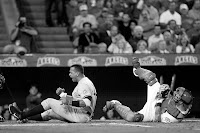
Showing posts with label Melky Cabrera. Show all posts

Tuesday, January 12, 2010

The Yankes Are Serious About This Budget Thing

Joel Sherman writes on his blog today that the Yankees only have $2M remaining to spend on a left fielder and as a way of making that point, unveils this tidbit:
Hal Steinbrenner, after all, has shown a much greater willingness to hold to some financial guidelines than his father, George, did. For example, the Post has learned, the Yanks had a completed trade last July with Milwaukee for Mike Cameron, pending ownership’s blessing to take on the money. But Hal Steinbrenner refused to add the approximately $5.5 million in salary and luxury tax it would have cost for the rest of the season, so the deal was scrapped.
Sherman leaves out some important details, namely who would have been exchanged for Cameron and when in July this deal almost took place. It was rumored that the Yankees were about to trade Melky Cabrera to the Brewers for Cameron last December, so it's possible that he would have been included in the deal again. Brett Gardner broke his thumb in July 25th, so the Yanks could have tried to orchestrate a trade in that small window before the July 31st deadline, in which case it would be more likely that other players would have been sent to the Brewers instead of Melky.

With a total salary of $10M and $125,000 bonuses kicking in at 425, 475, 525 & 575 plate appearances Cameron wasn't exactly a bargain last year, but that prorated amount would have only been about 2.7% of the Yankees payroll. It was a proverbial drop in the bucket at that point. Clearly it wasn't a necessary addition as the Yanks got all they needed out of centerfield in 2009, but it takes a lot of discipline as an owner to be convinced of that at the time.

Sherman goes on to say that the Yankees are interested in Xavier Nady and Reed Johnson but that the former might be slightly out of their price range. This means that signing Jerry Hairston, Jr. would all but exhaust their budget and unless Johnny Damon wants to come back on a bargain-basement-one-time-only-red-tag-special, he's obviously out too. Your move, Reed Johnson.

Wednesday, December 23, 2009

How Good Is Too Good?

Good morning Fackers. Yesterday, when I first heard about the Javier Vazquez trade, I had an inescapable, reluctant sort of a feeling. I knew the trade was one that would make the Yankees a better team next year without question, but I wasn't excited about it by any stretch.

It was unfortunate to see Arodys Vizcaino get sent to Atlanta just days after he been placed in the top half of the Yankees' top 10 prospects by both FanGraphs and Baseball America, but that wasn't what was bothering me. I had no particular attachment to Mike Dunn, so his loss certainly wasn't it. You don't want to part with a homegrown switch-hitting center fielder like Melky Cabrera who is only 25 years old and has already put in four years for the Yanks, but I don't think I'm going to miss him that much either.

Who we got back wasn't the issue. I don't expect Vazquez to have a year that in any way resembles his dominance in Atlanta, but he'll go a long way towards rounding out the Yankees rotation. What happened during his previous tenure in Pinstripes doesn't bother me at all.

The Braves were looking to unload payroll and the $11.5M Vazquez was making was the next best thing to dumping Derek Lowe. Regardless of what Mark Feinsand's source told him yesterday, this trade was a salary dump to some extent and I think that's what made the deal seem so uncouth. It's not to say that it wasn't a move that made sense for both teams - the Braves had six starting pitchers and the Yankees had four center fielders - but something still feels wrong about it.

The Yankees just won the World Series and they added a pitcher who was among the four or five best in the National League last year to be their third or fourth starter. With CC Sabathia making $23.5M, A.J. Burnett $16.5, Andy Pettitte $11.5, and now Vasquez another $11.5, their top four starters will make $62.5M in 2010, or more than the A's, Pirates, Padres and Marlins spent on their entire teams last year. Sure, the Yanks' total payroll bill for next year will probably come in somewhere near $200M, but staying close to that massive, arbitrary number isn't exactly something to be proud of.

Spending a ridiculous amount of money is nothing new to the Yankees - in 2005, they paid out $85M more than their closest competitor - but it's not as much the dollar amount as it is the players. Now that the Bombers are allocating those resources efficiently, it's hard not to understand how much money $200M actually is. Throughout the middle of this decade, the Yanks were continually paying the likes of Jason Giambi, Randy Johnson, Gary Sheffield, Jose Contreras, Jaret Wright, Carl Pavano and Hideki Matsui far more than they were worth. Now survey the current roster. It looks pretty damn lean by comparison.

I know that it's borderline irrational for a Yankees fan to feel any sort of guilt about the amount the team spends. They make a ton of money - some of which comes from me - and if they don't spend it on players, it's just going to be sucked up into a corporate vacuum, never to be seen again. The more they spend on payroll, the more enjoyable it is going to be to watch them on any given day during the season.

And perhaps that's the issue. Maybe this is just an offseason problem. As the summer moves along and the season develops, it's likely that the Yankees won't actually be as good as they are on paper right now and it won't seem as unfair that they have assembled an absolutely ridiculous collection of current and former All-Stars and future Hall of Famers. Even if they win 110 games next year, they are still going to lose at a 32% clip. Given that a 94 win team loses 42% of the time, it doesn't seem all that different over the long run - one game out of every 10.

Everyone wants their team to be awesome. But I think people want to see their team come together and exceed expectations rather than attempt to live up to impossibly high ones. Ideally, you'd like your team to be better than others by virtue of something other than their relative willingness to shell out tens of millions of dollars. Being a bona fide Goliath doesn't take away from the satisfaction of winning a World Series, but it tempers the enjoyment of every step along the way.

As it stands, the 2010 season will end in one of two ways: an expected victory or a major failure. So while the moves the Yankees have made this offseason have ensured they have a better chance to win a World Series coming into the season than they have had in quite some time, they have also guaranteed that they will have more to lose than ever before.

Tuesday, December 22, 2009

Vazquez Trade Reactions

We posted our initial take on the deal earlier this morning, but here is a collection of what else is being said around these here internets about the acquisition of Javier Vazquez:
Will from IIATMS looks at what this might mean for the Yankees' defense. Aaron Gleeman from Circling the Bases asks a similar question.

Ben from River Ave. Blues revisits Vazquez's last time in the Bronx.


Joel Sherman was the first to name Vazquez as the target this morning and has an in-depth breakdown of the trade. He also explained that the Yankees valued a starting pitcher over a left fielder and are still looking to keep their payroll under $200M, meaning LF will likely be filled on the cheap. They are also planning to deal either Chad Gaudin or Sergio Mitre before spring training.

There are over 200 comments on the BBTF trade dedicated to the trade as well.

And some quick quotes, taken completely out of context:
Dave Cameron, FanGraphs: "The reaction to this deal on Twitter has not been kind to Atlanta, with most people concluding that the Yankees got Vazquez for peanuts. I’m not so sure."

Joe Posnanski: Sigh. The Yankees traded for Vazquez to be their NUMBER FOUR starter. And the Royals signed Jason Kendall to be their starting catcher.

Keith Law: "At this point, the Yankees now have a rotation close to that of the Red Sox, and they could very well enter 2010 a better team on paper than they were at the same time before 2009.

Peter Abraham, Boston Globe: "You knew this was coming. Once the Red Sox signed John Lackey, there was no way the Yankees would go into next season with a rotation of CC Sabathia, A.J. Burnett, Andy Pettitte and two question marks."

Jonah Keri, via Twitter: "To be fair to the #Braves, any time you can acquire dryer lint for one of the best SP in baseball, you gotta do it.

Tyler Kepner, via Twitter: "Yanks use 6 prospects to get Granderson and Vazquez, yet keep Hughes, Joba, Montero, Melancon, Romine, McAllister. Not bad."

Ben Kabak, River Ave. Blues: "As much as it strengthens the team’s rotation, it also weakens their outfield. The leftfield situation currently looks like a Brett Gardner/Jamie Hoffmann platoon, which doesn’t exactly inspire confidence."

Rob Iracane, Walkoff Walk: "Let it be known that this guy (points to self) would rather have dismissed Nick Swisher, who cannot field his position, run the bases, or dress like a grown-up. But hey, Vazquez strikes out batters like it's his job (note: it is his job) so as a Yankees fan, I am pleased."

Satchel Price, Beyond the Box Score: "Considering what the Phillies landed for one year of Cliff Lee, arguably a superior pitcher, at a cheaper salary, I think that Atlanta got a pretty solid return for Vazquez, even if it doesn't include the impact bat that Atlanta sorely needs."

Kevin Kaduk, Big League Stew: "It's often been said that Vazquez is a pitcher that throws best when the expectations are low and his stats do back that up. "

Josh, Jorge Says No!: "Make no mistake about it though, if Vazquez can give the Yankees 200 IP with 190+ K's, and a 3.75 ERA, then there is no reason why he won't be able to win 15+ games with the Yankees the way this team is constructed."

And It Comes Full Circle: Javy Vazquez Returns

When Matt created the Nick Johnson trade tree last week, he had to go all the way back to the trade that sent Johnson to the Expos for Javier Vazquez. Since then, Johnson's been oft-injured but productive when healthy, putting up .402 career OBP. A year after being acquired from Montreal, Vazquez was traded to Arizona for Randy Johnson, who was disappointing in his tenure in Pinstripes. In the five years since that trade, he's thrown over 200 innings every season, with a combined ERA+ of 110.

It seems that Brian Cashman is now attempting to right those wrongs as the Yankees have reportedly acquired Javier Vazquez from the Braves along with lefty reliever Boone Logan in exchange for Melky Cabrera, Mike Dunn and Arodys Vizcaino, who was just named the Yankees third best prospect by Baseball America after an excellent campaign in short-season Staten Island.

Vazquez is coming off a terrific season for the Braves in which he threw 219 innings to a 2.87 ERA. He'll be making $11.5M next year (the last on his contract), so he won't come cheap, but he's very similar to Andy Pettitte in that he's likely to pitch a whole lot of innings at a better than average ERA. The Yankees might have bought at the peak of his value, but this is a salary dump to a certain exent as well because they didn't give up a whole lot.

Boone Logan is a 25 year old lefty who was traded to the Braves along with Vazquez from the White Sox last winter in exchange for two minor leaguers and two of the least manly-named baseball players imaginable - Tyler Flowers and Brent Lillibridge. Logan's career ERA is north of 5.00 and it's not a whole lot better in the minors, but he'll likely compete for a spot in the bullpen now that both Mike Dunn and Phil Coke are gone.

It's sad to see Melky go, but he's starting to get fairly expensive and hasn't displayed the kind of tantalizing ceiling that makes you think he is going to be an All-Star caliber player in the future. Dunn is a converted outfielder, so he is still early in his development as a pitcher. He could very well turn out to be a solid reliever, but for now his walk rate is awfully high. Arodys Vizcaino is a long, long way from the Majors, but he flashed a lot of potential this year and is the one piece that could be the most painful to see in another uniform in the long run.

My overall impression is that this is a great deal for the Yankees for this year. They get a very solid starter to fill out the back of their rotation (and a possibly lefty for the 'pen) in exchange for two fringe MLB players and a pitcher that is still several leaps and bounds from the Big League club.

However, this means that top 4 members of the Yanks' starting rotation will be making $62.5M this year. It also means the Yanks will most likely have to go outside of the organization to fill the hole in left field. I guess it's good that the Yankees are spending the money they are making instead of stuffing it in the coffers, but the talk of a "budget" that was prevalent early in this offseason is getting more and more laughable by the day.

Monday, December 21, 2009

The Easiest (And Cheapest) Outfield Solution

It's been almost two weeks since the Yankees acquired Curtis Granderson and during that time, their 2010 roster has begun to congeal. Andy Pettitte was re-signed, Jamie Hoffman was acquired via the Rule V Draft, Nick Johnson was signed as a free agent, Hideki Matsui became an Angel and it is widely assumed that Johnny Damon's career as a Yankee has come to a close. However, in the game of musical chairs which will determine the outfield configuration for 2010, it's not even clear that all the participants have been identified. The music is most certainly still playing.

At the moment, the Yankees have 5 outfielders on their 25 man roster: Granderson, Hoffman, Nick Swisher, Melky Cabrera and Brett Gardner. The good news is that 4 of them are capable of playing center field. The bad news (aside from the fact that only one of them can do so) is that only two of the five can hit like Major League corner outfielders (Swisher and Granderson).

Even though there has been some sporadic talk about Swish being traded this offseason, let's simplify this by assuming that he will be the Yankees' right fielder come Opening Day. That leaves four players for two starting jobs, one of which will certainly belong to Granderson.

When the Yankees picked up Granderson, I hoped aloud that they would consider putting him in left field and keeping the center field platoon from 2009 intact. Not only would it require no further trades or acquisitions and be relatively inexpensive (~$15M), but it it would result in one of the better defensive outfields in the league. And as they say, "a [run] saved is a [run] earned".

Granderson has been above (+12.9), below (-9.4) and just about average (+1.6) defensively in 2007, 2008 and 2009, respectively, according to UZR. Using a 3-4-5 weighted average of those scores, his UZR/150 is approximately +3 over the past three years. Given that he was a slightly better than average center fielder, it would be safe to assume that he would be a significantly better than average left fielder. Left field in Yankee Stadium is plenty large so it's not like stashing a rangy defender there would be a waste.

I'm going to refrain from citing the exact UZRs for the Gardbrera Duo due to small sample sizes, but I'm willing to assume that Brett is a very good fielder while Melky is probably about average or slightly below. Combine them and the Yanks are a tick better than average in CF.

In terms of offense, there are two leaps of faith that I am taking here:
1) Granderson's offensive output will be closer to 2007 and 2008 than to 2009.

2) Cabrera and Gardner will be as good as they were last year or better at the plate.
Neither of those are trivial considerations, but there are reasons to be optimistic.

Granderson's BABIP of .275 is likely to improve from last year given that it is significantly lower than his carreer mark of .322. Bill at the Detroit Tigers Weblog estimated that about half of that drop was due to Granderson's approach and the other half to luck. Hitting in the New Yankee Stadium should also help. Additionally, it would be a lot easier to find a solid hitting right-handed platoon partner for Granderson (like Reed Johnson) who can play LF as opposed to one who can play center.

Melky has already experienced years in which he regressed instead of improving in his young career and there are good reasons why Gardner won't necessarily improve next year. But they are both in their mid-20's and should be able to at least replicate what they did at the plate in '09 barring an injury.

The Yankees have an infield full of star-caliber hitters, a DH with a .400 OBP and a right fielder who hits about 30 HRs as well. They won 103 regular season games (and the World Series) last year with Gardner and Melky splitting CF duty. I think they can afford to configure left and center field in a way that would maximize defensive production while being close to average at the plate. There are other ways to fill those holes, but they would likely cause the Yanks to get older and more expensive in the process.

Lunchtime Links

As Chad Jennings pointed out this morning, it's going to take a lot to top last Monday, but there are a few odds and ends (some from over the weekend) worth checking out.

Over the weekend, E.J. from The Yankee Universe advocated making Brett Gardner the Yankees everyday center fielder.

On the other hand, Joe Pawlikowski from River Ave. Blues compared Gardner to Scott Podsednik, warning against using projections to predict his production in 2010. Unfortunately, the latter of these two posts provides the more realistic assessment.

Mark Carig from the Star-Ledger asked a person who used to do statistical analysis for a major league club for their reaction to the Granderson deal. The first sentence: "What a deal".

According to the Daily News, the Yankees and the Cubs could be trading partners. Gardner or Melky Cabrera are the likely targets since the Cubbies are in need of a center fielder, but it's not clear what the Yankees would want in return. Carlos Zambrano's name was mentioned but the asking price was reportedly "high". Even higher is his salary, so file this one under "Things We Aren't Buying".

Joe Posnanski saw Up In The Air over the weekend and wrote an epic post about movies and travel inspired by it.

This morning, Lar from Wezen-Ball dug up an interview with an ex-Yankee from the well-respected Weekly World News.

Bill Madden says that their agents have left Johnny Damon, Matt Holliday and Jason Bay out in the cold by mis-reading the free agent market. Easy there Bill, it's not even Christmas yet.

The Post says that Cashman is hoping to acquire a starter by New Years and names Jason Marquis, Joel Pineiro and Ben Sheets as targets. MLBTR adds a few more.

Sports Illustrated has an interview with Peter Gammons.

Sunday, December 13, 2009

Yanks Do Not Treat Wang Tenderly

Good morning Fackers. As we, and most everyone else predicted Friday, the Yankees yesterday tendered contracts to arbitration eligible players Chad Gaudin, Sergio Mitre, and Melky Cabrera, but not Chien-Ming Wang.

Wang, who made $5M last year, would have been guaranteed a minimum of $4M in arbitration. Wang missed the majority of both of the last two seasons. A freak lis-franc injury suffered while running the bases in interleague play ended his 2008 season on June 15th. After a rehab that the Yankees arguably botched, Wang returned in 2009 with three historically bad starts, culminating with a disastrous 1.1 IP, 8 ER outing against the Indians in the third game at the new Yankee Stadium, a game the Yankees eventually lost 24-4.

Following that outing, the Yankees placed Wang on the DL with a questionable "weakness in his abductor muscles" injury, allowing him to rehab in the minor leagues. But rather than allowing Wang the entirety of his 30 day rehab assignment to right his ship, the Yankees hastily activated him after just two starts, panicking after Joba Chamberlain exited a start after being hit with a line drive. Relegated to a mop up role, Wang wallowed in limbo, making three relief appearances over a ten day stretch. He was then returned to the rotation, making six starts that were mediocre at best. He exited his July 4th start against the Blue Jays, suffering from shoulder pain. Surgery at the end of July, the second shoulder operation of his professional career, officially ended his season, and likely his Yankee career.

The Yankees will likely make a token attempt to re-sign Wang to a team friendly, incentive laced deal, but I'm not holding my breath waiting for it to happen. Chances are he can find a better deal, or at least a better chance to pitch, elsewhere. There may also be some lingering hard feelings from Wang towards the organization following past contract negotiations and how his injury situation was handled. According to a Friday afternoon tweet from Brian Hoch, Wang's agent, Alan Nero, said Wang will look to move on if non-tendered. If this is the end of Wang's Yankee career, it will go down as one of the sadder chapters in recent Yankee history.

As for the rest of the Yankees' arbitration eligible players, Mitre and Gaudin and will provide added depth to the Yankee pitching staff, which will be thinner without Wang. Both will be in the mix for the back of the rotation/long man roles, and both - particularly Gaudin - may be of use in other relief roles. Meanwhile, Melky remains in the mix for the outfield, if not as a potential left fielder than in competition with Brett Gardner and recently acquired Jamie Hoffmann for back up roles.

The arbitration decisions leave the Yankees 40 man roster at 37. We'll take a look at some of the other non-tendered players during the week.

Friday, December 11, 2009

Non-Tender Deadline Preview

Good morning Fackers. Well, the whirlwind week of Winter Meetings is essentially behind us. My head is still spinning from all the updates, blog postings, tweets, and rumors floating about. But things are starting to take shape. I think the Yankees are far from being done maneuvering however.

The last event for this week is tomorrow's non-tender deadline for arbitration eligible players. Arbitration eligible players not tendered a contract by their club prior to the deadline become free agents. The Yankees have four arbitration eligible players:

  • Chien-Ming Wang: Wang is universally regarded as a goner. The Yankees do not want to offer him arbitration and play him more than the $5M he made in 2009 after he's missed nearly the entirety of the past two seasons. Wang started a throwing program last week, and his agent claims he won't be far behind other pitchers in spring training, stating he'll be ready to pitch by May 1st. Still, the Yankees don't figure it wise to commit the money to Wang given his injury history - including three shoulder injuries now - his poor performance last year and the uncertainty that surrounds him moving forward. I'll be sad to see him go. He was a very good pitcher for the Yankees for three plus years before that freak injury in Houston nearly two years ago. The Yankees likely botched his rehab and then didn't really put him in a position to succeed or improve upon his return.There's a chance Wang re-signs with the Yankees for less money, but I just don't see it happening. He'll likely receive a better offer from someone else; Joe Torre and the Dodgers have expressed interest.

  • Chad Gaudin: Surprisingly, Gaudin has been mentioned as a potential non-tender candidate, as he stands to make about $3M through arbitration. I can't see the Yanks non-tendering him however. If the priority is pitching, pitching, pitching, then left-field, the Yankees cannot afford to keep jettisoning pitchers. Say what you will about Brian Bruney, Phil Coke, and Ian Kennedy, but trading them subtracts from depth. I doubt the Yankees will let a capable, versatile pitcher like Gaudin go over a few hundred thousand dollars. His ability to be serviceable as a starter or a reliever would be of benefit to the 2010 Yankees.

  • Sergio Mitre: There's no indication Mitre will be non-tendered. Earlier in the off-season the Yankees declined their $1.25M option on Mitre, but that doesn't mean they don't want him around next year. He wasn't outrighted or designated for assignment, so it appears the Yankees are willing to go to arbitration with him, where they figure to get him for less than the value of his option. I wasn't impressed with Mitre at all last year, but again, pitching depth is the name of the game right now. At this point, Mitre doesn't figure to be a member of the starting rotation, so perhaps the sinkerballer can be of double play inducing value out of the bullpen and serve as the designated longman.

  • Melky Cabrera: There's no chance Melky will be non-tendered. After regressing for two straight seasons after an impressive rookie year, Melky was one of several Yankees to enjoy a bounceback season in 2009. His role for 2010 remains uncertain with the acquisition of Curtis Granderson and the word that the Yankees are trying to re-sign Johnny Damon. Cabrera could be in the mix for LF job, he could be the 4th outfielder, or he could be trade bait given the apparent glut of 4th outfielder / back-up center fielder types on the Yankee roster at present. But one way or the other, the Yankees will want to secure their rights to him for 2010, so he will be tendered a contract. After making $1.4M last year, some estimate Melky may earn as much as $3M in 2010.
Once the news breaks, we'll take a look at some of the players non-tendered by other clubs.

Thursday, November 12, 2009

Yankee Rumor Du Jour: Curtis Granderson

As soon as Joel Sherman found out that the Tigers were willing to listen to offers for Curtis Granderson, he immediately speculated that the Yankees would be "near the top of the list" of possible trade partners. This is not a knock against Sherman, who was the one person responsible for consistently churning up "news" at an unusually dull GMs meetings in Chicago while others were content to tell us that nothing was happening. It's his job to concoct interesting theories based on pseudo-facts to keep people reading about baseball even though very little is actually happening.

However, this morning, he really put on his tin foil hat thinking cap and got to work:
Curtis Granderson would be an ideal fit for the Yankees and is available. He is a very good player with a reputation as a better person. So he would enhance both the exceptional lineup and strong clubhouse community the Yankees already have.

GM Brian Cashman’s vision for the Yankees has been younger, more athletic and more cost efficient. Granderson will play next season at 29, which would give the Yankees another prime-aged player in their everyday lineup along with Mark Teixeira, Robinson Cano and Nick Swisher.
The problem is that Granderson is neither younger nor more cost efficient than 25 year old Brett Gardner who will be making close to the Major League minimum this year or 24 year old Melky Cabrera who will take the $1.4M he made last year to arbitration. So trading for Granderson would make the Yankees younger and cheaper, by making them older and more expensive.

To acquire Granderson, Sherman suggests that the Yanks deal Austin Jackson, Ian Kennedy and Zach McAllister and if that doesn't work, take on some players who are very old, extremely overpaid, and can't play the field. Exactly what Cashman was envisioning!
For example, Carlos Guillen has two years at $26 million left. Could the Yankees take that on and hope his deteriorating body and game holds up enough for him to provide switch-hitting depth in left field, first base and DH?

Or do they take on Magglio Ordonez, who is due $18 million next year and has a games started/plate appearance trigger for another $15 million in 2011. Like Guillen, Ordonez’s body and game are wearing out. He did still hit .310 last year, but with just nine homers. He played his best late in the year, hitting .401 from Aug. 1 to the end of the season, a period of 50 games in which he walked (19) more often than he struck out (17).
Sherman also names Nate Robertson ($7M), Jeremy Bonderman ($12M), Dontrelle Willis ($12M), Brandon Inge ($6.6M) and even Miguel Cabrera, who has $126M left on his deal and no ostensible defensive role in the Bronx.

The Yankees have one position that is occupied by truly young and cheap players and that is center field. Could the they stand to upgrade their production there? Yes. Do they need to trade for someone who is owed $32M over the next 4 years to do so? I really don't think so. Should they take on horrible and/or huge contracts from the Tigers in addition to do so? Absolutely not.

Tuesday, November 10, 2009

Revisiting Mike Cameron & CF

Good morning Fackers. As I mentioned yesterday morning, even though we continue to bask in the glow of the Yankees' World Series victory, the Hot Stove League is underway in earnest. The Elias Rankings for free agents were released yesterday. Brian Cashman arrived at the General Managers' Meetings in Chicago yesterday and explained that the Yankees will be taking the cautious approach with their off-season moves.

Be that as it may, other teams are already acting. One of the first deals this off-season occurred Friday, when the Brewers flipped shortstop JJ Hardy to the Twins for center fielder Carlos Gomez. On the surface this deal has minimal impact on the Yankees, but I think there could be a ripple effect to this.

It was a virtual lock that the Brewers were going to move Hardy, given that top prospect Alcides Escobar is primed to take over at short. The prevailing theory was that Milwaukee would use Hardy to bring in some much needed pitching help, and they still will, but in a roundabout way. Gomez will be an approximate $4.5M cost savings over Hardy next year, and Gomez' presence has allowed the Brew Crew to let incumbent center fielder Mike Cameron and his $10M salary walk as a Type B free agent.

This is where I think things can get interesting. The Yankees kicked the tires on Cameron when he was a free agent following the 2007 season and last off-season were involved in ongoing discussions with the Brewers about a potential Melky Cabrera for Cameron swap.

In Cabrera (.274/.336/.414, 99 OPS+, .331 wOBA, 2.3 UZR/150) and Brett Gardner (.270/.345/.379, 93 OPS+, .337 wOBA, 15.4 UZR/150) the Yankees have two good, young players at a premium defensive position, both of whom outperformed the average AL center fielder in 2009 (.265/.329/.403). As we detailed yesterday, in Austin Jackson the Yankees have a highly rated center field prospect who is probably half a year to a year away from being ready to take over. He is almost universally projected to be a better player than both Cabrera and Gardner, perhaps as soon as this coming season. All of which is a long-winded way of saying that the Yankees have a glut of young talent at a premium defensive position.

This is a good position in which to find themselves, as the Yankees have some trade chips to carry into a post-season with a relatively weak free agent market. Knowing that Jackson is likely a year away at most and knowing that Cameron, in whom they've expressed interest in both of the last two off-seasons, is available without having surrender a draft pick, might the Yankees consider trading one of their two current center field options now, and sign Cameron as a one year place holder for AJax?

I wouldn't rule it out. I don't envision the Yankees committing the years or dollars to Jason Bay or Matt Holliday. I don't think any of the other corner outfield free agent options are particularly palatable. If Damon and/or Matsui departs, the Yankees will be in the market for a corner outfielder/DH type. I don't particularly relish the idea of either Cabrera or Gardner playing a corner since they lose much of their value there, and I would imagine the Yankees feel the same way. If the Yankees are relatively certain that Austin Jackson will be prepared to be the center fielder in 2011, thereby relegating both Cabrera and Gardner to fourth/fifth outfielder status, then the time is now to cash in on either Gardner or Melky.

If it were up to me, Cabrera would be the one getting shopped. It's no secret here that we've been big advocates of Brett Gardner being the regular center fielder on the strength of his on base percentage, his speed on the bases, and his extraordinary range in the field. Cabrera had a very nice bounce back season in 2009, posting his best numbers since his rookie campaign in 2006. He's still just 25, has a good arm, is a decent enough defender, and is a switch hitter who has shown the ability to hit Major League pitching at a young age. But I'm still not sold on him, and I'm admittedly enthralled with Garnder's plate discipline, speed, and range. If someone else is going to take over in center, I'd rather have Gardner available off the bench than Melky.

As for Cameron, he's not without his warts. He'll be 37 come Opening Day, which is absolutely ancient by center field standards. He doesn't hit for a high average and strikes out a ton. But, he's still a valuable player. He walks at a good clip, posts a decent OBP, is a 20+ HR guy, and outside of a one year blip playing in the spacious confines of Petco Park's outfield, he's been an outstanding defender over the course of his career. He'd probably come cheaper than the $10M he made last year - perhaps $8M, and is unlikely to get a multiyear offer elsewhere. Dave Cameron at Fangraphs even makes the argument that Cameron is more valuable than Jason Bay. Far less importantly, he's considered yet another "good character" guy and is reportedly close with former teammates Alex Rodriguez and CC Sabathia.

Cameron could be a very nice one year place holder for AJax while allowing the Yankees to capitalize on the current value of Cabrera or Gardner to fill other needs. What do you think Fackers?

(Gardner/Cabrera Photo, Cameron Photo)

Monday, November 9, 2009

The Jackson Report: Looking To 2010

One thing we didn't focus enough on this year at Fack Youk was the Yankees' minor league system. Thankfully, there are several great resources in the Yankee blogosphere to fill in those blanks. Part of the plan for the off-season is to take a look at some of better prospects the Yankees have waiting in the wings. Today, we'll start with someone we did check on in periodically throughout the season: Austin Jackson.

Jackson is one of the top position player prospects in the Yankee system, and is probably the most Major League ready. Baseball America had him as the Yankees' top prospect entering 2009. The Hardball Times dropped him to ninth following this year, but that's perhaps more a reflection of the depth at the low levels of the Yankee system than it is a knock against AJax.

Jackson spent all of 2009 at Scranton, his first full year at AAA after seeing a single game there in 2007. He followed up on being named the AA Eastern League's Playoff MVP in 2008 by winning the International League's Rookie of the Year award in 2009.

2009 was just Jackson's fourth full season of pro ball. He hit .300/.354/.405 and swiped 24 bags in 28 attempts. The bad news is that Jackson's BB% dropped to a career low 7.4% and his K% jumped to 24.4% after being 21.7% and 22.0% the past two years. His increase in strikeouts did not translate to an increase in power, as Jackson's 2B, HR, SLG, and IsoP were all at three year lows. He also benefited from an unsustainable BABIP of .390

Overall, we should be very excited about Austin Jackson. As a 22 year old, he was quite young for AAA, and he still managed to post impressive numbers. Jackson is considered a "raw" prospect, as he was a major basketball recruit out of high school and didn't devote his full attention to baseball until signing with the Yankees. The gap between each successive level is more cavernous than the one before it, and after handling the low A/high A, and high A/AA transitions with aplomb, Jackson finally met some resistance this year. That might explain the disconcerting changes in his BB and K rates.

As for his BABIP, it certainly is unsustainable. However, Jackson's lack of power (just 4 HRs) and high K% is a recipe for a high BABIP. Add to that his LD% of 21.8%, a career high by a good margin, and his BABIP isn't nearly as flukey as it seems at first glance. Jackson's always fared well on balls in play, with a career BABIP of .361 and never once below .346 in four seasons of professional ball.

Late season indications were that the Yankees intended to leave Jackson in AAA to start 2010, and I think that's the right course of action. Interestingly though, Bill James' 2010 projections have Jackson at .294/.356/.411, better than both Melky Cabrera (.278/.341/.406) and Brett Gardner (.277/.368/.375). I think that's a bit too bullish on Jackson for next year; but then again this is Bill James. For what it's worth Jackson's 2009 numbers project to just a .259/.308/.343 line with just 3 HR, 32 BB and, 131 K according to the minor league equivalency calculator.

Based on his minor league service time, Jackson will need to be added to the 40 man roster this off-season. While I do believe Jackson will see the Bronx at some point in 2010, I don't think he'll break camp with the team. That said, I wouldn't completely rule it out it. There's no telling how the LF/DH situation will play out with Johnny Damon and Hideki Matsui being free agents, and I wouldn't be completely shocked if either Cabrera or Gardner is traded this off-season. Regardless of how it all plays out, I expect to see AJax holding down an everyday spot in the Yankee OF come 2011.

Off Season Preview: Outfield & DH

Good morning Fackers. So it's been just about four and a half days since the Yanks wrapped up the 2009 World Series, and about three days since the parade finished. Ready to stop celebrating and start thinking about next year yet? Me neither, but the reality of things is that the Hot Stove League is already underway. We've already seen a handful of trades, options exercised, buyouts paid, extensions agreed to, and free agency filings. The General Managers Meetings start today. It may be a bit of a buzz kill, but it's time to start thinking about the 2010 Yankees and who will make up that roster.

The biggest Yankee storyline this off season will be the situations involving Johnny Damon and Hideki Matsui. We'll assuredly take a look at both of them soon, but as we start our off-season coverage I'd like to take a broader view.

The Damon/Matsui situation(s) is/are really part of a larger issue for the Yankees: who will fill the outfield and DH spots next year? Nick Swisher is a lock. Barring a trade, Melky Cabrera and Brett Gardner will still be around. Austin Jackson waits in the wings. Damon, Matsui, and to a lesser extent Xavier Nady are candidates to be resigned. Matt Holliday and Jason Bay are big ticket names in the free agency pool, Chone Figgins is being mentioned as a potential left fielder, and second tier free agents like Vladimir Guerrero, Jermaine Dye, Mike Cameron, and Coco Crisp may also find their names cycling through the Yankee rumor mill.

In my opinion it boils down to this: amongst their own free agents, other team's free agents, or trades, the Yankees need to secure two players to fill a corner outfield spot and the DH spot.

We'll certainly run through all the options over the next couple of weeks (unless the Yankees do something quickly), but let me just state my own personal opinion right off: I want the Yankees to retain both Damon and Matsui. Part of that may be sentimental, in wanting to retain two of the more tenured members of the club. But it's also functional. Both are still useful players, despite some visible warts. But sometimes it's better the devil you know is better than the devil you don't.

The argument against this is multifaceted: both are old, both have varying degrees of physical malady and carry injury risk, both are defensively limited, both will be somewhat costly, and both will likely ask for more years and dollars than the Yankees should rightly commit. Critics of this idea will further note that the Yankees "need to get younger, more athletic, etc" and that the team needs to "open the DH spot" to periodically rest aging veterans Jorge Posada, Derek Jeter, and Alex Rodriguez.

Those are valid arguments. But I think they are risks the Yankees can afford to take. Next year's bench should feature the likes of Francisco Cervelli, Ramiro Pena, and either Gardner or Cabrera. All are young, all are athletic, and all give the Yankees some measure of versatility. Meanwhile, I agree with the concept of resting the older position players through the DH spot.

But what happens if Posada, Jeter, and Rodriguez all get a day a week at DH? Each would be replaced in the field by an offensively inferior player (Cervelli, Pena). And who then would DH the remaining three or four games each week? If Damon is the answer to that question, does that mean some combination of Gardner, Cabrera, and Jackson take two of three outfield spots in those games? How much offense would they be giving up by doing all of that?

The next six weeks or so should answer these questions. There are better (and more expensive) options out there, but I'm going on record now as saying that I think the best option for the 2010 Yankees is to bring back both Damon and Matsui.

Monday, November 2, 2009

Molina & Gardner In, Melky Move To Come

That's the news according to LoHud eminating from the press conference with Joe Girardi. Jose Molina will again be catching A.J. Burnett while Brett Gardner gets the start in center over Jerry Hairston, Jr., thankfully. The bottom third of the order was going to be a black hole one way or another, at least they have someone who is comfortable and excellent in center field and fast on the bases in Gardner, should he ever reach them.

Girardi also said that the Yanks are in discussions with the MLB in regards to a roster move with Melky Cabrera. We'll use this post to keep you updated on those developments and separate this stuff from the preview which is going up at 5:30.

Update: 5:26: Again, per LoHud, the Yankees will hear from the MLB concerning their roster move at 6PM.

Update 5:59: Ramiro Pena (not Freddy Guzman as we speculated earlier) will replace Melky Cabrera. Apparently the Yanks value Pena's versatility in the field over Guzman's speed on the bases. Pena has not appeared on the postseason roster at any point up until now but he may be thrust into action early. His best chance of appearing in a game will probably be tonight given that the Yanks are in a National League park and will likely be replacing Jose Molina at some point.

Update 6:27: Interesting tidbit from Mark Feinsand of which I was not aware:
According to the MLB press release, postseason rules provide that injured players can be replaced during the World Series if the severity of the injury, as determined by Major League Baseball, is such that it would require a disabled list assignment during the regular season.

Odds & Ends From Last Night

Good morning, Fackers. There were some incredible moments in last night's game that ranged from brutal to ecstatic. We covered the latter in the recap focusing on the 9th inning last night early this morning, but still wanted to talk about some of the events that set the stage for the dramatic conclusion.
  • If I didn't know any better, I'd say that Joe Blanton hit A-Rod on purpose in the first inning. Joe Blanton has hit just 26 batters in over 1000 career innings pitched. It just so happens he nails the Yanks' best hitter on the first pitch he throws to him? There certainly was an edge to be gained. The Phillies had gotten in CC Sabathia's head (not to mention A-Rod's) before the first half inning was over. One misplaced pitched and CC could have been done for the game. Joe Girardi told the media that the umps said they would use their judgment if someone was hit by a pitch, but home plate umpire Mike Everett's judgement left much to be desired last night.

  • Everett's strike zone, especially early in the game, was inconsistent to say the least. In the first inning alone, he called 5 of CC Sabathia's pitches that were clearly inside the strike zone or very close, balls. He also extended the plate outside against left handed hitters a good six inches throughout the night. Joe Blanton struck out 7 Yankees, 4 of them looking. Enough said.

  • In the fourth inning, Everett ruled Ryan Howard safe at home although he never touched the plate. It was a non-issue as he knocked the ball away from Jorge Posada and the Yankees never tagged him, but Everett was right on top of the play and had no excuse to miss it.

  • Chase Utley made a costly mistake on defense in the 5th inning (but made up for it at the plate later). Going to a double play instead of a sure force out on a grounder up the middle by Melky Cabrera, Utley attempted to flip the ball to Jimmy Rollins, but instead threw it straight up in the air and the runners were safe. It was scored a single, but it was obvious that he had the out at second and was getting greedy.

  • This brought up Sabathia with runners on first and second with no one out. Joe Girardi asked him to bunt. I'm guessing he was trying to stay out of the double play, which is semi-defensible, but Joe still had CC bunting with two strikes. With a pitcher who hits as well as Sabathia (and bunts as poorly) at the plate with the infield playing in, it was a very poor decision.

  • In the bottom half of the 5th, CC gave up a single to Jimmy Rollins and a walk to Shane Victorino before recording an out. The heart of the Phillies' order was looming but Sabathia induced pop outs from Chase Utley and Ryan Howard and struck out Jayson Werth swinging to escape unscathed.

  • Sabathia was awfully close to equaling the 7 innings of two run ball he threw in Game 1 when the Chase Utley stepped to the plate with two outs in the 7th. With an RBI double against CC earlier in the evening and two home runs off of him in Game 1, Utley again hurt the Big Fella. It was a 1-2 slider that hung up in the strike zone which Utley hammered to right field for a solo homer. As well as Utley had hit Sabathia and with Damaso Marte ready to go out of the 'pen, I think the only reason Girardi didn't pull Sabathia is because there was no one on base.

  • Melky Cabrera left the game with a strained hamstring after trying to beat out a groundball to first base. It's likely that Melky is done for the Series and the Yanks may make a roster move such as recalling Freddy Guzman to replace Brett Gardner as a pinch runner off the bench. Melky played pretty well this postseason and no one wants to see a player get injured, but if you had to pick a starting position player, he would be the easy choice.

  • Joba Chamberlain was very nearly the goat of the game. After CC Sabathia and Damaso Marte finished off the 7th inning Joba struck out Jayson Werth and Raul Ibanez swinging. He had Pedro Feliz down 1-2, but let him back to 3-2, and on the payoff pitch Feliz belted a line drive home run to left field. For the second time in two innings the Yanks had the Phillies down to their last strike but gave up solo homers. It tied to game at the time at 4 and things looked grim for the Yanks. Joba came back to strikeout Carlos Ruiz to end the inning but was visibly torn up in the dugout. After the Yanks rallied in the 9th, the cameras showed him thanking his teammates.

  • The crowd in Philly upheld it's sterling reputation by chanting at various times "Yankees suck", "Derek Jeter sucks", "CC Sucks" among others, typically at point when the Phillies were losing.

  • Speaking of the crowd, Citizens Bank Park was just as quiet as Yankee Stadium at various times. Jimmy Rollins' contention that it would sound more like a World Series at the games in Philly is partially true, but when their team is losing a pivotal game in the World Series, fans aren't going to be very loud.

  • Speaking of partially true things said by Jimmy Rollins, he might have predicted the series length correctly, he just had the wrong team.

Thursday, October 29, 2009

World Series Game 2: Idiot Wind

Here's a new one guys, Joe Girardi is driving us insane before the game even starts!

When Francisco Cervelli was dropped from the World Series roster, I said that we could "almost certainly infer" that Jorge Posada would be catching A.J. Burnett in Game 2. Earlier today I threw out the option of benching Nick Swisher and starting Brett Gardner in center field but said that I was "certain Joe Girardi won't do it".

Well friends, Joe Girardi certainly did remove Nick Swisher from the line up, but in favor of Jerry Hairston, Jr., not Gardner. Why, you might ask? Because Hairston totally crushes Pedro! In 31 career plate appearances, he has a line of .370/.433/.519. Pretty awesome, right?

/touches earpiece

What's that? Ah, I've just been told that the last time Hairston faced him was in two thousand fucking four when Pedro was a completely different pitcher. Since then, Hairston made over 1606 plate appearances for four different teams. But don't worry, those 31 PAs are totally relevant.

Hairston's a pretty good defender, but he's not about to take over center field and allow Melky Cabrera to play right, thereby shoring up two positions like a certain gritty, guttier option would have. (By the way, Hairston has only started one game in RF all year). He's not going to steal bases like Gardner theoretically could either. He's also 10 for his last 65, for what it's worth.

I was semi-in-favor-of benching Swish this morning so I guess I can't complain too much. But to do it in favor Hairston doesn't make a whole lot of sense. Even Eric Hinske, who figures to get some ABs in Philly and might benefit from a tune up would be a better choice. The Molina decision, on the other hand, doesn't make any fucking sense at all.

One might have thought that after the first inning of Game 5 in Anaheim, the sacred union of Burnett and Molina would have been all but dissolved. After all, Burnett gave up 4 runs in the first frame without recording an out and with Molina catching him. After Posada pinch hit for Molina, he and Burnett worked well enough to record two scoreless innings. A.J. gave up two baserunners in the seventh inning who eventually came around to score, but some of that falls on the relievers. Or at the very least, you could conclude that the catcher isn't the problem, it's Burnett. And then simply insert the better offensive option behind the plate.

Now everyone enters the game with a prepackaged scapegoat. If Burnett fares poorly, Girardi should have had Posada behind the plate. If the offense is dead and Jerry Hairston goes 0-4 with 3 Ks, Joe should have left Swisher in. He's inadvertently putting more pressure on his players because they now have to come up big to validate his inexplicable gutsy decisions. Ask Joe Torre how moving A-Rod down to 8th in the order worked out for him.

Oh yeah, Pedro is starting for the Phillies, but we already went over that.

As Jorge Posada said before Game 2 of the ALDS "we'd better win". Because if the Yankees don't, the blame is going to be aimed squarely at Joe Girardi. No pressure, Yanks.


People see me all the time and they just can't remember how to act,
Their minds are filled with big ideas, images and distorted facts.
Even you, yesterday you had to ask me where it was at,
I couldn't believe after all these years, you didn't know me better than that.

Idiot wind, blowing every time you move your mouth,
Blowing down the backroads headin' south.
Idiot wind, blowing every time you move your teeth,
You're an idiot, babe.
It's a wonder that you still know how to breathe.

Nick Swisher Futility Update


In some ways it's a little unfair to single one person out after and impotent offensive output like last night, but this has been a long time coming for Nick Swisher.

It's not that Swish is having bad luck at the plate, hitting balls hard but having them find defenders. He's having poor at bats, not working walks and missing hittable pitches. In his three at bats last night, he popped out softly to first, flew out softly to right and struck out looking on a change up right down the middle in the 8th inning.

In the first two at bats, Lee threw a lot of tough pitches, staying away from Swisher or keeping it below his knees. But in the third one, six out of the seven pitches he threw were directly in the middle of the strikezone (follow the link for higher resolution):

Swish was even given a generous ball on the second pitch of the at bat - the green square which was clearly high enough and right down the pike. So what did Swisher do with the five (really 6) pitches that were in his - or Major League hitter's - wheelhouse? He took three for strikes (and one for a ball) and fouled the other two off.

You don't take three four strikes in those respective locations in one at bat unless you are completely lost at the plate and are simply resorting to guessing. You don't foul the other two off unless your rhythm and timing are out of whack.

It was as if Lee & Ruiz had figured out that Swisher wasn't going to hit the ball no matter where it was and decided to just lay it right down the middle.

Yes, it's one at bat, but it's emblematic of how awful Swisher has been since Game 2 of the ALDS. He got a great pitch to hit in the last at bat of Game 5 out in Anaheim from Brain Fuentes and couldn't do anything with that either. He's hitting .114/.205/.143 this postseason and still starting every game. He's walked three times and struck out 12. He has four hits in 40 plate appearances, only one of which has gone for extra bases.

Swisher is prone to extended slumps and he picked a pretty terrible time to have one of his worst of the year. The sporadic schedule has probably negatively affected as a switch hitter since he has two swings that he needs to keep working and both have seemingly fallen into a state of disrepair.

I'm well aware that this is going to sound stupid and I'm certain Joe Girardi won't do it, but what has to happen for Brett Gardner to start in center field and Melky Cabrera in right? How bad does Swisher have to be before you give him the night off? Because I don't think he could get much worse. At least the alternative would provide a significant defensive upgrade in the outfield, something that's not nearly as hit or miss from game to game.

With Pedro starting in Game 2, Swisher is going to have to spin around and hit from the left side of the plate. He hasn't batted lefty since Game 5 in Anaheim which was a full week ago, but again, pretty much anything would be an improvement over how he looked last night. In his career, he tends to get one base a little better against lefties and hit for power more successfully against RHP. Either of those things would be fantastic.

I would love for Swisher to go out tonight and jack a homer or drive in a couple of runs and shut me and his other critics up. But there are absolutely no signs that he will. You can say he's due, but that's not what his at bats are saying.

Please Nick, do something, anything before the postseason is over. Bad Octobers make for long offseasons. And it's going to be a couple days longer if you don't get it going soon.

Monday, October 26, 2009

It's Always Fackin' Sunny

Ready for some fun with unsubstantiated internet rumors?

Over at Baseball Think Factory, they have a short clip from the most recent episode of It's Always Sunny In Philadelphia in which one of the characters tries to persuade another to run on the field during a Phillies World Series game and hand Chase Utley a letter.


Rather amusing, sure, but check out this little tidbit I saw in the comments section:
Fun fact: Kevin Youkilis made a cameo in this week's episode (the one this clip comes from). Can you spot where?
I had already watched the episode and saw no sign of the Youkstah so I was kind of puzzled by this. A little further down, the same commenter responds to one of the guesses:
I'm not sure if you're serious or not, but when I watched it I thought one of the corpses in the dungeon looked like him.
I'm absolutely serious, and you are correct: the last corpse pictured is that of Kevin Youkilis. Apparently he's a big fan of the show.

Pretty neat.
I guess it makes sense that I wouldn't have noticed it, if it was just a quick shot and he was supposed to be a corpse. Luckily, I still have the episode saved on my DVR, and I went back and found what they were talking about to verify that it was really him.

Let's compare to a similar angle. I'm gonna say no.

It resembles Youk in the most obvious ways - goatee and a bald head. But upon closer inspection, it really doesn't look like him at all. The teeth look sort of fake, which would explain the apparent overbite. But the facial hair looks like it's glued on. See how it's unnaturally darker on the left side? Say what you want about Youk but the man does not sport spotty or lopsided facial hair. The eyes don't look right. If you look closely at this one, the ears aren't the same shape either.

As one of the internet's foremost experts in Youkology, I'm about 99% confident that this person is not Kevin Youkilis. It was only on the screen for a couple of seconds, so at full speed it wouldn't be so obvious that it wasn't him. But we can agree that it's pretty obvious here, yes? I'm not sure why the commenter at BBTF seemed so certain about it. I'd be interested to hear why he was so matter-of-fact given that when you search for the connection, it comes up empty, save for that thread.

Anyway, are there any Always Sunny fans out there? I didn't start watching it until the 3rd season but I've got the first two downloaded waiting for me to catch up on at some point. Danny DeVito is fantastic but I think all the characters are hilarious in their own right.

To bring it back to the baseball and more specifically the Yankees, my buddy Cliff (who lives in Philly) was at Game 2 of the ALCS. After Melky Cabrera's at bat in the 13th inning happened, and he was stuck in Manhattan after missing the last train back to Philly, I texted him "MELKSTEAK!!!!"

Thursday, October 22, 2009

Red Light, Green Light

At about the one third mark of this season, I became very vocal here with my belief that Brett Gardner deserved the lion's share of the playing time as the Yankees' centerfielder. His broken thumb in late July pretty much derailed any chance of that becoming a reality.

There was never any doubt that Melky Cabrera would be the starting centerfielder in the post-season, and buoyed by the strength of his ALCS Game Four, Cabrera's small sample size post-season numbers have been good. While some have suggested that Gardner start in place of the slumping Nick Swisher, that shouldn't happen, and I highly doubt it will.

Outside of it flying in the face of conventional wisdom, Joe Girardi seems to be infatuated with the idea of having Brett Gardner available as a pinch running option off the bench. While Hideki Matsui, and to a lesser extent Jorge Posada, make that a desirable option to have, I think the underlying thought process is faulty in something of the same way that the Joba to the bullpen argument is: it doesn't matter how good your late game options are if your early game options don't put you in a place to leverage them. That is, Gardner's speed shouldn't count against him. Don't hold him back because he's fast; if he belongs in the starting line up put him there.

That aside, something unexpected has happened in Gardner's last two pinch running appearances. After being successful in 26 of 31 attempts this year and 39 of 45 in his brief MLB career, Gardner has been caught stealing as a pinch runner in both of the last two games.

At the risk of blowing a small sampling out of proportion, I'm curious about this. Generally speedsters like Gardner have permanent green lights; they're free to go whenever they want so long as they're not given an explicit red light. I would assume that Gardner's operating under those conditions, but the situations in which he's decided to run in the last two games have made me wonder.

In Game Three, Gardner pinch ran for Hideki Matsui in the eighth. He was on first base, with no one out, trailing by a run. After a throw to first, on a 0-1 pitch, Gardner took off for second. Given the situation it was a risky move to begin with, given the count, it was even riskier. The Angels pitched out, Gardner was gunned down at second, and the potential tying run went from on base to the batters box. The Yankees lost 14.3% of win probability in the process, the most costly Yankee out of the game.

In Game Four, Gardner entered again in the eight, again at first, again with no one out. This time at least, the Yankees were up 5-1. After two throws to first, Gardner took off on a 2-0 pitch and got caught again. At least there was no risk of a pitch out that time. Because of the score, this time it only cost the Yankees 1.1% of win probability.

I'm wondering what exactly the thought process is here. Is Gardner perma-greenlighted and going on his own? Is he under express orders to go? As a pinch runner, does he feel like he has to run? In a situation like Game Three's, why is he not given a explicit red light?

I'm not anti-stolen base. In the right situation it is a calculated risk well worth taking. Gardner's SB in the tenth inning of Game Two of the ALDS was a good one. It put him in scoring position as the potential winning run, and his speed later forced an errant pick off throw that put him on third base with just one out. But I'm dubious of the two latest attempts, and not just because of the negative outcomes. I wonder if Gardner's becoming entrenched in his role as pinch runner/defensive replacement and trying to make something happen in each of his limited opportunities.

Wednesday, October 21, 2009

Yanks Desecrate Angels

It's tempting to say that CC Sabathia and Alex Rodriguez won last night's game on their own. Sure there were many guys who made contributions to the win, but A-Rod drove in more runs than CC allowed in 8 innings and although the game was much closer than the final score indicates, the Angels never led in this game and were never particularly close. The ALCS MVP award race is certainly heating up.

Sabathia had an absolutely beastly pitching performance. He was efficient, needing only 101 pitches to plow through 8 innings and only one of them - a homer to Kendry Morales - would he have wanted back. The big man pitched to weak contact all night, striking out 5 Angels and the Morales home run was the only hit for extra bases. He did it all three days rest in a game that Yankees didn't want to lean to heavily on their bullpen - a huge and timely contribution.

A-Rod smacked a single and stole a base in the 4th inning, scoring from third on a close, hard collision at the plate after an infield bouncer by Robinson Cano. Mike Napoli's foot knocked him pretty squarely in the chest but he slid in under the tag and popped right up, scoring the Yankees first run. Alex then cranked a two run homer in his next at bat in the 5th, putting the Yanks up 5-0. Adding on to an already massive night, he doubled in the 9th inning, tagged up and took off for third, putting the pressure on Bobby Abreu. The throw was close to being there on time, but it bounced away from Chone Figgins into the stands, allowing A-Rod to score. For those scoring at home, A-Rod either drove in or scored 4 of the Yankees' runs and played a big role in the ones he scored. He forced the action all night and took over the game offensively, as much as you could expect one player in a 9 man line up to.

Both were one-man wrecking crews who, along with Melky Cabrera in particular, combined to smash the Angels apart in a 10-1 victory. Melky broke out of a postseason slide with a move out of Derek Jeter's playbook, a well-placed push bunt single towards first base. It worked like a charm, busting the slump with a real hit his next time up. He came to the plate with the bases loaded in the 4th inning and knocked in two big runs with a broken bat single. Melky later drew a walk against Ervin Santana before being driven home on a Johnny Damon homer and knocked in two more runs with a double in the 9th inning.

Melky silenced his doubters, namely the one moron who said he should never put on a Yankee uniform again and the other one who told him to go to hell, in a big way last night just like CC and A-Rod continued to do.

There's a sort of beautiful symmetry that the two guys on the Yankees who were perceived as the biggest choke artists coming into this postseason have not only made people think twice about their individual mettle but also the concept of clutch in general. Hey, maybe it's not indicative of a flaw in someone's mental make up if they have some bad postseason performances, you know? Guys can play well or not during October for extended stretches and it's not an indication of some asset or defect in their make up.

Aside from A-Rod and CC, people are sure to talk about the curious calls that once again plagued this game. Third base umpire Tim McClelland was the one at the center of the controversy this time. (Conspicuously) soon after Nick Swisher should have been picked off second base, McClelland said that he left third too early on a sacrifice fly by Johnny Damon. When the Angels checked, Swish was out, completing an inning-ending double play. The replay showed that Swish didn't leave early, but it was of the split screen variety so it was at the whim of whoever put it together to line the two clips up perfectly.

More egregiously, McClelland missed a double play that the Angels should have had in the fifth inning. Jorge Posada was caught in a run down between third and home while Cano was advancing from second. Both were off the bag when Mike Napoli tagged them, but only Posada was called out. If Cano was being forced to the base (which he wasn't) it would have been the right call. If Cano had put his foot on the bag, it would have been the right call.

Alas, it was not, and McClelland as the crew cheif addressed the media after the game to explain his mistakes. He admitted he was wrong on the Posada-Cano call but understandably didn't trust the replay on Swisher's tag-up. Neither of the errors led to any Yankee runs.

Predictably, the grounded rationalists over at Halos Heaven are taking this well. Just kidding, they've uncovered a vast conspiracy between FOX, the MLB and the umpires to get the Yankees into the World Series because they draw bigger ratings.

Speaking of the MLB and FOX being in cahoots, we've got a non-travel off day to sit through because the league has to milk the TV ratings for as much as they are worth and can't have too many weekday games starting at 4:00. As such, we'll have to wait until Thursday to find out when the next game at Yankee Stadium will be played.

Sunday, October 18, 2009

The 2009 Postseason: Where The Correct Calls Are Controversial Too!

One of the most questionable plays in last night's game (the most questionable according to Joe Buck) came in the 10th inning when Melky Cabrera was bearing down on second base after Jorge Posada chopped one to the right side. It appeared to be a tailor-made double play ball and Eric Aybar turned what looked to be the Yankees' 4th twin killing of the night. Except Jerry Layne called Melky safe.

The throw was clearly there in time, but upon further review, it appeared that Aybar had not touched the bag. As 'Duk at Big League Stew pointed out, the "neighborhood play" is commonly accepted in lieu of actually tagging the bag. His take:
From my viewpoint, I can see where Aybar and manager Mike Scioscia were coming from. That's an awfully gutsy call to make in that position. How can umpires look the other way nearly every other time, but enforce it the one time it actually matters? Considering the cold and wet conditions at Yankee Stadium, why couldn't Aybar get a free pass that's never debated in any other circumstance?
To say that this was "the one time" it actually mattered is a little misleading. At one point on the FOX Broadcast, Tim McCarver said they reviewed each of the three previous double plays the Yanks hit into and Aybar had touched the bag every time. They'd been consistent throughout the night.

Lane probably thought this was a particularly egregious offense of the unwritten rule. He could have very easily turned a blind eye to the play because even if replays showed that Aybar never touched the bag, he wouldn't have taken any real heat since people accept that the infielder doesn't have to actually make contact with the bag. But they do have to come close and make some sort of a effort or phantom tag.

Melky slid in hard, running into Aybar and doing his best to best to break up the DP. If Aybar actually stepped on the bag, Melky would have got there sooner and possibly broken up the play all together. That split second mattered.

Joe Buck brought up the play at least 75 more times in the broadcast, saying at one point that it was a good thing that no runs scored in the inning before it would have been terrible for baseball fans to see a call like that factor into the outcome of the game. A technically correct call. How awful!

In a postseason of blown calls, during a came with several wrong calls by the first base umpire, this should be a non-issue. But the fact that it was the 10th inning brings it under intense scrutiny. Props to Jerry Layne for having the balls to make the right call.