Tuesday, April 6, 2010

Game 2: We Gotta Live Together

Coming off a tough loss in Fenway on Sunday night, the Yankees face an even tougher pitching match up against the Red Sox this evening. The true ace of the Sox staff, 26 year old left hander Jon Lester gets the call this evening while the Yanks counter with A.J. Burnett.

Lester is coming off of two straight seasons with 200+ innings and sub-3.50 ERAs. Although he started one fewer game in 2009 then in '08, Lester recorded 73 more strikeouts, jumping his K/9 from 6.5 to 10.0. Predictably, his FIP dropped almost an entire run from 4.08 to 3.13 as a result. There are a host of other factors of course, but the increased velocity he saw across the board probably helped generate more swings and misses.

During that same span, Lester continued to allow under one hit per inning and walk just under 3 per 9. Despite the dramatic increase in strikeouts, Lester's ERA actually increased a tick from 3.21 to 3.41 based mostly on an increase in his home run rate from an incredible 0.6 to a simply solid 0.9. As a lefty in Fenway, has done an admirable job of keeping the ball in the park, allowing significantly fewer long balls at home than on the road.

In order to combat the southpaw on the mound, Joe Girardi has elected to go with Marcus Thames over Brett Gardner.

Why this makes sense: The Green Monster makes it more likely that Thames' will do more damage on offense and less on defense. The small left field at Fenway means less ground for him to cover in the bottom halves of the innings and large, looming target for doubles and home runs in the tops.

Why it doesn't make sense: If anyone should be sitting against lefties (based on previous track records - which is clearly why Thames is getting the start), it should be Curtis Granderson. Gardner hasn't even had a chance to make a start against a lefty this year and Girardi is already sitting him. There is strong an argument to be made for playing both Granderson and Gardner because each can exploit the soft-throwing Victor Martinez if they get on base.

Perhaps Girardi will give Gardner some chances against lesser lefties or in parks with bigger outfields, but Thames gets his shot tonight.

While it might be advantageous to Thames, Fenway was not kind to Burnett last year as he gave up 22 runs in 12 2/3 innings over three starts. The last one of those was a 5 inning, 9 run shellacking on August 22nd that saw Burnett and Posada clash over pitch selection. Burnett was apparently intent on throwing his curveball while Posada thought the Sox hitters were waiting on it. Whether or not there was real animosity between them, Burnett made six more regular season starts and 5 in the postseason, none of which were caught by Posada.

This season, however, appears to be a different story. Burnett has been working with Posada all throughout Spring Training in an effort to get on the same page. Posada apparently endeared himself to Burnett by staying late to catch a simulated game after A.J.'s scheduled start against the Braves got rained out and together, they've been attempting to refine his changeup.

Burnett and Posada aren't the best match. Burnett's tendency to bury curveballs in the dirt doesn't mix well with Posada's 38 year old body. Apparently they have different ideas about what to throw to which hitters in certain counts. But now they Jose Molina is gone to Toronto, they've gotta do their best to figure it out how they can make their battery combination a successful one.


-Lineups-

Jeter SS
Johnson DH
Teixeira 1B
Rodriguez 3B
Cano 2B
Posada C
Swisher RF
Thames LF
Granderson CF

Red Sox:
Ellsbury LF
Pedroia 2B
Martinez C
Youkilis 1B
Ortiz DH
Beltre 3B
Drew RF
Cameron CF
Scutaro 2B

Shorter Yanks vs. Sox Games This Year?

The most common complaint about Yankees vs. Red Sox games - especially from fans of other teams - is that they take too long to complete. Those folks have a point. The average MLB game lasted 2 hours and 52 minutes in 2009 while Yankees games clocked in at 3:08 and Red Sox contests at 3:04. When the teams got together, it took them an average of 3:20 to declare a winner.

Major League Baseball, and in particular Bob Watson who is responsible for standards and on-field operations, has tried to tighten the screws on the teams in an effort to make the games shorter. Watson recently told Business Week, “We’ve created a monster. Will we ever get this under control? I don’t know”. (Of course, he isn't looking to cut back on the amount of time sold to advertisers which necessitates that commercial breaks last about two minutes and thirty seconds each, but that's a different issue for another day).

Might the Yankees and Red Sox have done Watson a favor with some of their offseason moves? Is it possible that because the way the teams are constructed this year, the games might naturally be a little shorter?

The reasoning for the games being shorter this year goes something like this: Both teams improved their starting pitching and defense. Better starting pitchers allow fewer baserunners which lead to fewer plate appearances. Solid starters also go deeper into games, meaning that there should be fewer pitching changes, each of which - if executed mid-inning - takes several minutes (unless it's Jonathan Papelbon, in which case it takes several hours). Improved defenses also turn more balls in play into outs, thereby eliminating at bats and conserving starter's pitch counts.

Of course, there are two sides to the equation. As the article Business Week points out, the Yankees and Red Sox saw the most pitches in baseball last year, largely as a function of the fact that they scored the first and third most runs in the game, respectively. The Yankees also added Nick Johnson who saw 4.36 pitches per plate appearance last year, third most in the MLB.

What the article didn't mention was the fact that last year's slate of Yanks/Sox games included a 5 and a half hour, 15 inning marathon and 9 inning games with final scores of 20-11, 16-11, 14-1 and 13-6. The Yanks scored 99 runs in those 18 games and the Sox plated 101, so it's not just mound visits, crotch adjustments and "talking to the ball" as Watson claims, that are taking up everyone's time.

Additionally, these games often air on national networks and the additional commercials on ESPN and FOX slow them down. God Bless America probably adds a couple of minutes to each game played at Yankee Stadium as well.

Sunday night's 3:46 affair was not the best start for my half-baked theory, but I'm willing to bet that there will be some regression towards the mean in terms of the duration of the games. I'm not sure if they will come all the way down to the Yanks' average mark of 3:08 but it's a good bet that the average length will be lower than 3:20 by the time all 18 games are in the books.

Today In Tabloid Hysteria

The Yankees have only played one game and there's not much in the way of meaningful conclusions to draw from it. Should we A) wait for the season to progress a little further and see which of the things we saw Opening Night actually develop into legitimate trends or B) start panicking because the Yankees bullpen is grossly inadequate and has an ERA of 13.50!?!1!??

Your move, George A. King III:
BOSTON - Could the Yankees regret Phil Hughes beating out four other arms to cop the fifth spot in the World Champions' rotation?
If you're asking if the Yankees will regret making the potentially catastrophic mistake of choosing the best pitcher for the open spot in their starting rotation, I think the answer is probably "no". Regardless of what happens this year, I think the Yankee brass is going okay with the fact that they picked the guy who was throwing the best during Spring Training. And of course, whether the decision turns out well or doesn't has nothing to do with how the bullpen performs and everything to do with how Hughes fares in the rotation.
But how good would Hughes have looked Sunday night out of the pen in that ugly 9-7 loss to the Red Sox in Fenway Park?
How good would True Yankee Set-Up Man™ Joba Chamberlain© have looked back there, with his blazing fastball and unhittable slider, back in his natural role as a reliever? Oh, that's right. He came out of the pen, needed 33 pitches to get through an inning and a third and gave up a run.

I've found that pitchers generally look better in your mind than they do on the mound. When you're just imagining them facing the other team, it's like "Pfffttttsssssssssss, zooooooommmmm, wooosssssshhhhhhhh! STRIKE OUT!!!"

/makes stupid faces and exaggerated pitching motions

Unfortunately, in real life, the batter has a say in what happens and he generally doesn't give a shit about how you think that pitcher should look or perform.
The "Argument That Never Ends" is supposed to be about Chamberlain's role. Now, maybe that same debate should center around Hughes.
Well, George, if you could take you own arguments to their logical conclusion, you'd realize that this debate still does involve Chamberlain. Both of them should be in the bullpen while one of two guys who are older and worse than them occupy a spot in the starting rotation? That's a terrible solution on two fronts because it's both ineffective and short-sighted. That's a tough trick to pull off. But what would you expect from the guy who said Aceves was "leading the race to be the 5th starter" three appearances into Spring Training?

It's a poor allocation of resources to put superior pitchers in the bullpen when they are capable of starting (not to mention the fact that neither Hughes nor Joba would even be the closer). They aren't going to get enough high leverage innings to justify their presence there. It doesn't make sense for the future of the franchise either, because the two pitchers who have the best chance of holding down spots in the starting rotation over the long term would be stuck in the 'pen. But other than that, the plan is GENIUS!

A Tale Of Two Hæywards

It's been said plenty of times, but one of the reasons that sports are so compelling is that they are unscripted. They aren't like a movie or play or TV show or even a documentary that has been produced, edited, watched and re-watched countless times before you get to find out what happens.

Sure, we put up with plenty of boring games where nothing particularly incredible happens, but every so often, one of them is so good that you would have thought it was too unrealistic had it been written, acted and played out for you in a movie theater. On the opposite end of the continuum, once in a while you watch something so close to perfect almost happen and wish that someone had the power to go back and change the script.

Yesterday, two 20 year old kids with homophonic last names found themselves on opposite ends of that spectrum.

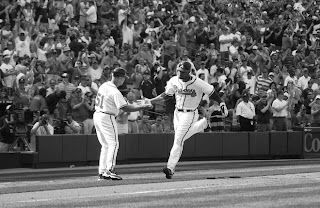
This spring, the front office of the Atlanta Braves decided that über-rookie Jason Heyward was so good, they couldn't afford to stall his arbitration clock by keeping him in the minors to begin the season. They may have sacrificed a year of team control and millions of dollars in the process because of it, but the phenom broke camp with the Big League club.

Yesterday afternoon in Atlanta, Heyward stepped in the box against the Cubs' Carlos Zambrano for his first Major League plate appearance. With his parents in the stands and the crowd chanting his name in between pitches, the level of excitement in Turner Field was tangible. The game was being broadcast on ESPN2, so plenty of eyes around the baseball world were focused in on the at bat.

Heyward took two 4-seam fastballs high for balls before connecting with a two-seamer low in the zone. The ball exploded off the bat and carried deep into the Braves bullpen in right field, good for a three run homer that put the Braves up 6-3. There was little doubt throughout the baseball community that Heyward was going to be a useful player right out of the gate, but as it so rarely does, the hype was justified immediately. It's not to say that this guarantees Heyward is going to have a great career, but that the fans in Atlanta didn't need to wait to see a glimpse of his considerable potential. Sometimes suspense is thrilling, but in this case it was the lack thereof that created the drama.

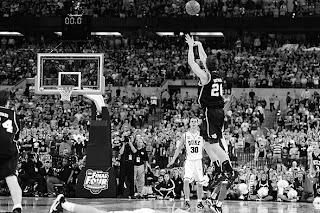
About 8 hours after Heyward's fairytale beginning, the best player on the Butler Bulldogs, Gordon Hayward, looked to complete a storybook ending to what was already a fantastic National Championship in his hometown of Indianapolis. It was one of just four times that the title game had taken place in the city that one of the schools called home and improbably, Bulter was keeping pace with Duke.

Hayward had struggled throughout the night, shooting just 2-9 from the floor in front of a very vocal and supportive crowd, but the Bulldogs hung in there. The game was neck and neck for the entire 40 minutes; the difference between the two teams never greater than 6 points. Since the battle was so tight, the end of it wasn't broken up by copious amounts of timeouts taken and fouls committed by a team trying to fight its way back into it.

With 13 seconds left on the clock in and Butler trailing by one point, Hayward started at the top of the key and began driving towards the basket, dribbling to the right. With about 6 ticks remaining, he planted his feet and pushed off parallel to the baseline, and lifted a high, soft 12 foot fadeaway. It wasn't a high percentage shot, but Hayward make a crisp release. As it began to descend from its apex, the ball was still perfectly on line with the hoop. However, it struck the inside of the back of the rim and ricocheted directly back towards the spot that Hayward took off from.

If the ball had carried just an inch less, Duke would have been down one with about five seconds to go. Instead, Duke's center Brian Zoubek pulled down the rebound and was fouled immediately, sending him to the free throw line with 3.6 seconds left. He made the first and after intentionally missing the second, the ball fell into Hayward's hands once again. The baby-faced sophomore only had time for a few dribbles and released the ball from half court just as the clock was expiring. It hit the backboard, deflected off the near side of the rim and fell to the ground as Duke became the National Champions.

Hayward came impossibly close, twice, to winning the game for a school that only shameless homer and alumni would have picked to be in the Final Four, let alone the Championship Game. The difference between those two shots going in or bouncing out is so small that no human being, no matter how skilled, could expect to control it. Concerning the last shot in particular, the disparity between hitting one of the greatest buzzer-beaters on the biggest stage possible in college basketball and going home empty-handed was the way that his neurons and synapses subconsciously fired over the course over several milliseconds.

Right or wrong, that's what we remember. We distill sports down to their most incredible moments, but don't often bother to think about the alternate outcomes and how close - literally fractions of an inch and hundredths of a second - they came to occurring.

Gordon Hayward is just a sophomore at Butler, so if he chooses, this doesn't have to be the end of his college career. But the odds against him leading a team that far into the NCAA Tournament let alone coming just thatclose to winning it are so long that they might as well not exist. Jason Heyward is likely just at the beginning of a long and successful career, but 5, 10, 20, 50 years from now, both of these athletes are going to be able to recall those two remarkable moments in incredible detail. Only one of them is going to bother to wonder what might have happened if it had turned out another way.

Monday, April 5, 2010

NCAA Championship Post

No Yankees tonight, but we have Butler-Duke for the NCAA Championship in what's likely to be the final 65 team tournament. Who ya got?

Fack Youk is pulling for:


We in no way, shape, or form endorse Duke, but in the interests of equal time and because he was an absolute genius, we'll leave you with this for the night:


Enjoy the game Fackers. After this one is over there's one fewer sport to draw attention away from baseball.

Game 1 Recap

[WPA data via FanGraphs]
[The chart above is based on WPA or Win Percentage Added. You can find a thorough explanation of it right here, but very quickly, it measures the general chance a team has of winning given the situation (score, inning, outs, baserunners). WPA tells the story of a game in a quick glance very efficiently. Above, you can tell that the Yanks were in control of the game from the outset but lost control of it late. (The numbers I've added correspond to points below)

You can find more interactive and complete versions of these charts and the data at FanGraphs and Baseball-Reference, but I though it might be nice to post a prettier-looking version here. As always, feedback is welcome in the comments.]

1. Jorge Posada and Curtis Granderson hit back to back homers off of Josh Beckett in the second inning to put the Yankees up 2-0. Posada's was just a cheapie off the Pesky Pole but Granderson launched over the Red Sox bullpen in right-center field. Nick Swisher and Brett Gardner added consecutive singles to give the Yanks four hits in a row, but the only runs they scored came on the solo homers.

2. The Yanks strung together a rally in the fourth that began with a double by Robinson Cano but it wasn't until there were two out that the they cashed in that run. Nick Swisher worked a walk. Brett Gardner and Derek Jeter followed that with consecutive singles, driving in two runs and leaving runners on the corners with Nick Johnson at the plate. Johnson fell in an 0-2 hole and Jeter took off for second. Foolishly, Victor Martinez tried to catch Jeter stealing but didn't, and allowed Gardner to swipe home in the process.

3. When Josh Beckett left the game with two outs in the top of the 5th inning, it appeared that he had been handily outpitched by CC Sabathia. Beckett had surrendered 5 runs and left runners on first and second base. Scott Schoeneweis escaped the inning without further damage but the Sox were down 5-1.

4. With a 5-2 lead, Sabathia began the sixth inning with a walk to Dustin Pedroia. Victor Martinez then doubled, setting the table for the Fackin' Youkstah. Youk sliced a ball down the right field line that Nick Swisher should have probably held to a double, but a poor line to the ball turned it into a three-bagger, equaling the number of triples Youkilis' had all of last season. Adrian Beltre singled home Youk two batters later to tie the game at 5.

5. The Yankees wasted little time in striking back. Like the Sox in the previous half inning, Mark Teixeira led off with a walk and Alex Rodriguez followed that with a double. Robinson Cano drove in Teix on a ground out and Jorge Posada followed that with a single, putting the Yanks up 7-5.

6. Their lead, however, would be short-lived. Chan Ho Park was called upon in the bottom of the 7th and gave up a single to Marco Scutaro then a two run homer to Dustin Pedroia. With the game now tied at 7, Park retired Victor Martinez but gave up a double to Youkilis. Joe Girardi called on Damaso Marte to face David Ortiz and he responded with a wild pitch that allowed Youk to advance to third. He and Jorge Posada got crossed up two pitches later and a catchable fastball rolled towards the backstop, allowing Youk to score and the Sox to take the lead.

7. Joe Girardi called on Joba Chamberlain to keep the game within 1 in the bottom of the 8th. Joba gave up a single to Cameron, a walk to Scutaro and an RBI single to Pedrioa to give the Sox an extra insurance run. He needed 29 pitches to record those three outs.

8. The Yanks brought the tying run to the plate in the 9th inning after Jorge Posada singled with two outs to keep their hopes alive. That allowed Curtis Granderson a shot at extending the game, but he grounded out to third. Granderson tasted both the highs and lows of the rivalry last night, hitting a homer in his first AB as a Yankee and making the last out of the game.

=====

Other thoughts:
  • Marco Scutaro lined out into a double play during the third inning but it appeard that Mike Cameron was safe diving back to first base.

  • Sabathia was in good shape heading into the sixth inning but seemed to lose the strikezone when he came back out to the mound, walking Pedroia on 5 pitches, falling behind Martinez 2-1 and Youkilis 3-0.

  • The home run that Dustin Pedroia hit off of Chan Ho Park probably wouldn't have gotten out of Yankee Stadium, but the double that A-Rod hit in the previous half inning almost certainly would have.

  • Curtis Granderson looked helpless against the first lefty he faced (Schoenewies) but worked a walk against the second (Okijima).

  • Posada had a good night at the plate, but the passed ball that allowed Youkilis to score the go-ahead run was his fault, even if Marte crossed him up.

  • The game lasted 3:46 and really started dragging towards the middle of it. Sure, 16 runs were scored but the pace was far from crisp.

Sunday, April 4, 2010

Game 1: Revival

Baseball starts tonight. We celebrate the milestones that line the path to this point like pitchers and catchers reporting and follow along with the "competitions" and roster cuts during Spring Training, but that stuff is only enjoyable because of what it all leads up to. This.

It's been five cold, dark and lonely months since Robinson Cano fielded a routine grounder from Shane Victorino, flipped it to Mark Teixeira at first base and converted the final out of the 2009 World Series. While 151 days is a pretty long time, we Yankee fans have relatively little to complain about; this was a very short offseason in the grand scheme of things, particularly when compared to the break between 2008 and 2009.

The Yanks were pretty much dead to rights with a month left in the '08 season, floated lifelessly through September and cleared out their lockers by the time the postseason had begun. The organization moved swiftly and compensated by snatching up three major free agents in CC Sabathia, A.J. Burnett and Mark Teixeria. However, the ensuing winter was tainted by excerpts from Joe Torre's book, backlash surrounding the opening of the New Yankee Stadium and most of all, A-Rod's steroid use and hip surgery.

By now, most fans have forgotten what was contained in The Yankee Years and accepted the New Stadium for what it is. A-Rod recovered in time to contribute significantly during the regular season and damn near carry the team through the playoffs. The three newest Yankees have already captured their first World Series ring.

Coming off a 103 win season and a World Championship, this winter was significantly less maddening for supporters of the Bronx Bombers. The franchise said goodbye to two solid veterans who played crucial roles in the Fall Classic (Johnny Damon and Hideki Matsui), along with their best homegrown pitcher in the past decade (Chien-Ming Wang). But they made some significant additions as well. The Yanks welcomed back Nick Johnson, Javier Vazquez and Marcus Thames while bringing in newcomers Curtis Granderson and Chan Ho Park.

As we discussed with Patrick Sullivan on Thursday, the Red Sox were equally active this offseason. They signed John Lackey to a five year contract while picking up Adrian Beltre, Mike Cameron and Marco Scutaro on shorter deals, all with the primary benefit of run prevention. To that end, both teams shifted their young center fielders to left in favor of a newly acquired veteran, ensuring that it's going to be much more difficult to find the gap in left-center against either of these teams this season.

The first test of the new defenses will come tonight in the cozy quarters of Fenway Park. Amidst the rumors of an impending contract extension, Josh Beckett will take the mound for the Red Sox. The Sox' ace-in-name-only had a solid 2009, tallying up an 3.86 ERA over 212 IP with an even lower FIP of 3.63. He will look to build upon that campaign along with his strong effort in his final Spring Training start in which he struck out 8 Rays in six innings.

Unlike Beckett, whose numbers in April are align closely with his career averages, CC Sabathia is a notoriously slow starter; his ERA in April is almost a full run higher than it is in total (4.54 to 3.62). However, did you know that his ERA in July is ever higher (4.61)? Does that make him a slow "middler" or somesuch? No, in all likelihood, it means that Sabathia has stacked up some poor starts in those months that skew his overall numbers. And as they say in those commercials for ambulance-chasing law firms, "prior results don't guarantee similar future outcomes".

As Matt noted earlier, there's a beautiful symmetry in that the baseball season is beginning anew on Easter. Both events celebrate a joyous return. Each carries its own connotations of a new beginning.

From here on out, slowly but surely, the season will work its way into the record books, pitch by pitch and swing by swing. Hundreds upon hundreds of hours of entertainment; of ups and downs; of great plays and miscues; of pinch hits and pitching changes; of triumph and defeat are on the horizon. But we don't need to concern ourselves with that just yet. Tonight is a night to appreciate what's in store without having to worry about how it's going to turn out.

Baseball is back, Fackers.


People can you feel it? Love is everywhere.
People can you hear it? Love is in the air.
We're in a revolution, don't you know we're right.
Everyone is singing, there'll be no one to fight.
People can you feel it? Love is everywhere.

Lineups:

Derek Jeter SS
Nick Johnson DH
Mark Teixeira 1B
Alex Rodriguez 3B
Robinson Cano 2B
Jorge Posada C
Curtis Granderson CF
Nick Swisher RF
Brett Gardner LF
Red Sox
Jacoby Ellsbury LF
Dustin Pedroia 2B
Victor Martinez C
Kevin Youkilis 1B
David Ortiz DH
Adrian Beltre 3B
J.D. Drew RF
Mike Cameron CF
Marco Scutaro SS

*Feel free to leave some thoughts in the comments during the game and perhaps we can get a good conversation going.

Buona Pasqua

Good morning Fackers! Happy Opening Day and Happy Easter. Or, as Francisco Cervelli and the other all-time, all-Italian Yankees might say, "Buona Pasqua".

To the right, we see Dan Pasqua, a Yonkers born, north Jersey bred, homegrown outfielder for the Yankees during the 1985, '86, and'87 seasons. Despite the unorthodox batting stance displayed here, Pasqua had some pop, knocking 42 homers in 746 career AB with the Yanks, and posting an impressive 0.210 IsoP during his time in the Bronx. Following the '87 season Pasqua was shipped off to the White Sox for pitcher Rich Dotson, who went on to have a disastrous year plus stint in pinstripes. Pasqua spent the remaining seven years of his career on the south side of Chicago, leading the '88 ChiSox with 20 home runs. As a measure of revenge against his hometown team, Pasqua absolutely torched the Yankees for the remainder of his career, hitting .349/.430/.620 against them in 149 PA.

=====

I've been borderline giddy for about the past twenty four hours. The spring weather has been outstanding over the past several days. I've been able to catch up on sleep from my lost weekend in Montreal. I had been looking forward to yesterday's Future Stars game since the outset of Spring Training. And I've been looking forward to tonight's game since the last piece of ticker tape fell five months ago.

I'm also happy because it's Easter. It's the biggest holiday of the year for Christians around the world (including the Greek Orthodox this year, as they often have it fall on a different date) and I'll be observing and celebrating the holiday accordingly.

I suppose that, without getting blasphemous or dragging the blog into a religion conversation, I find it appropriate that this year Easter - the biggest holiday for my religion - and Opening Day - the biggest day of the year for my secular religion - fall on the same date. Both days offer hope and anticipation of what's to come. Both are rites of spring that I look forward to each year. Both are preceded by long stretches of preparation. In fact, Ash Wednesday, the official start of Lent, fell on February 17th this year - the same day pitchers and catchers reported to Steinbrenner Field.

Or maybe I'm just waxing poetic. If I am, forgive me. I'm just excited to eat, drink, be merry, and watch Opening Night.

=====

Dan Pasqua spent the final full minor league season of his career, 1984, with the Yankees' AA affiliate in Nashville, TN and led the Southern League with 33 HR. So, in recognition of his last name, his time in Nashville, and today being Easter, here's the Yonder Mountain String Band with "East Nashville Easter":

Saturday, April 3, 2010

Saturday News, Notes, & Links

Tomorrow may be Easter, but I'm feeling like a kid on Christmas Eve knowing that Opening Day is just one sleep away. Here are some news, notes, and links on the one year anniversary of the first game ever played at the new Yankee Stadium. I had great seats for that game, my father, brothers and I were in the second row on the field level, directly behind the left field foul pole. Cody Ransom rang a dinger off that pole later in the game; sadly that was the high water mark of his 2009 season. Still, I'll never forget walking onto the concourse and getting my first glimpse of the new Stadium.

  • As we mentioned earlier, the Yankees have essentially finalized their roster, and it's no different than what we thought a week and a half ago. Marcus Thames was officially added the 40 man roster this morning, and Boone Logan was optioned to AAA. All the players who have been nursing injuries: Posada, Cervelli, Aceves, Marte, and Johnson, should be ready to go tomorrow night.

  • Also, as we mentioned earlier, the Yankees signed Chad Moeller to a minor league deal. Moeller lost out on the back up job in Baltimore and asked for his release rather than go to the minors. He's not as good offensively as Mike Rivera, but he has the reputation of a solid defender. He should be a good mentor to Jesus Montero. I'm hopeful that Moeller's contract does not include the opt out clause that many veteran players get on minor league deals. I think it's important the club have a good mentor for Montero all year, as well as a viable emergency option should Posada or Cervelli get injured.

  • The Yankees added another player to the Scranton roster today, when they acquired Robby Hammock. Chad Jennings reported it as a free agent signing, but The Times Pat Borzi says Hammock was acquired via a trade with Colorado for a player to be named later. Hammock has 180 games of Major League experience over five seasons, but none since 2008. He's capable of playing behind the plate and at the infield and outfield corners. He's reportedly ticketed for Scranton, where Jorge Vazquez will start the season on the DL.

  • With the addition of Hammock, Scranton's roster is jam packed with guys who should be playing nearly everyday. Juan Miranda will be the first baseman, but Vazquez will see some time there as well. Kevin Russo, Reegie Corona, and Eduardo Nunez will make up the remainder of the infield, and they should be rotating through the positions to increase their versatility as utility options. But Vazquez and Hammock will also presumably see time at third. In the outfield, Colin Curtis, Jon Weber, Greg Golson, Reid Gorecki, and David Winfree all figure to be on the roster, and Russo may also see time in the corners. Monetro and Moeller will be the catchers, and P.J. Pilittere may also see time behind the plate.

  • The Yankees have officially lost both their Rule Five picks. Kanekoa Texeira used an impressive spring to win a spot in the Mariners' bullpen. The Diamondbacks waived lefty Zach Kroenke, but he went unclaimed and accepted an assignment to AAA in exchange for keeping his spot on the 40 man roster. By right, the Yankees could have brought him back for $25K once he cleared waivers, but as a two time Rule 5 pick Kroenke had the right to declare free agency if that happened. By going unclaimed on waivers and keeping a 40 man spot with the Dbacks, he likely got the best possible deal for himself.

  • For the second time this spring, things got a little heated between the Yankees and Orioles yesterday. As Marc Carig points out, these two clubs have built up a bit of a history over the last year, from Aubrey Huff's fist pumps to A.J. Burnett gesticulating in the general direction of Felix Pie. The Girardi Yankees haven't been shy about coming inside over the past two seasons; this will be something to watch as 2010 unfolds.

  • Jack Curry of the YES Network has a story on Andy Pettitte in which Pettitte drops some more retirement hits. Nothing to see here folks. Firstly, Pettitte says nothing definitive. Secondly, this is no different than anything Pettitte has said each of the last four off-seasons as he's done the Brett Favre dance. Thirdly, there's no reason to believe that it won't continue. The guy can still pitch, and if he didn't want to go out on top after winning each of the three clinching games in the 2009 post-season, there's no reason to believe that this year is any more likely to be his last than 2009 or 2008 or 2007 was. Let's wait until a few pitches are thrown first.

  • Finally, Fangraphs has completed their organizational rankings series, with the Yankees taking the top prize. Here's Fangraphs' look at both the current talent and future talent.

That's it for today Fackers. We'll be back in the morning with all sorts of Opening Day goodness.

Prospect Game: The Kids Are Alright

Well here we are Fackers. It's the final day of Spring Training and we're just one day away from real baseball. Much like the Yankees' starting rotation, Jay and I have limited our innings this spring, trying to preserve some energy after a long 2009 season. But we're in the best writing shape of our lives and are working on some new pitches.

So before we kick things off for real tomorrow night, I suppose we should get in some training of our own with one of signature our game previews. We haven't done one all spring, but today's Spring Training finale offers a good opportunity.

The Yankee regulars will take on a team of the organization's top prospects at 1 PM on YES. Javier Vazquez will get the nod for the regulars. It'll be interesting to see if the mentally weak Vazquez can handle the immense pressure of facing the best minor leaguers the organization has to offer.

According to Chad Jennings, Marcus Thames has officially made the roster, bringing the Yankees' 40 man roster to 39. The final bullpen spot is the only thing up for grabs. Boone Logan is still in camp, and his making the team likely depends on the health of Damaso Marte, and to a lesser extent, Alfredo Aceves. Jorge Posada is in the line up today after missing the last two days with a stiff neck. Catchers Mike Rivera and P.J. Pilittere are still in camp, in case the bumps and bruises of Posada and Francisco Cervelli require a third catcher for the opening series. However, Jennings is also reporting that the Yankees have signed the recently released Chad Moeller, who spent much of the 2008 season with the club, to a minor league contract and that Rivera will be released. As expected, Nick Johnson is not playing today after suffering a bone bruise yesterday. Nick Swisher will DH; Randy Winn will play right, and the rest of the regulars are in the starting line up.

For the Prospects, Jonathan Albaladejo inexplicably gets the start. I guess Manny Banuelos, Jeremy Bleich, Zach McAllister, et. al. had other plans. Albie goes from making the Opening Day roster both of the last two years to starting for the Prospect team this year. Tough break. The Prospects' starting line up features last year's first round pick Slade Heathcott, Corban Joseph, Jesus Montero, David Adams, last year's second round pick JR Murphy as the DH, Colin Curtis, Bradley Suttle, Eduardo Nunez, and Melky Mesa. I'm sure we'll see others, including Austin Romine, as the game progresses.

In light of the recent injuries and the long, boring grind of the spring, these guys are more than ready to get away from Tampa. The prospects will stay behind a few days longer until the minor league season starts. Let's just hope everyone finishes today without any further bumps and bruises.

So as we get a chance to see the kids of the organization today, we'll turn to footage of some of rock and roll's foremost geezers, back when they were just young whippersnappers. In light of the embarrassing Super Bowl halftime show two months ago, I suppose it's nice to have reminder that back when Keith Moon and The Ox were still around, The Who weren't a total joke.


Sometimes, I feel I gotta get away
Bells chime, I know I gotta get away

And I know if I don't, I'll go out of my mind

Better leave her behind with the kids, they're alright

The kids are alright

Chasing The Dragon: Baseball's Quest To Conquer China

When the Yankees face the Red Sox tomorrow night, the largest viewing audience might not be in the United States:
For the first time, Major League Baseball's season opener will be televised live in China, broadcast by five outlets reaching nearly 300 million viewers, MLB announced Friday. The All-Star Game, postseason games and "This Week in Baseball" also will be broadcast in China this year as part of baseball's partnerships with 90 international broadcasters.
It's hard to tell how many of those 300 million Chinese residents who have the option of watching the first game of the regular season will actually tune into the broadcast. After all, it will be about 8:15 on Monday morning in Shanghai and Beijing when the first pitch is thrown.

Aside from American ex-pats, there are few MLB fans in China, especially in comparison to the population of over 1.3 billion. While around 16% of Chinese residents surveyed say they are interested in baseball, fewer than one percent of identify themselves as "loyal fans". Furthermore, that survey likely overestimates the interest due to sampling error. It's impossible to project the results of that study onto the entire population considering that there are hundreds of millions of Chinese that lack access to phone and close to a billion without internet connections and therefore couldn't be reached by conventional survey means.

However, where some might see a country that doesn't care much about baseball, Major League Baseball sees a tremendous opportunity.

After witnessing basketball achieve true global success - now with established professional leagues on all six inhabited continents - the MLB has become increasingly tantalized by the international market. While the sporting landscape in the United States is becoming more saturated by the day, baseball envisions adding new fans by popularizing the game overseas. China, with its massive population, appears to be the largest and potentially most profitable untapped resource for the expansion of the game.

Xie Long, the managing director of MLB China explained, "I believe the sport of baseball has tremendous potential in China. What MLB wants is to agitate this big market and get more people playing baseball in China".

The World Baseball Classic was established with the goal of expanding the game abroad in mind. While the title of the tournament is ultimately decided between countries with established baseball traditions like the U.S., Japan, the Dominican Republic, Venezuela and South Korea, encouraging nations like the Netherlands, South Africa and especially China to field teams demonstrates that there are other motives at work. By tapping into national pride via international competition, baseball believes it can generate interest in the sport on a level that extends beyond a tournament that only happens once every three years.

As the largest and most widely recognized name in baseball and in all of American sports, the Yankees have been leading the charge throughout China. They have some goals that are separate from the MLB's (selling Yankee-branded merchandise, etc) but the ultimate aim is the same - to generate interest in the sport worldwide.

Back in early February, executives representing the team embarked on a week-long trip - with their newest World Series trophy in tow - throughout Asia. They stopped in Hong Kong, Beijing and Tokyo, shaking hands, posing for pictures and participating in events and ceremonies. Brian Cashman and Randy Levine were at the front of the pack, glad-handing their way through China and Japan, giving out free Yankees shirts and caps.

Due to the presence of Hideki Matsui on their roster over the past seven years and the ubiquity of baseball in Japan, Tokyo was an obvious stop. The presence on the Chinese capital (Beijing) and its financial center (Hong Kong) on the itinerary were less self-explanatory.

=====

Baseball has been played in China for almost 150 years, beginning when an American medical missionary and native New Yorker named Henry William Boone started spreading the game there with a missionary zeal in the early 1860's. However, today, like it did then, baseball exists only fringe of the Chinese sporting landscape, far behind pursuits like basketball, badminton and table tennis.

In the first years of its introduction to China, baseball quickly began to develop a foothold. The Shanghai Baseball Club was created shortly after Boone first began teaching the game and served as a posh social establishment for the next forty or so years. Around the same time, students in the Chinese Educational Mission began traveling to the United States and returned to their home country with a fondness for what, at that point, was a quirky and decidedly American game.

By the mid-1890's three western-oriented colleges in China had organized baseball teams. But it wasn't until 1905 that a game was staged between two all-Chinese squads on the mainland. After the Russo-Japanese War, which ended that same year, many Chinese students flooded into Japan, where inter-collegiate baseball had become Nippon's preeminent national sport.

While baseball was still far from common in China, it began to attain some historical and political significance in the 1910's. Sun Yat-sen, who learned the game during the spent time in Hawaii as a teenager, was said to have used baseball as a way to train soldiers to throw hand grenades in Changsha, the notoriously unstable capital of the Hunan Province. Years later, soldiers in the People's Liberation Army would embrace the game to such an extent that it would be commonly referred to as "junqiu" or "army ball".

Despite the country's early introduction to baseball, its popularity among students returning from abroad and the game's intertwinement with military history, baseball never achieved the popularity it did in Japan, Korea, Taiwan or even the Philippines. A legitimate professional league was never established, much less embraced.

Eventually, during the reign of Mao Zedong, baseball all but disappeared from China's sporting landscape. Some historians claim that the sport was explicitly banned because it was perceived as a symbol of "Western decadence", but whether or not that was the case, the spread of the game was squelched by Mao's ethnocentric Cultural Revolution.

After Chairman Mao's death in 1979, baseball slowly began to reemerge. Coaches from the U.S. were sent on goodwill missions. The game was used as a vehicle of diplomacy between China and Japan. Youth leagues began to sprout up. This time though, the Chinese took their cues from Japanese style of play instead of the American one.

Major League Baseball's involvement in China didn't begin in earnest until Dodgers' president Peter O'Malley made a visit to the Tianjin Physical and Cultural Center Institute in 1986 and paid for a baseball field to be constructed there. Ever since, the MLB has been making inroads into China, ranging from the grand gestures like the ones made by O'Malley - and more recently by the Yankees - to grassroots efforts to introduce the game to the school systems and establishing youth baseball academies and development centers.


The Yankees, like many of the larger MLB franchises, are particularly tantalized by the untapped resources of talent China may hold. Discovering a player with superstar talent could accelerate the spread of the came throughout the country in ways no contrived ceremonies, press tours, or even youth academies could hope. An article from The Economist explains:
Somewhere in China, reasons Mr Cashman, there is a kid who can throw a baseball at 98mph (158kph). Find him, turn him into a star and he will awaken a nation of fans. He points to the spectacular commercial success of America’s National Basketball Association (NBA) in China after the recruitment of the seven-and-a-half-foot Yao Ming, from Shanghai, to the Houston Rockets, whose jerseys are a ubiquitous presence on the backs of Chinese children.
Just based on sheer probability, there has to be a Yao Ming of baseball in China, somewhere, right? Maybe he's working in a rice paddy or toiling away in a factory, oblivious to the talents he possesses. Perhaps he's fishing somewhere on the Yangtze River or working in a marketplace in Shanghai. With such a massive number of capable and athletic men calling the the Peoples' Republic home, there has to be a few who would be good at baseball if given the chance, doesn't there?

Unfortunately, it's not that simple.

=====

Basketball has been alive and well in China for over 100 years. James Naismith created the game at a YMCA in Springfield, Massachusetts in 1891 and within four years it had traveled across the Y's worldwide network all the way to China. Basketball has been a part of Chinese culture almost as long as baseball has been played in Japan.

Baseball was introduced in Japan in 1872 and it took another 92 years for the first Japanese player, Masanori Murikami, to reach the Major Leagues. To be sure, there were a host of technological and cultural factors that hindered that initial introduction like arduous and expensive travel and rampant xenophobia that won't prevent the first Chinese player from making that trip. However, the notion that any country harbors Major League talent based on sheer probability is slowly being eroded.

Yao Ming wasn't just discovered by chance. His parents were both professional basketball players and in addition to being freakishly tall and athletic, Yao devoted countless hours to perfecting his craft during his teenage years. He started playing professionally at age 17, and was pressured to enter the NBA draft at 19 but held out until he was 22. When he finally declared his eligibility, he was surrounded by a team of advisors who carefully controlled every aspect of his professional life. Although he was bestowed a great set of genes, Yao wasn't born a great basketball player.

To an even greater extent, great baseball players are made, not born. Yao's 7' 6" frame gives him a physical advantage that doesn't have an analog in baseball. His height allows his easy access to the hoop whereas there are no distinguishing bodily features that guarantee an advantage in baseball. A perfect physiology isn't as important as an ideal throwing motion or batting swing and those have to be honed over time with the assistance of knowledgeable coaches.

In addition to its considerable history in the country, basketball has a lower learning curve than baseball. It requires less - and less expensive - equipment and can be played in a smaller area either indoors or out. In terms of rules and fundamentals, it's far simpler than baseball too.

As Chris Jaffe demonstrated in his book Evaluating Baseball's Managers, widespread knowledge of what are now considered to be the fundamentals of baseball are slow to form. Jaffe explains:
Fundamentals first have to be developed. Then they diffuse. Next, their instruction becomes institutionalized. Once the lessons become second nature to one generation, the next wave can be fully and immediately immersed in them.
It took baseball decades to establish the baseline of common knowledge of the game that we now take for granted. Kids in China don't grow up watching baseball games. They don't play stickball in the streets. They mostly choose between basketball, badminton and table tennis. There is no sport with significant popularity similar to baseball like cricket in India. There isn't even one that requires a hard throwing motion which could be roughly translated to pitching.

=====

Two years ago, a California sports management company created a reality show called The Million Dollar Arm to try to coax pitching talent out of India, offering a prize of $100,000 and the chance to compete for a $1M contract to the winner. Eventually, out of 37,000 entrants, two were chosen. Danesh Patel threw 90 mph during his tryout and won the top prize. Rinku Singh clocked in at 84 and was given $2,500 along with the chance to play in the minor leagues. Their management company held a tryout attended by 30 Major League scouts. Singh and Patel were signed by the Pirates for $10,000 apiece.

They were eventually assigned to the Pirates Rookie Ball team in Bradenton, Florida where they recorded a buoyant account of their journeys in broken English on a blog that carried the same name as the contest. Combined, Patel and Singh each recorded a win but only pitched a total of 18 2/3 innings in their first season. They returned to India last fall and are back in minor league Spring Training now.

Although the Million Dollar Arm contest only staged tryouts in 12 cities, it sampled a wide swath of talent in India, a country which has a fondness for cricket - baseball's closest sporting relative. If the best a nationwide search in India with a (potential) million dollar prize could produce were two low level minor leaguers without much chance of making the Big Leagues, much less becoming a star in them, is it realistic to expect China to do much better?

=====

Spreading a sport to a new country, especially a game as complex, equipment heavy and open-space-dependent as baseball to a nation as impoverished and overcrowded as China, is a tough road to hoe. It's going to require the same missionary enthusiasm employed by Henry William Boone when the game was first introduced to the residents of Shanghai back in the 1860's, along with money. Lots and lots of money.

As baseball officials discovered in their quest to provide funding to a youth program in Cambodia, it requires not only a significant amount of cappital but close and careful oversight of the way those funds are allocated. Where money is being given away, there will always be those who are willing to take it but don't have the ultimate goal in mind.

Even if the programs are successful, will they end up like youth soccer in America where the participation rates are high but yield relatively few fans of the highest levels of the game? Right now the MLB claims that over four million people in China play baseball, but before this most recent initiative, MLB games were hardly televised at all.

The MLB has to consider its efforts in China as a long term investment and one that might not pay dividends for decades, if ever. However, Jim Small, vice president of MLB Asia thinks it could happen faster than that:
We plan on taking advantage of the dynamic climate that is taking place in China right now. With so many things changing so quickly, with information much more accessible through the internet and through other means, it is possible to make changes much quicker now than 10 years ago.
Will those in the People's Republic be watching when the Yankees and Red Sox meet in Fenway on Sunday night? Will they remember to watch the All-Star game when it rolls around three and a half months from now and the postseason 11 weeks after that?

When it comes to expanding the interest in the game of baseball worldwide, China represents the largest potential gain. But that doesn't mean that it's the best bet. It doesn't even necessarily mean that it's a risk worth taking. However the MLB, like any corporation, is set up with the implicit goal of infinite growth and profits. When viewed through that lens, China appears to be a gamble baseball has to take.

Friday, April 2, 2010

Prediction Round Up

There isn't a whole lot of variety in these, but I wanted to consolidate the predictions that we asked everyone to make at the end of the AL East interviews we did this week.

Here are the interviews with our fantastic guests:
And everyone's predictions in graphical from, including Matt's and mine:

There you have it folks. According to our panel of experts, there is a 100% chance that the Yankees win the AL East this season!

Actually, that's not what it means at all. You can't divine overall probabilities based on individual predictions (in this scenario at least). For instance, let's say that we are going to flip a coin that has a 60% chance of coming up heads and a 40% chance of landing on tails. Which one are you going to pick? Well everyone that's not a moron is going to pick heads. As a result, you'd end up with something like 95% of people choosing heads with the remainder of the superstitious dummies telling themselves that "tails never fails". And that doesn't reflect the actual probability of the event. It's the kind of thing that happens when you have some rational people looking at similar data.

Realistically, what this means is that the Yanks are in the neighborhood of 50-45-40%, the Sox are 35-30-25% and the Rays are 30-25-20%. Or something? I don't know but the midpoints sum to 100 and that sounds about right. Take it from me, I predicted the correct order that the AL East would finish in last year and had every team's total within 5 wins. (What's that you say? I also had the Mets playing the Cubs in the NLCS? Nevermind that.)

Anyway, that's it for today. We'll have some good stuff running over the weekend, so in the unlikely event that you need a break from the awesome weather that is forecasted for the northeast, we'll be there for you.


AL East Q&A: Drunk Jays Fans

And now it's time for the final installment of our quest to survey the landscape of the AL East. After this, we can all stick our heads back up our asses and go back to only caring about the Yankees and the team they are playing at the time.

In some ways I think we've saved the best for last. Drunk Jays Fans has been providing the kind of vulgarity and analysis that we at Fack Youk strive for since the very beginning of 2007 - back when this blog was just a couple of pixels in a server in White Plains. Andrew Stoeten and Dustin Parkes might be drunk, but they are kindly drunks. One of the signature offerings on their site are the helpful guides which explain things like how to delude yourself into believing your team will still make the playoffs and how to sneak down into good seats at the Rogers Centre. They also do a post each year breaking down the most prominent Blue Jays-related blogs on the interwebs which is well worth the read. Now they well help us make sense of where the Toronto Blue Jays are at heading into the 2010 season:

FY: For the first time since 2002, the Jays' Opening Day starter will not be Roy Halladay. How are you dealing with the loss? Are you satisfied with the package that the team got in exchange for Doc? Could Kyle Drabek help the Big League club this year?

Dustin Parkes: Jays fans have had so little to cheer for outside of every fifth day when Roy Halladay would start otherwise meaningless games that removing him from the team is like cutting off the index fingers of a thumbless man. It hurts for now, but if there's hope that the procedure somehow leads to having Antonio Alfonseca hands in the future, the pain becomes berable.

While no one is going to replace Halladay to Toronto's fan base, as far as the package that the Jays got in return, Brett Wallace can definitely fill out a pair of trousers. And Kyle Drabek and Travis d'Arnaud aren't too shabby either.

I recently saw one of those Jim Bowden videos on FOXsports.com where he interviews baseball executives on a webcam (because he just like totally gets social media and internetty things). In the episode that I saw, Bowden spoke with all of the GMs involved in the Halladay deal, and while Alex Anthopoulos doesn't come right out and say it, it's fairly clear that he got the best deal he possibly could have.

Considering that Roy Halladay in his prime couldn't help the Blue Jays out of their mediocrity, it's doubtful that Drabek, Wallace or d'Arnaud will supply anything close to an immediate impact. However, if Toronto's playoff drought has been good for anything, it's been in developing patience and all Jays fans have right now is the hope that things will improve, and this threesome makes that hope more realistic than it's ever been.


FY: Thirty-two year old Bronx native Randy Ruiz was excellent at the plate for Toronto over 130 plate appearances last year, smacking 10 home runs (3 against the Yanks) and accumulating a line of .313/.385/.635. How does he fit into the picture this year? Will he finally see significant playing time in the Majors after 10+ years spent almost exclusively as a farmhand?

Andrew Stoeten: He doesn't really fit into the picture, and it's unfortunate, but there just isn't a realistic place to put him-- especially with a manager like Cito, who would love nothing more than to fill out the exact same lineup card every day of the season. (Ugh). Most fans, I think, would love to see the Jays give Ruiz a genuine shot, but not if it means watching Adam Lind butcher balls out in left field all year, or anybody other than Lyle Overbay attempting to corral all the throws Edwin Encarnacion is going to try to launch into the first row.

It's funny, because this year's Jays are exactly the kind of team that should be giving a guy like Ruiz a chance to show he's not just a AAAA player, but barring injury I really don't see it happening. Even if Overbay is eventually moved, it will open the door more for Wallace than Ruiz.

Perhaps if he makes good use of the few at bats he's given something will change, but as far as it seems now, as usual, it's a longshot.


FY: The Jays signed Cuban prospect Adeiny Hechevarria to a $10M deal in March and rumor has it that he passed on a larger offer from the Yankees. How do you feel about the acquisition and how high in the farm system is he going to start the season?

Stoeten: There's really nothing not to like about the deal. Ownership and the new GM have said repeatedly that, while they're not going to spend money just to spend it, they've still got capital, and they're open to anything that they believe will help the club in the long run. Not only does the Hechevarria deal add the kind of potential asset that, as Alex Anthopoulos likes to say, doesn't often become available, it also shows ownership's willingness to put their money where their mouth is.

Most expect him to start at New Hampshire in Double-A, which sounds reasonable-enough to me.


FY: Aaron Hill broke out with 36 homers (more than twice his highest previous total) and a .357 wOBA last year (also a personal best), but his OBP (.330) was slightly lower than his career mark. IS HE ON STEROIDS? In all seriousness, what are the chances he can duplicate or improve on his production this season? Where do you think he ranks among the very deep second base crop in the AL East?

DP: Here's my theory on the Aaron Hill power surge: While he was out with a concussion for most of 2008, the only thing he could do was lift weights. He managed to beef up a bit and it resulted in a more powerful swing. However, it would be foolish to expect the same power numbers this year. What we might be able to expect, based on his Spring Training numbers, is a more patient approach at the plate.

Less home runs, but more doubles and walks will still rank Hill as the most valuable second baseman in the AL East, no matter what Dustin Pedroia's brother tries to tell children.

FY: Lastly, how do you think the standings will look when the season comes to a close?

Parkes: Yankees, Rays, Sox, Orioles, Jays.

FY: Thank you gentlemen for your time.