Showing posts with label hideki matsui. Show all posts

Friday, April 16, 2010

Game 9 Recap

1. After sitting the top of the Angels' order down in dominant fashion in the first inning, Phil Hughes faced Hideki Matsui to lead off the second. Hughes threw two consecutive fastballs, the second one breaking right over the middle of the plate and Matsui smashed it into the Yankees bullpen to put the Angels up 1-0.

2. Leading off the bottom of the 2nd inning, Robinson Cano leveled the score at 1-1, redirecting a 90MPH fastball that Scott Kazmir left over the inner half out into the right field seats.

3. In the bottom of the third, Derek Jeter joined the lead off home run party, taking two fastballs from Kazmir before smashing a line drive to right that gave the Yankees a 2-1 lead. After Nick Swisher flied out to center, Mark Teixeira and A-Rod worked back to back walks, but Cano and Posada grounded out back to back to end the inning.

4. Marcus Thames came to the plate to lead off the fourth, but instead of jacking a home run he managed only a lowly single. It was okay as Curtis Granderson followed him with a triple down the right field line. Randy Winn grounded out to second without scoring Granderson from third, but Jeter got the job done with a single in the next at bat. 4-1 Yanks.

5. Kazmir gave up yet another lead off hit to start the 5th, this time a double to A-Rod. Cano followed with his second homer of the game, sending Kazmir to the showers and putting the Yankees ahead 6-1.

6. After expending 26 pitches to get through just four hitters in the top of the 5, Phil Hughes came back out for the 6th inning, having already thrown 97 pitches. He had Torii Hunter 1-2 but ultimately surrendered a single and then walked Matsui on 6 pitches. That free pass ended Hughes night and bought in David Robertson, who gave up the inherited runner before getting out of the inning. 6-2 Yanks.

7. The Yanks' bullpen came together to close down the game from there. Robertson got two outs in the 7th before turning it over to Damaso Marte, who retired Abreu. Marte gave up two straight singles to start the 8th before getting one out and passing the baton to Joba Chamberlain. It only took 3 pitches for Joba to get Howie Kendrick to ground into an inning-ending double play.

Chamberlain came back out for the ninth inning but Mike Napoli worked a walk and Eric Aybar singled with two outs, bringing on Mariano Rivera for the ol' one out save. Four pitches later, Mo retired Bobby Abreu and the Yanks won 6-2.

IFs, ANDs & BUTs
  • It was quite poetic that Robinson Cano (who was named after Jackie Robinson) had two home runs and Mariano Rivera (who is the last active player to wear #42) nailed down the save. Of all the games played in the Majors last night, the Robinson's surviving family chose to attend this one. That's pretty cool.

  • Hughes struck out 6 batters but also walked 5 in 5 innings. The only of the three hits he allowed that went for extra bases was the homer to Matsui. A respectable sixty six of his 108 pitches went for strikes but the Angels extended a lot of at bats by fouling good pitches off. Hughes might not have been efficient, but he was effective. His fastball seemed extra live in the first inning, getting two swinging strikeouts, but lost a little life as the game progressed. Hopefully that will change as we get deeper into the season and he develops a little more stamina.

  • Hughes had a balk in the 4th. Hideki Matsui was on first, and it wasn't like Matsui forced him to make a mistake; it appeared that Hughes just forgot he was there.

  • Mike Napoli lined a single up the middle that very nearly scored Matsui but Curtis Granderson gunned him down at the plate.

  • Curtis Granderson added a second triple with two outs in the 5th inning, that one standing up. The ball bounced around against the wall in right center for a moment and by the time Abreu had fielded it, Granderson was already around second.

  • Randy Winn went 0-4, rapping three groundballs and striking out swinging once.

  • Girardi pinch hit Nick Johnson for Marcus Thames against right hander Matt Palmer in the 6th inning with the Yanks already up 6-2. During a game with a four run lead might have been a good chance to give Thames an AB against a righty, but Girardi was unwilling to sacrifice that potential advantage. That's fine, but what happened to the philosophy of using these early season games to find out what guys are capable of doing?

  • Bringing in Rivera for the save was probably equally unnecessary, but it was a nice moment considering his uniform number and the occasion.

  • The Yanks won their third straight series via a third consecutive rubber game and now sit at 6-3.
The homestand continues tomorrow at 7:05 as the welcome C.J. Wilson and the Rangers to town.

Wednesday, April 14, 2010

Matsui's Reception

Matt already summed up Hideki Matsui's warm welcome back to the Bronx in the recap of of the home opener and Jason added another part of the story that wasn't obvious on the broadcast in the comments, but I wanted to capture some of the images that YES showed of fans in the stands.

That yellow Godzilla banner is a familiar site and the woman in the blue jacket appears to be holding up an "MVP" sign. We'll give her the benefit of the doubt and assume that there is more it than we can see.

Two guys who don't appear to be Japanese are holding up the flag of Matsui's home country. Probably big fans of his looking to show their appreciation. That's an awfully nice gesture.

Dude.

I don't think using the fictitious solicitations of a prostitute from a movie is the best way to convey to Matsui how much his contributions to the franchise meant to you, unless you are propositioning him for sex on behalf of the entire fanbase. And by the way, Full Metal Jacket was about the Vietnam War, you dummy. Hideki Matsui is Japanese, remember? Can you see why some people might find that offensive? No? Do I have to get Gunnery Sargent Hartman to explain it to you, maggot? BULLSHIT, I CAN'T HEAR YEAR YOU!

Is this guy an insensitive asshole who is making a somewhat racist joke? Just a clueless moron who doesn't know the origin of the reference? Some combination of the two? So many questions...

Monday, January 11, 2010

Dissecting The DH Signings

So far this offseason, free-swinging goat roaster Vladimir Guerrero, World Series Hero and spousal sketch artist Hideki Matsui, and injury-prone on-base messiah Nick Johnson have all been signed as DHs for elite offensive teams.

According to the Dallas News Vlad's deal is for $5M with incentives making comparable to the $5.5M deal Johnson got from the Yankees and the $6M one Matsui received from the Angels. Johnson's contract includes bonuses for every 25 plate appearances over 400 and mutual option or buyout for 2011, giving it the largest possible value of the three. But for this coming year, the values are likely to be quite similar.

While Johnson is more than 5 years younger than either Matsui or Guerrero, he carries similar risk of injury, having spent far more than his fair share of time on the DL over the course of his career. Johnson may be capable of playing first base and Matsui may want to play the outfield, but all three figure to DH almost exclusively in 2010.

Offensively, each has a unique profile. By getting on base at a .400 clip, Johnson offers something much different than either of the other two aging sluggers, but when healthy each provides similar overall value to a lineup.

The biggest difference between Matsui and Guerrero is that Matsui is coming off one of the best years of his career (not to mention the World Series MVP), while Vlad just completed one of his worst, both in terms of games played and at bat for at bat production. Johnson, meanwhile, came to the plate 574 times, the second most in his career and got on base quite often, but his slugging percentage was the lowest of the three.

However, the Yankees would gladly trade points in SLG for OBP considering he's going to be hitting in front of Mark Teixeira and Alex Rodriguez. Matsui and Guerrero are going to hit more towards the middle of the order and their higher slugging percentages will be more useful in driving in runs. In terms of a fit for the line up, it seems that Johnson and the Yankees are a perfect match.

So between Matsui and Guerrero, who figures to provide more value for their team next year?

The chart below shows Vlad's numbers since he came to Anaheim back in 2004 (darker numbers are better).

While it hasn't been an even decline across the board, it's easy to see that he's fallen a long way in every category listed above in the last six years. Conversely, Matsui's 2009 line (.274/.367/.509) was very similar to his career marks (.292/.370/.482) with the exception of his batting average being slightly lower and his slugging percentage slightly higher. While Guerrero is still (supposedly) younger than Matsui and had a higher, longer career peak, it seems as though Vlad is further into his decline phase.

Plate discipline has a way insulating a batter from the effects of aging and that is one category Matsui owns Vlad in. Vlad walked in only 4.7% of his plate appearances last year, the lowest of his career, while Matsui walked in 12.3%, sightly above his career average.

Was luck a factor? Matsui had a BABIP of .275, which was .23 lower than his career mark. Guerrero was down slightly to .314 from his mean of .322. Vlad hit more fly balls in 2009 than in previous years, particularly infield fly balls. His line drive percentage was actually up last year, but he saw a dive in his HR/FB rate (-4.6%). Matsui had the same underlying factors ( increases in FB, IFFB, LD%), but his HR/FB rate nearly doubled to 17.9%. You can chalk some of the difference up to the New Yankee Stadium, but it appears he was fortunate with his results as well.

In 2010, Matsui will be moving to a less favorable hitter's park while Vlad will be moving to a more favorable one. As Jack Moore points out over at FanGraphs today, Vlad has excellent numbers at the Ballpark in Arlington, but "the data from the last few years in Anaheim far outweighs the fact that he’s killed the Rangers at home over the last six."

If I were a GM, I would be worried about Vlad's slow downward spiral over the past couple of years. While he had a higher, more sustained peak than Matsui, he seems to be more susceptible to the aging process than Godzilla. His bat speed has already started to leave him and the results have not been good. This isn't to say that Matsui is a sure bet either with his balky knees and all, but his patient approach at the plate and solid production last year seem to make him a better value in 2010.

Monday, December 21, 2009

The Easiest (And Cheapest) Outfield Solution

It's been almost two weeks since the Yankees acquired Curtis Granderson and during that time, their 2010 roster has begun to congeal. Andy Pettitte was re-signed, Jamie Hoffman was acquired via the Rule V Draft, Nick Johnson was signed as a free agent, Hideki Matsui became an Angel and it is widely assumed that Johnny Damon's career as a Yankee has come to a close. However, in the game of musical chairs which will determine the outfield configuration for 2010, it's not even clear that all the participants have been identified. The music is most certainly still playing.

At the moment, the Yankees have 5 outfielders on their 25 man roster: Granderson, Hoffman, Nick Swisher, Melky Cabrera and Brett Gardner. The good news is that 4 of them are capable of playing center field. The bad news (aside from the fact that only one of them can do so) is that only two of the five can hit like Major League corner outfielders (Swisher and Granderson).

Even though there has been some sporadic talk about Swish being traded this offseason, let's simplify this by assuming that he will be the Yankees' right fielder come Opening Day. That leaves four players for two starting jobs, one of which will certainly belong to Granderson.

When the Yankees picked up Granderson, I hoped aloud that they would consider putting him in left field and keeping the center field platoon from 2009 intact. Not only would it require no further trades or acquisitions and be relatively inexpensive (~$15M), but it it would result in one of the better defensive outfields in the league. And as they say, "a [run] saved is a [run] earned".

Granderson has been above (+12.9), below (-9.4) and just about average (+1.6) defensively in 2007, 2008 and 2009, respectively, according to UZR. Using a 3-4-5 weighted average of those scores, his UZR/150 is approximately +3 over the past three years. Given that he was a slightly better than average center fielder, it would be safe to assume that he would be a significantly better than average left fielder. Left field in Yankee Stadium is plenty large so it's not like stashing a rangy defender there would be a waste.

I'm going to refrain from citing the exact UZRs for the Gardbrera Duo due to small sample sizes, but I'm willing to assume that Brett is a very good fielder while Melky is probably about average or slightly below. Combine them and the Yanks are a tick better than average in CF.

In terms of offense, there are two leaps of faith that I am taking here:
1) Granderson's offensive output will be closer to 2007 and 2008 than to 2009.

2) Cabrera and Gardner will be as good as they were last year or better at the plate.
Neither of those are trivial considerations, but there are reasons to be optimistic.

Granderson's BABIP of .275 is likely to improve from last year given that it is significantly lower than his carreer mark of .322. Bill at the Detroit Tigers Weblog estimated that about half of that drop was due to Granderson's approach and the other half to luck. Hitting in the New Yankee Stadium should also help. Additionally, it would be a lot easier to find a solid hitting right-handed platoon partner for Granderson (like Reed Johnson) who can play LF as opposed to one who can play center.

Melky has already experienced years in which he regressed instead of improving in his young career and there are good reasons why Gardner won't necessarily improve next year. But they are both in their mid-20's and should be able to at least replicate what they did at the plate in '09 barring an injury.

The Yankees have an infield full of star-caliber hitters, a DH with a .400 OBP and a right fielder who hits about 30 HRs as well. They won 103 regular season games (and the World Series) last year with Gardner and Melky splitting CF duty. I think they can afford to configure left and center field in a way that would maximize defensive production while being close to average at the plate. There are other ways to fill those holes, but they would likely cause the Yanks to get older and more expensive in the process.

Friday, December 18, 2009

The Return Of Nick The Stick

Good morning, Fackers. It appears as though the Yankees are close to signing Nick Johnson to a one year, $5.5M deal. Johnson can play exactly one position, first base, and since Mark Teixeira is as much of an everyday player as there is on the team, it looks like Johnson - health permitting - will be a more or less full time designated hitter. Apparently the Yanks weren't so intent on rotating the DH slot to their aging players after all.

With a career OBP of .402 (.426 over the last three years), Johnson is a powerful offensive asset who sees lots of pitches, has excellent strike zone discipline and hits left handed pitching well (.440 OBP against LHP last year) despite being left handed himself. Sticking a guy like that in the 2 hole - in front of Teixeira and A-Rod - is going to lead to a significant increase in RBI opportunities for those two. Nick the Stick's power has declined over the past three seasons (SLG .520, .431, .402), but it would be reasonable to assume that Yankee Stadium would help in that capacity.

The most obvious knock on Johnson is that he's injury prone, suffering ailments ranging from stress fractures in his hand to a fractured cheek bone to a broken femur to back problems to torn ligaments in his wrist. As a result, he has appeared in an average of only 93 games over the past 8 years (including the 2007 season, which he missed entirely). Conventional wisdom says that stashing him away at DH would help prevent injuries, but that's far from a guarantee.

It would have been nice to bring Johnny Damon back but that seems very unlikely if the deal for Johnson goes through. He was asking the Yankees for twice as much money as Johnson over a contract three times as long. Sure, the fact that Damon is able to play the outfield would have increased the flexibility of the roster, but if other players really need a day off, there isn't a good reason that Joe Girardi can't just give Johnson a rest.

As far as Hideki Matsui goes, I think Johnson is a better fit for the Yankees offense. Granted, they both provide next to nothing defensively, but at the plate, they are very similar. Johnson has a career wOBA of .371 and was at .373 last year. Those numbers for Matsui are .367 and .378, respectively. However, Matsui's numbers are predicated on power (which is volatile) while Johnson relies on the more stable on OBP.

I'd rather have someone with a gaudy OBP who A-Rod and Teix will continually have the opportunity to drive in than another, lesser power hitter behind them. Both Matsui and Johnson are injury prone, but the former suffers from chronic knee injuries that are only getting worse while Johnson seems to have been afflicted with more random and flukey ailments.

For what it's worth, Johnson was $1M cheaper than Matsui and it might have been more. As Brian Cashman noted in reference to Bobby Abreu, a player is less likely to take a pay cut from their former employer than from another team.

I don't want to hear about the money that Matsui makes for the organization over in Japan, because that's the team's problem, not the fans'. Who cares how popular the Yankees on the opposite side of the world? We don't benefit from the money they make over there. The fact that Matsui has performed well in the postseason is great, but there's no guarantee that he'll repeat that performance next time around.

Overall, I like this move for the Yankees. It carries limited risk and if Johnson can grind out his usual production for 500 or so plate appearances, he will be a tremendous asset to the line up.

Tuesday, December 15, 2009

The Divergent Paths Of Matsui & Wang

The Yankees signed two bona fide stars from Asian countries in the 2000's. After the disasters that were Katsuhiro Maeda and Hideki Irabu and before the debacle of Kei Igawa, Chien-Ming Wang and Hideki Matsui played vital roles on the team this decade.

Wang was acquired all the way back in 2000, starting at the one of the lowest levels of professional ball the Yankees could place him in (the short season NYPL) and didn't make his Major League Debut until 2005. On the opposite end of the spectrum, Hideki Matsui arrived via much fanfare after winning both the Central League MVP and Japan Series title in 2002 and joined the Yankees out of Spring Training in '03.

The graphic below follows the careers of the two men, both of whom are athletic heros in their respective countries. In many ways, left the Yankees the same way they came to them; Matsui a champion and a hero and Wang an unwanted minor leaguer. It shows in their salaries as well. Matsui has already made $73M in the United States and is due $6.5 more while Wang netted about $10M between the Majors and Minors and will have to take when he is given from his next team.
  1. The Taiwanese right hander was signed as an amateur free agent in 2000 and made his debut pitching in the short season New York Penn League for the Staten Island Yankees. He had a fantastic first season, throwing 87 innings at a 2.45 ERA.

  2. Wang injured his shoulder and missed the entire 2001 season. However, he rebounded nicely in 2002, compiling a 1.72 ERA over 78 1/3 innings.

  3. Amidst much hype, Hideki Matsui was signed as a free agent from the Yomiuri Giants of Japan and given a Major League contract. Expectations varied but many expected his prodigious power to carry over from Japan. He hit only 16 home runs his first year but did rack up 42 doubles.

  4. During 2003 and 2004, Chien-Ming made most of his ascent through the Yankees' minor league system. He began at Rookie ball in Tampa, and jumped to AA by the end of '03. Despite an ERA in the 4.00's during his time in Trenton, he made it to AAA by the end of 2004.

  5. Hideki Matsui's ostensible prime as a Yankee came in 2004 and 2005. He played in every game in both years, hit .302/.378/.509, averaged 27 home runs and 112 RBIs while striking out scarcely more than he walked.

  6. 2005 was the year that Wang made the jump to the Big Leagues. He wasn't pitching spectacularly in Scranton but when Jaret Wright got injured the Yankees were forced to call him up. He pitched 7 innings of two run ball in his first start and ended up sticking with the team for the rest of the season, going 8-5 with a 4.02 ERA in 17 starts.

  7. In May of 2006, Matsui broke his wrist attempting to make a catch in the outfield, ending his season and his consecutive games streak of 1768 which he had carried over from Japan. He was in the middle of a solid offensive season, hovering at a 128 OPS+ through 51 games.

  8. Wang's peak as a Yankee was high but it was also steep, lasting only two complete seasons. In 2006 and 2007, just as Matsui was relegated to the background, Wang burst onto the scene. He won 38 games in those two years (the most in the Majors during that time) and pitched 417 1/3 innings of 3.67 ERA ball.

  9. Matsui re-emerged in 2007 but injuries to his knees and hamstrings limited his defensive ability and he appeared in 143 games, 112 in left field. In 2008 he was injured again, appearing in only 93 games and putting up a 108 OPS+, the lowest of his career.

  10. On June 15th, 2008, Wang's career entered a downward spiral from which he has not recovered. He missed the rest of the '08 season and when he returned in 2009, he couldn't have been much worse, surrendering 23 runs in 6 innings in his first three starts. The Yanks jerked Wang around (/obligatory) calling him up after only two minor league starts after Joba Chamberlain got hit with a line drive. He alternated between the bullpen and the rotation for 9 more appearances before being placed on the disabled list July 15th and undergoing shoulder surgery.

  11. Hideki Matsui rebounded in 2009, having one of his better offensive seasons strictly at the Yankee DH. He hit 28 homers and drove in 90 runs despite playing in only 142 games. Of course, his career as a Yankee was capped over with a resplendent World Series recognized by the MVP award. He just signed a $6.5M contract with the Angels.

  12. In the process of rehabbing his shoulder injury, Chien Ming Wang waits in limbo. The Yankees declined to tender him a contract and he doesn't figure to be ready to pitch until May at the earliest. As such, he may wait until then to sign his contract.

Sayonara Hideki-San

Good morning Fackers. Well I would have bet you a dollar that last week's Winter Meetings would be the peak of the Hot Stove League. Then yesterday happened. We'll get to all the hullabaloo a little later on today, but the only proper way to lead off this morning is to bid a fond farewell and thank you to Hideki Matsui for seven years of good and loyal balky-kneed service.

Matsui came to the the Yankees from the Yomiuri Giants as a free agent following the 2002 season. While Ichiro experienced unprecedented success in his first two years in the Big Leagues, other Japanese postion players - Tsuyoshi Shinjo and So Taguchi - had not been as successful. Matsui was the first slugger to come out of Japan and no one quite knew what to expect. Bolder predictions forecasted as many as fifty home runs; others weren't quite so optimistic.

Early on at least, the pessimists were right. After an Opening Day grand slam, Matsui had a difficult time adjusting to two seamers and sinking fastballs. He perpetually flailed at pitches on the outer part of the plate, trying to pull everything - a habit he's yet to outgrow. It seemed as if every other at bat saw Matsui rolling over one and grounding weakly to second. Through his first fifty eight games - more than a third of his first Major League season - Matsui was hitting .250/.299/.357 with just 3 HRs. He had grounded in to eight double plays, most of them surely of the 4-6-3 variety as he tried again and again to pull the pitch low and away.

Matsui struck bottom in an early June interleague series in Cincinnati. The Yankees were 33-23, leading Boston by a game and a half, Toronto by two, and Baltimore by four and a half. Despite their record, they were playing listless baseball, foreshadowing the early portions of seasons to come. Prior to the opening game of the season, George Steinbrenner named Derek Jeter as the eleventh captain in Yankee history. Matsui went just 1 for 8 over the next two games, dropping his triple slash line to its lowest mark of the season. But he was about to get right.

In the series finale, dropped to seventh in the order, Matsui went 4 for 5 with three doubles, a home run, two runs scored, and three RBI. He hit .311/.385/.485 with 13 HR over the season's final 105 games, finishing with a respectable .287/.353/.435 line in finishing second to future Yankee legend Angel Berroa in the AL Rookie of the Year voting. He wouldn't look back for the remainder of his Yankee career.

After extremely productive seasons in 2004 and 2005, Matsui's body began to betray him in 2006. Off to another solid start, he broke his wrist in May 2006 game as he attempted a diving catch in left field. The injury cost him 111 games and relegated him almost exclusively to DH duty upon his return. In 2007 and 2008 Matsui's knees, abused from years playing on the astroturf of the Tokyo Dome, did him in. He required surgery on his right knee after the '07 season and on his left during the '08 season. Relatively healthy in 2009, he bounced back with his best season in four years, culminating with the World Series MVP.

More than just his significant offensive production in the middle of the line up, Matsui's professionalism will be missed. He was quiet - not all of it due to the language barier - dignified, and well respected by teammates, announcers, media, fans, and opponents alike. Outside of the "core four" he was the most-tenured Yankee. Now he's the newest Angel.

The Yankees easily could have matched the more-than-reasonable $6.5M, one year deal Matsui received from the Angels. But, with Matsui's physical limitations, he wasn't priority number one - or even priority number three this off-season. The club wasn't willing to make a decision on him until other situations resolved, and that thought process didn't change even when Matsui was willing to accept a very team-friendly offer. It's not a pleasant outcome, but it's what the off-season plan dictates. For the second consecutive year it appears the Angels will get themselves a helluva bargain on a former Yankee.

So thanks Hideki. And good luck to you, except of course during the ten or so times the Angels and Yankees meet next year. It's been a fun seven years Godzilla, but now, they say he's got to go.


Sunday, December 13, 2009

Yanks And Damon Worlds Apart

Depending upon which you reports you believe, the Yankees may or may not have begun negotiating with Johnny Damon late last week. Various reports state that the two sides are worlds apart, with the Yankees offering 2 years and $18M and Damon requesting 4 years and $52M. Putting aside for a second the sheer lunacy of a 36 year old with questionable defensive skills and perhaps park-inflated value wanting a four year deal with an average annual value of $13M in a depressed market, I'm fairly confident the reported offers are accurate. Damon is a Scott Boras client, and since those figures came from notorious Boras mouthpiece Jon Heyman, I believe they are the actual figures being discussed.

We can infer a few things from this. Since it's all part of the negotiating process, I'd assume both sides would be happy offering/accepting more/less than what's currently on the table. If that's the case, we know the Yankees are willing to guarantee a second year and to do so at a market rate contract similar to what Bobby Abreu received from the Angels. We also know that Damon and Boras aren't ready to cave - at least not yet - in light of the Yankees recent outfield acquisitions of Curtis Granderson and Jaime Hoffmann. I'd imagine that they'll try to hold out until Matt Holliday and Jason Bay sign, further defining the outfield market. I just don't know if the Yankees will be willing to wait that long.

Meanwhile, according to a Ken Davidoff tweet on Thursday, there is increasing sentiment that the Yankees will wind up re-signing Hideki Matsui. While the Yankees still have room for both Damon and Matsui, it's more likely that only one or the other will be back next year. The Yankees likely prefer Damon since he can split time between DH and the outfield, but if he and Boras continue to drag their feet in negotiations, the club may turn back to Matsui, who hasn't been seriously rumored to be going anywhere else.

I'm sure this will be one of the predominant Yankee story lines as we move through the next few weeks of the off-season.

Wednesday, December 9, 2009

All Granderson, All The Time

Good morning Fackers. My gut reaction to the Curtis Granderson trade was indifference. Or confusion maybe. As best as I can describe, I don't think it's a bad trade, I'm just not sure it was a necessary trade. Perhaps this stems from some bias on my part, as from the start, I thought the Granderson-to-the-Yankees rumors were just unfounded rumors.

People far smarter than me (Keith Law, Rob Neyer, Dave Cameron, etc.) have labeled this a steal of a deal for the Yankees. I can understand that point of view and I can't come up with a solid counterargument against it. But my knee jerk reaction is that the Yankees had an average to just-above average centerfield platoon in 2009. Curtis Granderson is without a doubt an improvement upon that platoon, but outside of his outstanding 2007, he's been just very good rather than excellent over the past four years. I suppose that's still worth the price paid since Austin Jackson's ceiling is apparently to become Curtis Granderson, but it stings a bit to lose three guys that we've followed through the system over the past several years. I suppose any good trade has a price to pay, and the fact that I don't want to give up the likes of AJax, IPK, and Coke but that I'm not heartbroken over it means that it was a decent trade.

That said, the more I think about the deal, the more questions I come up with. In no specific order here are some thoughts and questions, some of which probably echo the multitude of thoughts already expressed on this deal:

  • Where does Granderson play? At present the Yankees don't have a left fielder, but as above, they have a decent CF platoon. Does Granderson play left? A lot of Granderson's value comes from his ability to produce as he can as a centerfielder.

  • Related to that, where does this leave Johnny Damon and Hideki Matsui? There's virtually no chance they both return now, if not because of roster spots then certainly because of payroll. Does either return?

  • Granderson can't hit lefties. Gardner's a lefty, Melky's a switch hitter who can't really hit lefties either. Granderson likely needs a platoon partner. Does this mean Reed Johnson, as suggested by Keith Law and a host of others? If so, does that not leave room for Melky or Gardner? Or do we ignore Granderson's numbers against lefties and chalk it up to insufficient sample size, or assume that he can turn it around like Paul O'Neill before him?

  • Brian Cashman was quoted this week as saying the Yankees priorities are "pitching, pitching, pitching and then leftfield". I assumed that to mean they were going to acquire pitching, or at least firm up pitching. Well, they have a left fielder, potentially, but all they've done so far is subtract pitching. Don't get me wrong, no one is going to cry over Brian Bruney, Ian Kennedy, and Phil Coke. But in them you have three guys who have proven themselves capable of pitching at the Major League level in various capacities. Now all three are gone without another pitcher to show for it. It may not have a major impact on the overall talent level, but does impact the depth.

  • So much for keeping payroll down, or even reducing it. Granderson has a manageable deal for the next three to four years, but he's guaranteed $23.75M over the next three years, including $5.5M this year, with a $13M option or $2M buyout for 2013. Again, manageable, but more than what the Yankees would have been playing for the likely CF alternatives during that time.

  • The Granderson deal should all but prevent the Yankees from dealing for Roy Halladay. All Halladay rumors started with Joba or Hughes combined with AJax or Montero. While 3 of those 4 guys are still available, making such a trade would leave the Yankees nearly completely devoid of young talent at the Big League level and the top levels of the farm system. Losing AJax and IPK may not be the worse thing in the world, but I think it does make it more important to keep the likes of Hughes, Chamberlain, and Montero.

  • The Yankees have lost two relief pitchers over the last two days. Again, no big loss. But, Damaso Marte has been consistently inconsistent in the last two years and may be in the mix to be "The Eighth Inning Guy (TM)". Joe Girardi loves to match up. With Coke gone, I have to figure that barring a trade, Mike Dunn will be in the Yankee pen next year. In fact, given that the Yankees insisted he be pulled from the initially proposed deal, I imagine they have plans for him. Dunn's K rates are very appealing, but his BB rates scare me. A lot. He may be left handed Bruney. in fact he may make Bruney look like Greg Maddux by comparison.

  • Granderson appears to be another high character acquisition for the Yankees. Obviously his talent is what precipitated the deal, but given the number of talented "character guys" the Yankees have brought in over the past year following years of malcontents, I can't help but wonder if the organization is targeting players who contribute both on the field and in the clubhouse.

Anyway, those were the first things that came to mind. This one's been dissected a thousand different ways throughout the Yankee blogosphere already. I'm sure we'll have more to say over the next several days.

Friday, December 4, 2009

Pondering Left Field And The DH

Good morning Fackers. Friday morning. Finally. Good Lord, a five day work week after a three day work week and four day weekend is a special kind of torture. I think I'd rather be water boarded. And still there's eight hours to go until that sweet, glorious weekend.

Speaking of interminable waits, today is the last weekday prior to the Winter Meetings. Maybe, just maybe, that'll get things moving and we'll get some actual player movement. Then again, the non-tender deadline for arbitration eligible players isn't until next Saturday, so the free agent market may not materialize until clubs know the full spectrum of who will be available.

Either way, the Yankees' biggest needs remain the ones we identified immediately after the World Series: filling the left field and designated hitter jobs for next year. As I stated then, I think the Yankees' best options for 2010 are to have both Johnny Damon and Hideki Matsui return on one year deals. To that end, here are a couple things I came across yesterday that speak to that (again, more confirmation bias on my part).

First up, we have Jay Jaffe at Futility Infielder examining the Yankees' decision not to offer arbitration to Johnny Damon. Jaffe points out that based on Nate Silver's calculations from four years ago, the value of the potential compensation picks forgone by not offering arbitration to Damon is somewhere in the neighborhood of $12M.

I've already stated that I thought it was a worthwhile risk to offer arbitration to Damon, but this drives the point home even more. It was no sure bet that Damon, as a Boras client seeking a multiyear deal, even would accept arbitration. If he refused, the club picks up the equivalent of $12M as compensation. If he accepted, the club keeps him for a year, which is probably all they really want to commit to him, at a price tag of about $15M - about $5M more than market value and exactly what Fangraphs pegs his worth, on average, over the last two years.

Yes, we're only talking about draft picks here, which don't always pan out and may be overvalued, as questioned by the blog-formerly-known-as-The-Yankee-Universe yesterday. But as Fangraphs pointed out last week, there are several factors to consider when pondering an arbitration offer. And all things considered, it appears the Yankees were unwilling to risk a $5M investment for a potential $12M return. Then again, the Yankees had the free agent market figured perfectly last year, so what do I know?

Next up, we have The Bronx View pondering if the DH spot is undervalued. And they raise very valid questions. The popular narrative is that the Yankees need to "free up" the DH spot so that Jorge Posada, Alex Rodriguez, and Derek Jeter can get some time off there. There's two problems with that. First every time one of those three players is the DH an inferior offensive player takes their position in the field for the day. Second, The Bronx View estimates those three players might account for 79 games at the DH spot next year; who is the designated hitter for the remaining 83 games?

I'm all for resting the aging veterans from time to time, whether it be with a full day off or with a day at DH. But that's going to cover half the season's games at most. The Yankees cannot afford to turn the DH spot over to an offensively inferior player for the other half of the games, particularly if they don't replace Damon's offense in left field.

I'm sure the options are being discussed at the Yankees' organizational meetings in Tampa. Hopefully, with the Winter Meetings starting Monday, we're not too far off from getting answers to these questions.

Tuesday, December 1, 2009

You'll Get Nothing And Like It


With a hat tip to RAB, Joel Sherman tweets that the Yankees have declined to offer arbitration to any of their free agents. While this makes perfect sense for unclassified free agents such as Hideki Matsui, Eric Hinske, Jerry Hairston Jr, and Jose Molina, not offering arbitration to Johnny Damon, Andy Pettitte, and Xavier Nady means that the Yankees will not receive draft pick compensation if any of them sign elsewhere.

I can understand the Yankees' thought process here, though as I stated previously, I think it was worth the risk to offer arbitration to Damon. That said, the Yankees had the market figured perfectly last year in declining offers to Pettitte, Bobby Abreu, and Jason Giambi.

Nothing is settled as a result of this. Pettitte will almost assuredly be in the Bronx if he chooses to play next year, and I still think that Damon and the Yankees make the most sense for each other. Nady is likely gone, but not offering him arbitration doesn't preclude him from coming back if that's what both parties want.

Damon now becomes a more attractive candidate to other teams, as they are free to sign him without surrendering a draft pick. This likely won't impact the Yankees at all, as their refusal to offer him arbitration indicates that they have a dollar amount in mind for Damon and they're not going to exceed that be it in arbitration or on the open market. What it does signal though is that if the Yankees are truly interested in bringing Damon back, they are apparently willing to offer at least an option year if not a guaranteed second year. It's highly unlikely that Damon will be accept a one year contract on the open market, and arbitration was the club's best bet to ensure keeping him for one year and one year only.

We'll be back in the morning with a run down of who amongst the Type A's was offered arbitration and how it might impact the Yankees free agent shopping.

Tuesday, November 10, 2009

Some Evening Links

While the General Managers' Meetings continue at the O'Hare Airport Hilton, there's not much worthwhile to pass along other than irresponsible rumor mongering based on vague and non-specific quotes. MLBtraderumors.com can keep you up to date with what's going on outside the nation's busiest airport. Here are some links to get you through the night:
  • Joel Sherman reports that Johnny Damon won't give the Yankees a home team discount. I'm not going to put too much stock into this at this point. First of all, it's based on what Scott Boras says. Secondly, this is typical early posturing in free agent negotiations. Thirdly, we'll continue to discuss this at length here as the Hot Stove League moves on.
  • This one came through BBTF over the weekend (I swear on all that is holy that I don't read OK Magazine). A-Rod's special lady friend's kind-of-dad, Kurt Russell, weighs in on the Yankee third baseman. Normally I would dismiss this as just another Hollywood asshole giving us his opinion on something we didn't ask for in the first place, but Russell actually knows a little baseball, spending three years in the Angels' organization until a shoulder injury ended his career. He's also the uncle of former Met Matt Franco.

That's it for tonight Fackers. See you in the AM.

Replacing A World Series MVP [Part II]


Yesterday, Matt noted that for the third time since 1996, the Yankees will have to evaluate whether or not to retain a World Series MVP who is heading into free agency. In 1996, they opted to let John Wetteland walk in favor of an up-and-coming closer named Mariano Rivera. However, they decided to keep Scott Brosius after their legendary 1998 campaign instead of turning to Mike Lowell, who had just posted two excellent minor league seasons, the majority of which came at AAA.

Interestingly, 11 years later, Mike Lowell found himself playing the role of Brosius for the 2007 Red Sox with frightening accuracy. Lowell had a standout year at the plate that was driven by a batting average well above his career mark, played excellent defense at 3rd while putting up an OPS+ in the 120's, made the All-Star team, and drove in exactly 15 runs in the postseason en route to a team championship and a World Series MVP.

Membahs of Rex Sawx Nation were all, "Aw, you've gotta resign Mikey Lowell. Dood is fackin' moooooney!" And, yes, some people (presumably a group of 7th graders) even started a petition, which included this gem:
These statistics show that Mike Lowell has elevated his game since his coming to Boston. In the perspective of Red Sox Nation, he has been the team MVP the entire 2007 season. He delivered for the team when the team needed something big to happen. Mike Lowell has been "a clutch player" this entire season.

However, this past post-season, he has taken things to another level.
[cites 2007 postseason stats]
So how did Mike Lowell's incredible postseason carry over into the 3 year, $36M contract he signed with the Sox? What of his "Bostonian Game Elevation" and "Clutch Player-ing"?

Since the beginning of the 2008 season, Lowell has hit only slightly above league average for a third baseman, played no more than 110 games in either season at 3rd base, underwent hip surgery, watched his defensive skills erode and oh by the way, kind of sucked in the playoffs.

So what of Hideki Matsui, who finds himself in a similar situation this year? Matsui won't be looking for a deal anywhere near as long, and didn't even play defense this year, but both are older players coming off surprisingly strong offensive seasons, punctuated by productive postseasons and, of course, the WS MVPs.

Yesterday, Brian Cashman came right out and said that he wasn't going to be influenced by what Matsui (or Johnny Damon) did in the playoffs when it comes to deciding whether or not to hold onto them this offseason:
We’re thankful for the guys who did what they did, and if you had a great postseason, terrific.

What they are when they went into October, that’s what they still are, regardless of how good or how poor they played in the postseason.
I know Matt advocated bringing Hideki Matsui back yesterday (not because of his postseason, obviously), but I'm on the other side of this debate. There are certainly going to be offensive losses involved with giving Posada, A-Rod, Jeter and Damon days off by DH'ing them, but there will also be defensive upgrades. I believe those players are going to need the days off and having to sit Matsui by no fault of his own will make it more difficult for Joe Girardi to give guys adequate rest, regardless of how professional Matsui is about it. And if he's on he bench in 1/3 or 1/2 of the games, how effective will Matsui be when he finally gets to the plate?

Matsui's knees have become a nagging problem and he needed to have them drained multiple times throughout the season. They have already turned him into a full-time DH so I think it's fair to wonder how long it will be before they total kill his baserunning skills and begin to sap his offensive power as well.

He was a great hitter and a consummate professional in his time with the Yankees, but I think it's time to say "sayonara" to Godzilla and send him off on the highest possible note. Thanks for the memories, Hideki.

Monday, November 9, 2009

Replacing A World Series MVP

For third time in their last five championship off seasons, the Yankees will have a World Series MVP entering free agency.

In 1996, closer John Wetteland took home the hardware, appearing in 5 games, saving all four Yankee wins, and striking out 6 while posting a 2.08 ERA in 4.1 innings of work. Just 30 years old, Wetteland's contract expired following the season. The Yankees had absolutely stolen him from the Expos prior to the '95 season and he spent two memorable years as the Yankee closer. He recorded 74 saves in those two seasons, and his other stats were even more impressive: 167 ERA+, 1.03 WHIP, 9.7 K/9, 3.86 K:BB.

Yet, Wetteland didn't inspire a sense of confidence. Despite his impressive numbers, he always seemed to be walking a tightrope in the ninth inning, blowing 10 saves over the two years. He absolutely melted down in the 1995 Division Series, to the point that Buck Showalter wouldn't even use him in the deciding Game Five, instead allowing an exhausted David Cone to be relieved by an exhausted Jack McDowell, and by Wetteland's eventual replacement.

With Mariano Rivera turning in an astounding 1996 as Wetteland's set up man, the Yankees allowed their closer to walk, bequeathing the role of closer to Mo. The rest is history. Wetteland signed a four year, $23M contract with the Rangers, where he continued to excel as one of the league's best closers until back injuries forced him to retire following the 2000 season.

Two years later the Yankees found themselves in a similar predicament. Scott Brosius won the 1998 World Series MVP on the strength of his .471 showing with two huge home runs in Game Three, including a three run shot off Trevor Hoffman in the eighth inning, erasing the final lead the Padres held in that Series.

Unlike Wetteland, Brosius came to the Yankees almost as an afterthought. After two miserable seasons in New York, the Yankees were able to unload Kenny Rogers on Oakland following the '97 season for a player to be named later. Eleven days after the initial deal, the clubs agreed on Brosius, who was coming off a dismal .203/.259/.317 (53 OPS+) season. Perhaps the Yankees thought he could recreate the success he enjoyed in '95-'96 (.284/.369/.486 121 OPS+), but if nothing else the Yankees were rid of Rogers and had picked up a player who could be in the mix to replace the Wade Boggs/Charlie Hayes tandem at third base and was versatile enough to see time at shortstop and all three outfield positions.

Brosius went on to have a career year in the magical 1998 season, hitting .300/.371/.472 (121 OPS+) and driving in 98 runs while batting primarily eighth or ninth. He strong performance coupled with his historic showing in the World Series prompted the Yankees to re-sign Brosius to a three year $15.75M contract, despite the fact that he was 32 years old and the Yankees had Mike Lowell ready to take over. Lowell would be 25 come next Opening Day and had hit .304/.355/.535 with 26 HR and 99 RBI at AAA, a year after hitting .315/.401/.562 with 30 HR and 92 RBI.

With Brosius in tow for another three years, the Yankees flipped Lowell to the Marlins for three minor league pitchers, one of whom never appeared in the Bigs, one of whom never made it to the Bronx, and who pitched a combined 44 innings in the Majors. Brosius wouldn't come close to replicating his 1998 numbers for the remainder of his career. As likable as Brosius was, as good as his 1998 season was, as big as his HRs were in the '98 and '01 Series, electing to keep him over Lowell was a mistake.

Eleven years later, the Yankees face a somewhat similar situation with Hideki Matsui. Unlike Wetteland and Brosius, Matsui is not a new comer, being the most tenured Yankee outside of the "core four". He's 35, considerably older than both Wetteland and Brosius at the time of their WS MVPs. Unlike with Wetteland and Brosius, the Yankees don't have a young replacement waiting in the wings. Jesus Montero is still seen as a catcher and is still likely a year away; Juan Miranda has posted good numbers at AAA but doesn't project to carry his weight as a Major League DH.

Given that Matsui is strictly a designated hitter at this point, the Yankees do have some additional flexibility in that they don't have to have a direct replacement for him, but his offense (.274/.367/.509, 128 OPS+) will be difficult to replace no matter what they do.

Retrospective hindsight says the Yankees went 1 for 2 the last times they faced such a decision. Time will tell how they fare this time around.

The Jackson Report: Looking To 2010

One thing we didn't focus enough on this year at Fack Youk was the Yankees' minor league system. Thankfully, there are several great resources in the Yankee blogosphere to fill in those blanks. Part of the plan for the off-season is to take a look at some of better prospects the Yankees have waiting in the wings. Today, we'll start with someone we did check on in periodically throughout the season: Austin Jackson.

Jackson is one of the top position player prospects in the Yankee system, and is probably the most Major League ready. Baseball America had him as the Yankees' top prospect entering 2009. The Hardball Times dropped him to ninth following this year, but that's perhaps more a reflection of the depth at the low levels of the Yankee system than it is a knock against AJax.

Jackson spent all of 2009 at Scranton, his first full year at AAA after seeing a single game there in 2007. He followed up on being named the AA Eastern League's Playoff MVP in 2008 by winning the International League's Rookie of the Year award in 2009.

2009 was just Jackson's fourth full season of pro ball. He hit .300/.354/.405 and swiped 24 bags in 28 attempts. The bad news is that Jackson's BB% dropped to a career low 7.4% and his K% jumped to 24.4% after being 21.7% and 22.0% the past two years. His increase in strikeouts did not translate to an increase in power, as Jackson's 2B, HR, SLG, and IsoP were all at three year lows. He also benefited from an unsustainable BABIP of .390

Overall, we should be very excited about Austin Jackson. As a 22 year old, he was quite young for AAA, and he still managed to post impressive numbers. Jackson is considered a "raw" prospect, as he was a major basketball recruit out of high school and didn't devote his full attention to baseball until signing with the Yankees. The gap between each successive level is more cavernous than the one before it, and after handling the low A/high A, and high A/AA transitions with aplomb, Jackson finally met some resistance this year. That might explain the disconcerting changes in his BB and K rates.

As for his BABIP, it certainly is unsustainable. However, Jackson's lack of power (just 4 HRs) and high K% is a recipe for a high BABIP. Add to that his LD% of 21.8%, a career high by a good margin, and his BABIP isn't nearly as flukey as it seems at first glance. Jackson's always fared well on balls in play, with a career BABIP of .361 and never once below .346 in four seasons of professional ball.

Late season indications were that the Yankees intended to leave Jackson in AAA to start 2010, and I think that's the right course of action. Interestingly though, Bill James' 2010 projections have Jackson at .294/.356/.411, better than both Melky Cabrera (.278/.341/.406) and Brett Gardner (.277/.368/.375). I think that's a bit too bullish on Jackson for next year; but then again this is Bill James. For what it's worth Jackson's 2009 numbers project to just a .259/.308/.343 line with just 3 HR, 32 BB and, 131 K according to the minor league equivalency calculator.

Based on his minor league service time, Jackson will need to be added to the 40 man roster this off-season. While I do believe Jackson will see the Bronx at some point in 2010, I don't think he'll break camp with the team. That said, I wouldn't completely rule it out it. There's no telling how the LF/DH situation will play out with Johnny Damon and Hideki Matsui being free agents, and I wouldn't be completely shocked if either Cabrera or Gardner is traded this off-season. Regardless of how it all plays out, I expect to see AJax holding down an everyday spot in the Yankee OF come 2011.

Off Season Preview: Outfield & DH

Good morning Fackers. So it's been just about four and a half days since the Yanks wrapped up the 2009 World Series, and about three days since the parade finished. Ready to stop celebrating and start thinking about next year yet? Me neither, but the reality of things is that the Hot Stove League is already underway. We've already seen a handful of trades, options exercised, buyouts paid, extensions agreed to, and free agency filings. The General Managers Meetings start today. It may be a bit of a buzz kill, but it's time to start thinking about the 2010 Yankees and who will make up that roster.

The biggest Yankee storyline this off season will be the situations involving Johnny Damon and Hideki Matsui. We'll assuredly take a look at both of them soon, but as we start our off-season coverage I'd like to take a broader view.
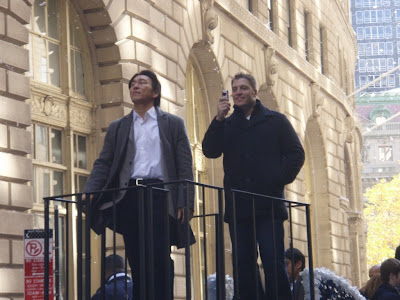
The Damon/Matsui situation(s) is/are really part of a larger issue for the Yankees: who will fill the outfield and DH spots next year? Nick Swisher is a lock. Barring a trade, Melky Cabrera and Brett Gardner will still be around. Austin Jackson waits in the wings. Damon, Matsui, and to a lesser extent Xavier Nady are candidates to be resigned. Matt Holliday and Jason Bay are big ticket names in the free agency pool, Chone Figgins is being mentioned as a potential left fielder, and second tier free agents like Vladimir Guerrero, Jermaine Dye, Mike Cameron, and Coco Crisp may also find their names cycling through the Yankee rumor mill.

In my opinion it boils down to this: amongst their own free agents, other team's free agents, or trades, the Yankees need to secure two players to fill a corner outfield spot and the DH spot.

We'll certainly run through all the options over the next couple of weeks (unless the Yankees do something quickly), but let me just state my own personal opinion right off: I want the Yankees to retain both Damon and Matsui. Part of that may be sentimental, in wanting to retain two of the more tenured members of the club. But it's also functional. Both are still useful players, despite some visible warts. But sometimes it's better the devil you know is better than the devil you don't.

The argument against this is multifaceted: both are old, both have varying degrees of physical malady and carry injury risk, both are defensively limited, both will be somewhat costly, and both will likely ask for more years and dollars than the Yankees should rightly commit. Critics of this idea will further note that the Yankees "need to get younger, more athletic, etc" and that the team needs to "open the DH spot" to periodically rest aging veterans Jorge Posada, Derek Jeter, and Alex Rodriguez.

Those are valid arguments. But I think they are risks the Yankees can afford to take. Next year's bench should feature the likes of Francisco Cervelli, Ramiro Pena, and either Gardner or Cabrera. All are young, all are athletic, and all give the Yankees some measure of versatility. Meanwhile, I agree with the concept of resting the older position players through the DH spot.

But what happens if Posada, Jeter, and Rodriguez all get a day a week at DH? Each would be replaced in the field by an offensively inferior player (Cervelli, Pena). And who then would DH the remaining three or four games each week? If Damon is the answer to that question, does that mean some combination of Gardner, Cabrera, and Jackson take two of three outfield spots in those games? How much offense would they be giving up by doing all of that?

The next six weeks or so should answer these questions. There are better (and more expensive) options out there, but I'm going on record now as saying that I think the best option for the 2010 Yankees is to bring back both Damon and Matsui.

Friday, November 6, 2009

Victory Parade Pictures

The parade today was a pain logistically - to be expected when you cram a couple extra million people into Manhattan on a Friday morning - but I managed to get a couple pretty good pictures (culled from a ton of other shots of other people's hands and cameras) and wanted to post them here.

Ladies and gentlemen, your 2009 World Series MVP.

And Paul Blart, Mall Cop.


Miiiiiiiiiiiiiiiiichael Kay.


Freddy Sez with his frying pan/sign combo. If I hadn't seen this, I would have assumed that they had to shake him awake on a park bench somewhere to get him to come along.


A-Rod, giving the Jay-Z/Rocafella hand gesture and wearing a very goofy-looking hat that he may or may not have bought from Justin Timberlake.


Alfredo Aceves and his wife (I'm guessing), along with Phil Hughes right behind him and Brian Bruney on the far right.

Surprised they didn't make Bruney walk.

Get it? Because he gives up too many walks!!!!1!1one!!exclamationpoint!


Sabathia and Teixeira with the appropriate signage.


Mr. Derek Jeter, but that's not the best part of the picture, in my opinion. It's that pretty much everyone is holding up a camera.


Jeter with his parents behind him, Minka Kelly on the left and a roll of toilet paper in his hands. Unlike A.J. Burnett, who gunned the one that was thrown to him back into the crowd, Jeter politely tossed it aside.


Me taking a pictre of someone taking a picture of Joba who's taking a picture of us.

/universe implodes


Andy Pettitte and his family. Tell your wife to stop texting, dude.


Mariano Rivera waving a Panamanian flag. He "closed" the parade, you could say.


The scene was... interesting. There was very nearly a big fight that broke out because a group of thuggish kids thought someone "was invading their territory". Word for word, I swear. Guys, there are about 3 people per square foot down here, no one has "territory".

We got of at the Rector St. stop on the 1 line and the cops weren't letting people walk up to Broadway. Instead we had to go all the way down to Battery Park and get to Broadway from there. Coming around the Citi Bank building there was a total human gridlock. Some geniuses were yelling for everyone to "just move" as if there were some people blocking the way who just needed to be reminded of that. Others were encouraging people to "keep pushing", which from my experience with dense pedestrian traffic isn't the safest thing to do.

There were a bunch of little fuckers (maybe 15-16 year old kids) that decided it would be a great idea to bodypaint themselves white with pinstripes and the number 27 on their back, apparently not realizing that they'd be brushing up against people all day. The people behind us had noisemakers and kept running into TGI Friday's to take shots during the parade. If the Yankees have the best fans in the world, they weren't at the parade today.

But that's fine. We saw it. It was awesome. There a couple of moments where I got the chills watching players go by and the ticker tape fall down. And that's about all you can ask for, right?

Thursday, November 5, 2009

The Coronation

The Yankees had been tortured by the own high expectations for 9 long years. Not by the supposed "Championship or Bust" mantra that for the most part is wildly overplayed, as much as their actions as a franchise. Even if they had pretended like they didn't care that much about winning, it would have been painfully apparent that they did.

Since 2000, the Yankees have spent over $1.5B on player's salaries, let alone the amount paid to coaches, training staff, front office personnel, scouts, minor league operations and countless other employees singularly dedicated to assembling the best baseball team possible. And last night, it's seemed like it was all worth it.

If the last nine years have taught us anything, it's that you can't buy championships (despite the common Yankee-hater refrain). You can certainly try. You can buy extended streaks of regular season success. You can come pretty close to buying a playoff berth. But you still have to run the gauntlet of a three-tiered playoff system which was a lot harder than it seemed back when Paul O'Neill, Tino Martinez, David Cone, Bernie Williams & Co. were still wearing Pinstripes.

This year, it seemed easy again.

The Yankees cruised through the second half of the season, didn't face elimination once in the playoffs, and the Phillies didn't have the tying run on base at any point after the third inning last night. After Damaso Marte impossibly mowed down Chase Utley to end the 7th inning and Ryan Howard to begin the 8th with 2 strikeouts six pitches, we could relax and savor the moment.

Last night was a coronation of the a team who, despite what Jimmy Rollins wants you to think, was the best team in baseball for most of this year by a considerable margin. It was validation of the last 9 years of aggressive free agent spending and high-upside drafting.

It was a celebration for Hideki Matsui and A-Rod and Sabathia and Burnett and Cano who will never have the fact that they haven't won a World Series held against them again. And probably just as sweet for the guys who played supplemental roles and ended up in the right place at the right time. It was a culmination for Jeter, Pettitte, Posada and Rivera who amazingly won a 5th title together 9 years after their last. This is as good as it gets.

We were all in vastly different places in our lives 9 years ago. I was a 16 year old kid who was a Yankee fan but didn't really know that much about baseball. I couldn't have told you what OPS meant or who Bill James was. The Yankees had just won 4 out of 5 years and if you had listed the players the Yanks were going to acquire and told me it would take until now to win again, I would have thought you were batshit insane.

But it did take that long. Which makes it that much sweeter.