The outstanding Men's Ice Hockey tournament will wrap up this afternoon with the Gold Medal Game between the U.S. and Canada. These two squads met last Sunday, with the U.S. taking a 5-3 victory to finish group play undefeated.
Since then, the U.S. beat Switzerland in the quarterfinals Wednesday and trounced Finland in the semis on Friday, scoring six goals in the game's first fourteen minutes. Team USA continues to get superb goaltending from Ryan Miller, who bettered Switzerland's Jonas Hiller and Finland's Mikka Kiprusoff, the only other goalies in the tournament who have come close to Miller's level of play.
As for the Canadians, their loss to the U.S. and the point lost via a shootout victory over the Swiss in group play left them with the sixth seed. With Roberto Luongo replacing Martin Brodeur between the pipes, they beat up on Germany 8-2 on Tuesday, and then faced Russia on Wednesday. What many predicted to be the eventual Gold Medal Game entering the tournament was reduced to a quarterfinal game, and the expected heavyweight match between the two deepest teams in the tournament was a laugher, with Canada winning 7-3. In the semis on Friday, Canada jumped out to an early 2-0 lead over Slovakia, then withstood a late rally to take a 3-2 victory.
Last week's match up came one day short of the thirtieth anniversary of the Miracle on Ice; today's game comes on the fiftieth anniversary of the U.S. winning gold at the 1960 Games. This is also a rematch of the 2002 Gold Medal Game, when the Canadians took gold on American soil. The U.S. looks to return the favor today.
It's tough enough to defeat a team like Canada once in this tournament, let alone twice. It's even tougher to do it when the gold medal is on the line and the entirety of the arena is behind the Canadians. But this U.S. team is talented, has had an outstanding run through this tournament, and has the best player at the most important position. That'll go a long way towards evening the odds, and anything can happen in a single game. Puck drops at 3:15 EST. Let's go USA!
There are three features in the local broadsheets on Robinson Cano today. The first one comes from Mark Fiensand in the Daily News. The scribe talked to Brian Cashman about Cano's potential and Cash said:
He's already one of the premier guys in the game, but that's the only thing separating him from taking it to a whole other level. If he can be more selective at the plate, he could have a Hall of Fame-type career.
Like we've said before, Cano's ability to make contact with balls out of the zone makes it difficult for him to be patient. For him to get better, it would involve laying off of pitches he knows he can hit in order to wait for ones that he could hit harder. These decisions occur in a split second and are more a matter of intuition than choice. But maybe with some hard work he could make that jump.
Marc Carig of the Star-Ledger talked with Jesus Montero about working on cars with his father and how that might translate to improving his skills as a catcher:
What about [working on race cars] makes it worthwhile for you?
I like to have fun. People teach me. I know already a couple of things. You have to do it perfect. If you do it wrong, the engine doesn’t work. Those engines have so much power. They have to be perfect for the race. So we try to pay attention every single time when we’re doing something. That’s why I like it.
How much of that translates to baseball, especially learning a position like catcher, where you’ve got to deal with a lot of details?
Catching is like a little bit more fun for me. It’s fun to control the game, to be behind the plate, calling pitches, to be like the third manager of the game. And it’s about having fun in the game, try to make my pitchers laugh all the time.
In the Post, Jorge Posada acknowledges the about the amount of catching talent in the Yankees' system (including Montero), but says he's is going to make it tough for them to take his place. Let's hope he's right.
David Pinto at Baseball Musings takes a look at the Yankees offense and suggests that Nick Johnson's value might be maximized batting "second leadoff" or ninth. It won't happen but it's an interesting thought.
Yesterday, Rob from Bronx Baseball Daily wrote a interesting and thoughtful post about some comments that Steve Lombardi from Was Watching made in reference to Carl Crawford. Rob made some even-handed commentary on a delicate subject but more has come up since his post was written and I wanted to take a moment to highlight the issue here.
Two things about Carl Crawford: One, he’s very “street.” Think Mickey Rivers meets Rickey Henderson – not that there’s anything wrong with that.
Okay, we all know "street" is a another term for "ghetto", but with a slightly less overt racial connotation. You can say that there "isn't anything wrong with that", but the fact of the matter is that you're still judging someone that you don't personally know based on a few things you've gleaned from watching them on TV. Why Steve even felt the need to point this out, I don't know, but he then went on to say:
Two, I dunno why…but… I just have this feeling that he’s one of those players who will be out of the game by the time he’s 35 years old. Granted, that’s not until 2017. And, I could be totally wrong on this… and he’ll be a Tim Raines type who plays into his late 30’s.
I’m just saying… if it were me, I’d be careful about giving him a very long term deal once he hits the free agent market. I’d be very concerned about going more than 5 years on an offer. But, that’s just me…
Lombardi has since denied that those two "points" (if you can even call them that) were connected, but if the hunch about Crawford being out of the game when he's 35 isn't related to the presumption that he's "street", then where did it come from? As Tom Tango is fond of saying, "Summary opinion without evidence is the very definition of bullsh!t". And Steve's statement is either A) prejudiced, B) bullshit, or C) both.
Additionally, given how much Lombardi criticizes Brian Cashman, I find his "analysis" of the Crawford situation to be endlessly amusing. Steve just has a feeling that Carl Crawford won't have a long career, so the Yankees should be careful about giving more than 5 years (as if any long term signing wouldn't be made with care). At least the Yankee GM bases decisions on tangible things that can be supported with evidence, as opposed to abstract feelings and hunches that admittedly can't be explained ("I dunno why... but...").
Predictably, people jumped on him in the comments about this, particularly the use of "street" and Lombardi attempted to "clarify" himself:
Just to clarify the “street” comment…
If you’ve ever heard Crawford interviewed, you probably understand this…
His communication skills are very far from polished. He’s not Jeter, Granderson, A-Rod or Teixiera like in terms of the way he presents himself verbally.
Further, have you seen the huge tattoo on the side of his neck? Somehow, I don’t think you’ll see Mariano Rivera or Andy Pettitte running out and getting one of those too.
Carl Crawford isn't under consideration to be the Yankees' next official spokesperson, so I'm not sure why his communication skills or the placement of his tattoos are relevant. CC Sabathia, A.J. Burnett and many other players have a ton of tattoos. Joba Chamberlain isn't very good with the media. Would you like to use those things to infer things about their respective characters, Steve?
Late yesterday, Lombardi again attempted to "clear up" his comments about Crawford by citing the fact that he is a fan of Rickey Henderson:
Yeah, Rickey Henderson – who is really no different from Carl Crawford in terms of his image or whatever you want to call it. Really, the only difference between Henderson and Crawford is that Henderson had a better batting eye and played in the majors for a quarter-century whereas Crawford just has eight season under his belt, to date.
So, if I were a racist, explain to me why I have so much respect and admiration for Rickey Henderson – and have a picture of him hanging in the rooms of all my children? Does that sound like a racist to you?
"I respect Rickey Henderson as a baseball player. HOW COULD I POSSIBLY BE RACIST?!?!"
Let's ditch the R-word. Because apparently if you respect an athlete of a certain race and hang a picture of them in your children's rooms, that absolves you from being a racist in any other capacity.
What were talking about here is prejudice, which, to be clear is, "a preconceived belief, opinion, or judgment made without ascertaining the facts of a case". The biggest problem with Lombardi's statements is not the fact that they may or may not have racial connotations. I take issue with trying to draw conclusions about a person's character based a few interviews and the placement of one tattoo.
Rob from BBD actually took the time to ask a Rays blogger about Crawford's reputation as a person, instead of just assuming he already knew what he was about. Here's a bit of what Devon Rodgers from Rise of the Rays told Rob:
From all I have seen he is a very positive person. When I am hanging around by the field before the games, he is always joking around with the players, batboys and security staff. He is very well liked by the players and he is one of the fan favorites.
Kinda makes the tattoo and the PR skills seem irrelevant, doesn't it?
I don't think we should expect players to embrace statistics. It's probably unrealistic even to think they should understand them. Stats are for those of us who observe the game and would like to try to better understand the big picture. They aren't tailored for those on the field, playing in the moment.
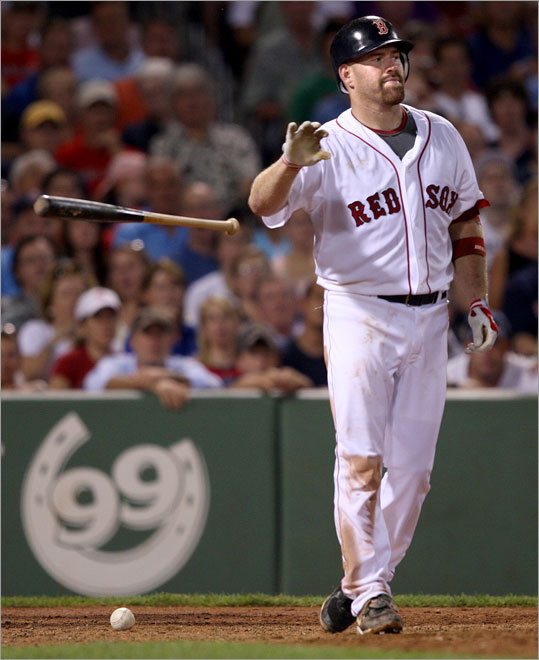
There are limited situations wherein a player might be able to adjust their strategy thanks to stats, but as I mentioned yesterday, defense isn't one of those situations. But you'd hope that players would at least understand the impulse to quantify defense objectively. Youk? Not so much: (h/t BBTF)
I don’t know how they do it. How do you measure defense? You make an error, you make an error. You get to a ball, you don’t get to a ball. What if you have a bad hamstring and you can’t get to a ball up the line? I don’t know what they evaluate, but a good ballplayer is a good ballplayer.
Well, yes, that's exactly how they try to measure defense. By tracking who gets to balls and who doesn't. Just because you have a legitimate excuse - like an injury - for not getting to a ball doesn't mean it shouldn't count against you.
In that statement is exactly why we need objective stats. And yes a "good ballplayer is a good ballplayer", but part of being good involves defense. There is no universal truth that tells us who is good at defense. There isn't even a central source where scouts come to a consensus about who is or isn't good. UZR clearly has its flaws as a system, but it attempts to find a numerical representation of who is good and who isn't. When we get our hands on Field f/x data, UZR is likely to be left in the dust, but it's the best we have now.
Youkilis was in a jovial mood as he picked apart some of the stats of the day - particularly Ultimate Zone Rating, or UZR, which is used to measure how many runs above or below average a fielder allows.
“I don’t go off all those UZRs . . . is it UZR?” Youkilis said. “I don’t even know what it is. I hope my UZR is sick, along with my OBSTR.
OBSTR? I thought Jim Bowden had just raised the bar in the field of make-believe baseball statistics when he invented the cutting edge metric "OBPATUZXYZ". However, Kevin Youkilis has apparently just upped the ante by creating the Obligatory Bullshit Stat Trivializing Rationality. It may go down as the WAR of anti-stat dunderheads.
Anyhow, since Youk isn't a fan of UZR, we thought we'd create a few, more tangible stats that he might excel in and ultimately embrace:
Kevin Youkilis this morning when talking about the brave new world of defensive stats: "My UZR better be sick!"
"Ahh you fackin' kiddin me? It's wicked haahd to get a ball past the Youkstah!"
I think we might be dealing with a sort of Zack Grienke situation here, wherein a player knows about a stat and what it measures but doesn't really understand the metric. And for the most part, it really doesn't matter. Youk understanding the components Ultimate Zone Rating isn't going to make him a better defender. He already knows that he should try to get to every ball he possibly can. UZR isn't the type of metric that's going to lead to a strategic epiphany. It's just the best method we have for quantifying a very complex process in motion.
Actually, his UZR is slightly higher in his time at 3B. Granted he's logged more than twice as many innings at 1B, but he hasn't been "much better at first", despite the fact that conventional wisdom would suggest a player would perform more effectively at the "easier" defensive position.
From his perch atop the baseball blogopshere, Rob Neyer wonders if the fact that the Yankees don't have any up-and-coming stars at premium defensive positions will be their fatal flaw in years to come:
Still - and I know this is a stretch, but please bear with me - if you're looking for a small chink in the Yankee armor in the coming decade, it's that Mark Teixeira might be their best player. He'll be in his 30s, and he'll be playing first base. Ideally, your best player is a bit younger, and playing in the middle of the field. Cal Ripken. Alex Rodriguez when he played shortstop. Willie Mays and Mickey Mantle. Joe Morgan and Johnny Bench.
All of those fellows were the best players in their leagues at one point or another. Is there anyone now on the Yankees' roster with a decent shot at being the best player in the American League in 2011? One of the five best players in the league? I don't think so. Which probably won't matter much. But if one or two of the veterans falls off more than expected, it would be nice if the Yankees had a young superstar ready to step into the breach.
If Albert Puljos was the Yankees' first baseman, would the fact that he was their best player still be a chink in their armor? He plays first base and just turned 30 a month ago. The point being that Teixeira's position only counts against him in so far as it affects his level above replacement. The fact that the Yanks best player is a first baseman isn't necessarily a bad thing.
Still, Neyer's point is well taken. Historically, the two most decorated positions on the Yankees are center field and catcher. With the exception of the 1920's dynasty when they had both Ruth and Gehrig, when they were at their best, the Yankees have featured great players in both positions. Dickey and DiMaggio; Berra/Howard and Mantle; Munson and Murcer; Posada and Bernie. Add to that Rizzuto and Jeter at shortstop and the Yanks have a storied history of finding excellent talent at premium defensive positions.
Like any other team, if you can get great offensive production up-the-middle, it becomes much easier to build an offensive powerhouse. You can find good hitting first baseman or left fielders on the open market a lot easier than shortstops, center fielders or catchers.
However, well-rounded second baseman are quite valuable as well. The Yankees have been lucky to have Tony Lazzeri, Jerry Coleman, Joe Gordon and Gil McDougald in the past. Neyer either forgot about Robinson Cano or chose to disregard him. I think Cano has a chance to be one of the 5 best players in the AL in 2011. Maybe he isn't one of the best 5 players in baseball now, but he's either the best or second best second baseman in the AL and he's only 27 years old. In his good years, he's an incredible hitter for his position, plays above average defense and hopefully his best seasons are ahead of him.
Furthermore, the Yanks have placed a lot of emphasis on their pitching in recent years through both free agency and the draft. Sabathia and Burnett figure to comprise a solid foundation for the rotation well into the middle of the coming decade and hopefully Hughes and/or Chamberlain will establish themselves as better than average Major League starters.
Having a solid core of talent up the middle is a surefire way to build a winning team over the long term, but there are other ways to do it. Having above average talent at basically every position, a solid defense and a top notch pitching staff can certainly work in combination as well.
Good morning, Fackers. As much of the East Coast recovers from the winter storm that swept over it last night, the Yankees are down in Tampa beginning Spring Training in earnest. While we celebrate pitchers and catchers as the beginning of camp, as Joe Girardi said earlier this week, it doesn't really kick into full gear until the position players arrive.
Most of the new arrivals had already went through their physicals and took off by the time the writers hit the clubhouse yesterday, but today they will start doing their first drills as a full squad. Of course, we've still got a while to wait before any action appears on our televisions. A week from today, the first Spring Training game (against the Pirates) will be televised on YES. Marc Carig from the Newark Star-Ledger has the full TV schedule.
Here are some other links to start off the day:
Cliff Corcoran from Bronx Banter put out his annual Camp Classic. In it, he examines every player not guaranteed a spot coming out of Spring Training from the 40 man on down to the non-roster invitees.
Similarly, Matthew Pouliot from Hardball Talk continues his "Diving into the Depths" series with a look at the Yankees and organizes a depth chart by position.
On XM Radio last night, Brain Cashman acknowledged that Brett Gardner might be one of the best center fielders in baseball, but said that Curtis Granderson was likely to be their center fielder this season. Ben from RAB thinks that Cash's statements might be an indication that the Yanks don't see Gardner as a long term solution.
On Twitter, Joel Sherman reports that the Yankees are converting Kei Igawa to a reliever in a last ditch effort to extract value from his $46M contract. Considering Joe Girardi is almost certainly going to select two lefties for his bullpen and Boone Logan might be the front runner for that spot, it appears that Igawa will be given a real chance. You can't blame them for trying to make use of him, but the reaction from fans won't be very positive if he stumbles out of the gate.
It's about the time of year that ESPN typically starts stacking new baseball "analysts" - read: past players and executives - on top to their already bloated crew. To wit, they announced that Aaron Boone and J.P. Ricciardi will be contributing to Baseball Tonight this coming season. We Yankee fans like Boone, and Ricciardi seems like a bright, sabermetrically-inclined sort of a guy, but they might need to add a second row of seats on the set of the show.
Larry from Wezen-Ball put together an interesting graphic showing the history of every Major League park marked with the Championships and Pennants won by the team that in habits it.
The ubiquitous Jonah Keri recently appeared on two podcasts that are worth checking out. The first is FanGraphs Audio, which as host Caston Cistulli proclaims "is like a bald eagle: less endangered now than it had been until recently". The second appearance is on Kissing Suzy Kolber's House of Punte. The relevant portion begins just after the 18:00 mark and there is a bit of overlap with the FanGraphs interview. The typical crowd over at KSK will probably not take kindly to the decided lack of poop humor, dick jokes and NFL character sketches, but you folks will likely enjoy the material.
Ozzie Guillen is on Twitter and already dropping gems like "going to eat in half hour why dye no have a job ?". In honor of his presence, Jonah compiles a list of the 9 sports figures who aren't on Twitter but would be in a perfect world.
Baseball America released its Top 100 Prospects list. Jesus Montero is 4th and they his his power a perfect 80 on the scouting scale. The only other Yankees was Austin Romine and he is 86th. Austin Jackson is 76th. Pat Andriola from the Hardball Times lists a couple of things he disagrees with, including ranking Jackson higher than Fernando Martinez.
We might have linked to this already, but for a more detailed and Yankee-centric prospect picture, check out Mike from RAB's Top 30.
We discussed this at length when we did the first edition of our new encyclopedia in 2004. IIRC, the deciding factor was that the Baltimore franchise went bust during the season and was turned over to the league. After the season, the league then sold a new franchise to investors in New York City. We felt that wasn't really a relocation or a transfer; it was simply filling the gap in the league that was opened when the Orioles' franchise disintegrated.
Of the 39 players who appeared for Baltimore in 1902, only five appeared for New York in 1903. Jimmy Williams was the regular second baseman for both clubs. Herm McFarland, a utility player in '02, became a regular outfielder in '03. Ernie Courtney played one game for Baltimore. in 1902, then 25 for NY in 1903. Harry Howell was the only pitcher of consequence to make the transition. Snake Wiltse (4 G in '03) also appeared for both.
Before 1900, the Baltimore Orioles had been a National League club. They existed from 1892 to 1899, winning three straight championships in 1894, 1895 and 1896 and featured greats such as Wee Willie Keeler and John McGraw (who would go on to become player-manager of the team in 1899). The O's were disbanded after that 1899 season when the National League was contracted from 12 teams to 8.
The Orioles were re-formed with some of the same pieces, including McGraw, shortstop Bill Keister and second baseman Jimmy Williams in 1901 as an AL squad. Commissioner Ban Johnson had begun the American League and after a season without baseball in Baltimore in 1900, the city and the players were anxious to rejoin. However, Johnson was a proponent of "clean baseball" whereas McGraw was most certainly not.
Up until that point, baseball games were marked with brutal violence, including umpire abuse. According to the Bill James Historical Baseball Abstract:
Players spiked one another. A first baseman would grab the belt of the baserunner to hold him back a half-second after the ball was hit. Players tripped one another as they rounded the bases. Fights broke out on more days than not. Players shoved umpires, spat on them, and punched them. Fans hurled insults and beer bottles at the players on opposing teams.
The Orioles were the best team of the 1890's by a considerable margin, and were responsible for promoting this style of play. McGraw in particular was especially nasty. As was noted in The Ultimate Baseball Book, he "had a genius for making enemies".
So perhaps McGraw becoming the manager for one of the teams in Johnson's new, "clean" league wasn't the best idea. But they needed each other. After spending 1900 in St. Louis, McGraw wanted to return to Baltimore and Johnson needed a team there.
It all came to a head during the Orioles second season in the American League. After a litany of fines and brief suspensions for his foul and sometimes violent play, Johnson suspended McGraw indefinitely. After the decision came down, McGraw persuaded John T. Brush, the chairman of the National League Executive Committee to buy a share of the Orioles. Brush obliged and promptly began by releasing McGraw and other players from their contracts. McGraw landed with the Giants where he would play for the next four and a half years and manage for the next 29. It got so bad that the Orioles couldn't field a full team by mid-July and the American League took ownership of the club and starting filling the roster with players from other AL teams.
Up until 1902, the National League claimed that they had the right to keep the American League out of New York. However, when Brush had bought a controlling interest in the Giants - already being managed by McGraw - Johnson chose to disregard the pact. After their blanant sabotage of the Orioles, Johnson saw an opportunity to get even. He decided that he needed to give the American League a foothold in what was then the undisputed baseball capital of the world.
With the help of commissioner Johnson, the Highlanders then began snatching up talent from National League teams. They pillaged Wee Willie Keeler from Brooklyn and Jack Chesboro, Lefty Davis, Jesse Tannenhill and Wid Conroy from Pittsburgh, among others. They also built a brand new stadium in Washington Heights called Hilltop Park which, to the dismay of the Giants was only a few blocks from the Polo Grounds. It would be a few years before the team would compete but the new owners of the franchise, Frank Farrell and Bill Devery, were set up very nicely by the commissioner and his desire for revenge.
The Highlanders undoubtedly took the place of the Orioles as the 8th team in the American League when they began play in 1903. However, the fact that only five (or six, depending on the source) players carried over from Baltimore to New York calls into question whether or not they were really the same team. They didn't have the same manager or owners. So were they the same franchise? It seems like the Orioles were killed by John McGraw and John T. Brush only to be reincarnated by Ban Johnson as the Highlanders. One in the same though? I'm not sure.
There is a debate going on over in the comments at the B-R blog and if you feel strongly either way, let your opinion be heard. I could go either way.
Over at the Hardball Times, Justin Inaz put together an excellent piece on the run scoring environments throughout the various minor leagues. If you pay attention to minor league ball, you know that the Pacific Coast League is notorious for being a "hitter's league", while the Florida State League is a much tougher run scoring environment. Thanks to Justin's work, we now have a snapshot of what the differences were in aggregate from 2007 to 2009.
The Yankees have teams in the Florida State League (High A Tampa), Gulf Coast (Rookie - also Tampa), International (AAA Scranton) and NY-PA (Short Season Staten Island) Leagues, which are the four lowest scoring leagues in the minors. They also have teams in the Eastern (AA Trenton) and South Atlantic (Low A Charleston) which are in the lower half of the bunch as well.
This means that Yankee pitching prospects who put up excellent numbers generally aren't quite as impressive as a hitting prospect who is doing the equivalent on the other side of the ball. And also that a pitcher in the Pacific Coast League with the same numbers as a Yankee farmhand in Scranton is likely to be pitching a whole lot better.
The difference between the Gulf Coast and Pioneer Leagues, which are both Rookie circuits is over 1.2 runs per game. Part of the reason is location. While the Gulf Coast League plays its games at or near sea level in humid conditions, the Pioneer League calls cities like Casper, Wyoming; Helena, Montana; and Idaho Falls, Idaho home, each of which is situated in the arid Northern Rockies at over 3,500 feet of elevation.
Of course, the size of the ballpark is also a major factor. Many clubs try to match their Big League parks to their minor league ones. This helps teams determine what kind of talent they have both offensively and defensive in the minors and eases the transition a bit when they finally call up their prospects.
The article at the Hardball Times also has a more detailed chart that includes the slash stats, home run rates and other pieces of data from the different leagues along with an explanation of the right column in the chart above - Base Runs. Check it out.
Now for a public service message on behalf of the man pictured reading his autobiography to the above: The fine folks from Baseball Prospectus are putting on an event this coming this Sunday, February 28th from 3-5PM at the Yogi Berra Learning Center on the campus of Montclair State University in New Jersey. Kevin Goldstein, Christina Karl, Steven Goldman along with friend of the blog and mustache aficionado Jay Jaffe will be appearing in person to promote their 2010 annual and inevitably to field angry questions about PECOTA. It will be a panel discussion and the Yanks upcoming season will certainly be discussed in depth.
If you are in the Northern New Jersey area, consider checking it out and taking a stroll through the museum while you are there. For more information, call (973) 655-6891.
The most prominent and overarching storyline of the Yankees offseason to this point has been their desire to stay under their predetermined but officially undisclosed budget. Particularly when it came to picking an option to reinforce left field, it was the primary concern. In acquiring South Korean right hander Chan Ho Park for $1.2M plus $300,000 in incentives, the Yanks have demonstrated that their adherence to their magic number wasn't simply dogmatic. The same goes for their practice of building their bullpen out of the minor leagues.
As was the case when Mark Teixeira was signed last year - although obviously to a far lesser extent - Brian Cashman decided that Chan Ho Park was worth lobbying the ownership to spend extra for. Park rejected a $3.25M offer to stay with the Phillies midway through the offseason and watched his price fall steadily until, apparently, the Yankees couldn't afford not to sign him.
Park began 2009 as a starter for the Phillies, struggled and was ultimately bumped to the bullpen after a particularly dismal 1 1/3 inning, 5 run effort against the Nationals in mid-May. Once transitioned to the 'pen, he was extremely useful for the Phils, pitching more than one inning in 13 of his 38 appearances and compiling a 2.52 ERA over 50 innings in relief. Park blew Game 2 of the NLCS against the Dodgers but was otherwise very effective in the postseason as well, particularly against the Yanks in the World Series (3.1 IP, 0 ER).
Prior to the move, it seemed like the Yankees were essentially set in the bullpen with Rivera, Hughes/Chamberlain, Robertson, Aceves, Marte, and some combination of Gaudin/Mitre/Logan/Melancon. Given the Major League deal to Park, it's likely that he makes the team out of Spring Training. Consequently, the Yanks may decide to trade Gaudin and his $2.95M salary, as he could be more valuable to a team in need of a 5th starter than one who would employ him primarily as a mop-up man. They could also decide to stash the loser of the much ballyhooed Hughes-Chamberlain Battle in Scranton to start the season, although Joel Sherman doesn't think that is very likely.
Of course, the Yankees are going to catch some flak for this because of the emphasis they've continued to place on the budget. But Brain Cashman isn't a politician. He doesn't need to get re-elected or appease his constituents, so it doesn't matter that he deviated slightly from a previously stated plan (or two). In the end, it's not about sticking to the stated goals; it's about making the team better.
All told, the signing does seem likely to make the Yankees better. During an offseason in which many teams were more than willing to pay good relief pitchers far more than they deserved, Cashman and Co. found a relative bargain. You can question whether or not the signing was really necessary - or worth exceeding the budget for - given that the bullpen was already in good shape, but it's hard to argue that this isn't a good value for the Yanks.
Good morning Fackers. Believe or not, I was planning on running this post this morning even before last night's Team USA win over Team Canada in Vancouver. Last night's game was certainly an upset. But personally, I don't believe it's as big of an upset as many are making it out to be. Either way, it's certainly not half the upset as the one that took place in Lake Placid, NY thirty years ago today.
This is the fourth Winter Olympics featuring NHL players, and the fifth featuring professional players. Hockey wise, we're so far removed from the 1980 Miracle on Ice, that it's easy to lose sight of just how massive an upset that game was.
The Soviet team was easily the greatest assemblage of hockey talent on the face of the planet in February of 1980. With the Iron Curtain still firmly in place, the NHL was still nearly a decade away from importing its first Russian talents. The Soviet National Team featured the best players of - at worst - the second most hockey-crazed nation on the face of the planet. They trained and played with, literally, military precision. They had gone 3-4-1 against the NHL's best Canadians in the 1972 Summit Series, dominated lesser WHA talent 4-1-3 in the '74 Summit Series, and more recently had gone 2-1 with a +5 goal differential against a squad of NHL All-Stars in the 1979 Challenge Cup. For all intents and purposes, the Soviets were a professional All-Star team competing in an amateur tournament.
On the flip side, Team USA was an assemblage of American collegiate talent led by University of Minnesota head coach Herb Brooks. Brooks was the final player cut from the 1960 US squad, a team that went on to win gold in Squaw Valley. Heading into the 1980 Games, that was the final time the Soviet didn't win men's Olympic gold. Brooks' captain was former BU Terrier Mike Eruzione, the team's oldest player at 25, who was three years removed from his collegiate days and toiling in the minors at the IHL level before joining the Olympic squad. Less than two weeks prior to the Miracle on Ice, the Soviets had crushed Team USA 10-3 in the final pre-Olympic warm up.
Something similar was expected on the evening of February 22, 1980, part of the round robin medal round. Instead, on the strength of a goal from Eruzione that proved to be the game winner, the US beat the Russians 4-3. A win against Finland in their next game clinched the gold.
As I compose this post, the post game coverage on MSNBC is declaring last night's game the biggest upset since the Miracle on Ice. It's not even close. It's not even in the neighborhood. The forty skaters to take the ice last night are all high caliber NHL players. Not all are superstars, but all are professionals playing in the best league in the world. Yes, the Canadian roster is absolutely stacked. Yes, perhaps maybe just three or four of the US players could crack the Canadian line up. But in a short tournament - hell even on any given night in the NHL - anything can happen. For a pumped up Team USA to come out and beat Team Canada last night is an upset, and is impressive. But, without even considering the socio-political climate of 1980, last night's game is worlds away from the Miracle on Ice.
That said, yesterday was a great day for hockey. The Big Six all paired up in a trio of good match ups: Eastern European powers Russian and the Czech Republic in the afternoon, the Battle of North America in the evening, and Sweden and Finland in a Scandinavian Showdown for the night cap. We'll see all of them again in the medal round.
As nice as it was to see the US win last night, I was hopeful they would save their upset for the medal round. Canada and Russia are loaded, and with both teams being upset this week, I don't know how good the chances are that they both lose again before it's all said and done. As exciting as it was to see the Swiss push Canada in to the brink in a shootout loss on Thursday, part of me was relieved that Canada pulled it out, postponing their upset for another day.
Still, who knows what will happen over the remainder of the tournament. Perhaps the US can recapture a bit of the Miracle from 30 years ago. Their roster features two defensemen with ties to the 1980 team. Ryan Suter is the son of 1980's defenseman Bob Suter, and my former classmate at Boston College, Brooks Orpik, is named after the coach of the '80 team. Come this time next week we'll know if this is their time. I'm going to enjoy watching it all unfold.


 Posts
Posts