Showing posts with label WWII. Show all posts

Thursday, July 22, 2010

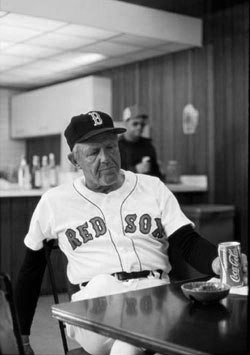
Ralph Houk: 1919-2010

He was nowhere near the mythical figure of George Steinbrenner or the constantly stately presence of Bob Sheppard, but yesterday, just a few weeks shy of his 91st birthday, former Yankee catcher, manager, and general manager Ralph Houk passed away in his home in Winter Haven, Florida.

Drafted by the Yankees in 1939, Houk played three years of minor league ball before voluntarily enlisting with the Army Rangers. He attended Officer Candidate School at Fort Riley in Kentucky and eventually participated in the invasion of Normandy and The Battle of the Bulge. After being shot in the calf during the latter, he returned to the battlefield immediately after he had the wound bandaged.

Later in that same battle, Houk disappeared for three days after he was sent him out to doing some scouting of enemy troops, his commanding officer recalled:
When he turned up he had a three-day growth of beard and hand grenades hanging all over him. He was back of the enemy lines the entire time. I know he must have enjoyed himself. He had a hole in one side of his helmet, and a hole in the other where the bullet left. When I told him about his helmet, he said 'I could have swore I heard a ricochet.' We marked him 'absent without leave' but were glad to have him back alive.
Houk returned from the war decorated with a Silver Star, a Bronze Star with an oak leaf cluster and a Purple Heart and earned the nickname The Major.

When he rejoined the Yankees in 1946, he started in AA and made the jump to AAA mid-way through the season. When the '47 season rolled around, he found himself serving as Yogi Berra's back up for the Big League club and went 3 for 3 with a double and a walk in his debut on April 26th. He only made it to the plate 104 times in that season, and it would turn out to be a career high, never amassing more than 14 in the remainder of his eight years with the Yankees. During all that downtime, he talked with the pitchers out int he bullpen and started collecting an impressive amount of knowledge about all angles of the game.

He began his career as a manager before he even hung up his cleats. The Yankees named him manager of their AAA team at the time, the Denver Bears, and he strapped on his gear and took a couple of hacks at the plate in 1955 before deciding his days as a player were over. In 1958, he left Denver to serve as Casey Stengel's first base coach, where he remained for three years.

The experiences The Major had in the army ended up coming in handy when he took over for the ousted Stengel before the 1961 season, as he said in an interview with Time Magazine:
Being in the war probably helped my managing. It made me understand the problems young men have and the pressures they go through not only in a war but in baseball.
By most accounts, Houk was a "player's manager" but possessed a fierce temper which he would occasionally direct towards the umpiring crew. He wouldn't throw one of his men under the bus to the media, but he would unload on them behind closed doors if he perceived a lack of effort.

Houk would arrive to the ballpark four hours early - something that wasn't nearly as common is those days as it is now - to begin preparing for the day's game. He spent that time looking over line up cards and strategizing with his coaches and scouts about the opponent to see if he could "pick up one or two little things".

His disciplined preparation - along with an incredibly loaded roster - brought the Yankees two World Series titles in his first two seasons at the helm and an AL Pennant in the third. After the 1963 season, however, Houk became general manager and asked Yogi Berra to be his skipper. The Yanks lost in the Fall Classic again in 1964 and Houk (unpopularly) fired Berra and replaced him with Jonny Keane.

After Keane led the team to a 77-85 record in 1965 (good for just 6th place in the AL after five consecutive pennants) and began the '66 season 4-16, Houk took over as manager once again. The Yanks finished in last place that, 9th out of 10 the following season, and had descended into mediocrity. Houk's final season as the Yanks' skipper was in 1973, the last year that the team was still owned by CBS. George Steinbrenner asked Houk to return, promising to bring him talent and restore the once-great franchise but demoralized by the fans' constant booing, Houk decided to move on.

From New York, The Major went to Detroit, managing the Tigers through five marginal seasons from '74 to '78. He also skippered the Red Sox from 1981 to 1984 but had no division titles to show for his efforts in either stop. He became vice president of the Twins in 1986 and held that post in 1989, when he decided to retire for good.

Despite spending the end of his career with other organizations, Houk is best remembered as a Yankee. Although he wasn't a big part of it, the Yankees won six World Series in his eight years as a player. His managerial career started with the legendary summer of '61 and ended just before George Steinbrenner took over the team in 1973. He was a great solidier and baseball man who lived a long, proud life. Rest in peace, Major.

Wednesday, March 24, 2010

A Quick Announcement About Comments

Fackers, we are under attack. During the wee hours of the past two nights, we have been absolutely blitzkrieged by spammy comments. Some blogger user by the name of "mamamia" has dropped two spam bombs on every post dating all the way back to mid-December. Not cool.

I have taken action against this evil menace. I eradicated every one that was left yesterday, and am in the process of getting rid of the hundred or so that popped up last night. More importantly to some of you though, I've had to put the comments in moderation mode, meaning that you might have to wait for them to be approved. I'll do my best to stay on top of okaying them.

Hopefully this is just a temporarily thing. I don't want to have to put a word verification step or anything else that's going to be annoying/inconvenient to those of you who actually want to join in the discussion here. Thanks for hanging tough. Together we can vanquish the wretched bitch known as "mamamia".

Friday, February 12, 2010

5 Days Until Spring Training: Joe DiMaggio

The son of Sicilian immigrants, Joe DiMaggio's given name was actually Guiseppe. He grew up in San Francisco where his father made a living as a fisherman, manning a boat that wasn't quite large enough for crabbing but was sufficiently sizable to make a living on during the 1920's in the rich waters of the San Francisco Bay. DiMaggio's father, also named Guiseppe, came from a long line of Sicilian fisherman as did the fathers of most of the boys Joe D. used to play baseball with on North Beach playground.

Naturally, the elder Guiseppe wanted all five of his sons to become fisherman, but he didn't understand that by immigrating to America, he had opened up their options far beyond anything they could have conceived back on Isola delle Femmine. They weren't consigned to the sea like he had been at their age. Only the two oldest DiMaggios became fisherman. The youngest three all went on to play Major League baseball.

Dom and Vince both had pretty decent careers. Each player over a decade and both brothers retired with OPS+ around 110. Not bad, but Joe was clearly head and shoulders above his kin.

Vince was actually the one who got Joe back into baseball after he briefly lost interest in his mid teens. Vince asked his manager with the San Francisco Seals to let his kid brother to fill in at shortstop for three games at the end of the 1932 season while the incumbent Augie Galan was barnstorming in Hawaii. In 1933, Joe officially became part of the team.

During his rookie season, just 18 years old, DiMaggio started the season on the bench. Eventually he took the place of a slumping right fielder and began his inexorable march to superstardom. Starting on May 27th, DiMaggio recorded a hit in 61 straight games, shattering the previous Pacific Coast League record. It was then he truly became hooked on baseball:
Baseball didn't really get into my blood until I knocked off that hitting streak. Getting a daily hit became more important to me than eating, drinking or sleeping. Overnight I became a personality.
DiMaggio had a unique minor league baseball experience. Instead of being drafted by an franchise and assigned to one of their teams thousands of miles from where he grew up, he played all of his minor league ball for his hometown Seals. He later explained:
I had the good luck to spend my entire minor league career in the Pacific Coast League, in which all travel and accommodations were first-class, and with my hometown team, the San Francisco Seals, at that. Playing on my hometown team meant when the club played its home stands I could live with my parents, occupy my own room.
The Yankees originally wanted to purchase DiMaggio at the beginning of the 1935 season but Charley Graham, owner of the Seals, drove a hard bargain. He agreed to give up Joltin' Joe, but only after he completed the '35 season in San Francisco. Additionally, the Yankees had to send three players to the Seals before the '35 season began. This made the Seals a heavy favorite in the PCL that year, and they took full advantage.

DiMaggio hit .398 with 100 extra base hits and 173 RBIs. The Seals captured their first Pacific Coast League title in 4 years and Joe was named League MVP. After the season ended, the Yankees sent $75,000 and completed the deal. DiMaggio made the long trip from California to Spring Training in St. Petersburg with fellow Italians and Bay Area natives Tony Lazzeri and Frank Crosetti, the latter of whom was bought from the Seals in 1931.

DiMaggio's personality didn't seem fit for the Big Apple. The Daily News called him "timid" and referred to his as Dead Pan Joe when he first arrived. Later in his career Hank Greenberg noted that if DiMaggio said "hello" to you, that was a long conversation by his standards. He was hyped endlessly by the New York papers and billed as the "Babe Ruth's successor", but in terms of disposition, he was much more like Lou Gehrig than Ruth.

Joe hit .323/.352/.576 with 29 HRs and 125 RBIs in his first year in the Bronx, made the All-Star team and finished 8th in the MVP vote. Had there been a Rookie of the Year award then, he surely would have won it. His sophomore campaign was even better, with a line of .346/.412/.673 and a whopping 46 home runs despite hitting right handed in Yankee Stadium for half of his games.

Over the course of his career, DiMaggio his 148 homers in the Bronx compared to 213 on the road. Left-center field at Yankee Stadium was 460 feet away during his playing days and straight away center was 490. It was a short 281 feet down the line, but the 45 degrees directly ahead of DiMaggio ranged from 430 feed in left field to 406 in right. It suffices to say that the Yankee Clipper lost a fair amount of home runs to Death Valley.

If anything, the extra square footage in the Yankee outfield help Joltin' Joe hit for average. With more ground for the outfielders to cover, there were more places for DiMaggio's hits to fall. On May 14th, 1941, he began his legendary 56 game hitting streak which lasted until July 17th in Cleveland. That day, three great defensive plays - two by third baseman Ken Keltner and one by shortstop Lou Boudreau - kept Joltin' Joe hitless. Undeterred, DiMaggio hit safely in 16 straight games immediately, collecting a hit in 72 of 73.

That year, primarily on the strength of his hitting streak (and maybe aided by the fact that he only struck out 13 times in 621 PAs), the Yankee Clipper stole the MVP from Teddy Ballgame, who hit .406 and roundly trounced him in every other significant batting category, save for runs batted in.

From 1936-1942, DiMaggio hit .339/.403/.607 (159 OPS+), averaged 31 home runs and 133 RBIs and won two AL MVPs. He homered more often that he struck out and played excellent defense.

DiMaggio was known for his long strides that allowed him to cover wide swaths of Yankee Stadium's expansive center field. According to Tiger slugger Hank Greenberg, the only way to get a hit against the Yankees was "to hit 'em where Joe wasn't." He developed his nickname "The Yankee Clipper" because as he patrolled center field he looked as smooth and graceful as the popular 19th century clipper sailing ships known for their speed and ability to cut through wavy waters.

After 7 excellent seasons for the Yanks, DiMaggio went to war in 1943. Well, more correctly, the was drafted into the Army Air Force. He traded in his $43,750 salary from the Yanks for a $50/month wage from the Army, but he continued playing baseball. He became a part of the 7th AAF and was stationed in Santa Ana, California. Joe spent most of his time in the service as a physical education instructor and playing baseball on the Santa Ana team. By contrast, Ted Williams was a fighter pilot.

While his time in the Army was a relative walk in the park, his parents were not so lucky. Since they were Italian immigrants, they were classified as "enemy aliens" and forced to carry identification cards on them at all times. They were not allowed to go beyond five miles from their home with out a government-issued permit. DiMaggio's father was banned from fishing in San Francisco Bay, where he had made a living over the previous 30 years.

The Yankee Clipper lost three full seasons to WWII. When he returned to the Yankees, he was 31 years old and it took him a bit to regain him form, hitting only .290 in his first year back. He hit for a lower average and with less power in his final six seasons than he did in his first seven but still managed a 150 OPS+ over that span. He picked up his third and final MVP in 1947, nudging out Ted Williams by one point despite on-base and slugging percentages over 100 points lower than the Splendid Splinter's, not to mention significantly fewer homers, RBIs and runs scored. It probably helped that the Yanks made it to the World Series and the Sox finished 3rd in the AL.

Williams and DiMaggio were almost swapped for each other in 1949. Boston Red Sox owner Tom Yawkey and Yankees GM Larry MacPhail verbally agreed to a trade, however it fell apart when McPhail balked at Yawkey asked for a young catcher by the name of Yogi Berra. It seemed at the time that the two principles of the trade were stuck in the wrong parks - the left handed Williams in Fenway and the righty DiMaggio in Yankee Stadium. However, they made out pretty well despite their inhospitable home parks. Berra, it turns out, would have been a much bigger loss for the Yanks because DiMaggio was done as a player only two seasons later.

Helped greatly by his hitting streak, DiMaggio became a central figure in American pop culture. Although he was an incredibly great player, his fame outpaced his talents. He was referenced in countless songs such as John Fogarty's Center Field, We Didn't Start the Fire by Billy Joel and Mrs. Robinson by Simon and Garfunkel. He was mentioned on I Love Lucy, Seinfeld, and Star Trek: Deep Space Nine. Hemingway even mentioned him in The Old Man and the Sea.

The Yankee Clipper accomplished an awful lot despite playing in only 13 seasons in the Big Leauges. He was a 9-time World Champion, 3-time AL MVP, 2 time batting champion, and a 13-time All-Star (the only player to be selected for the All-Star Game in every season he played). His career line was .325/.398/.579 BA and he tallied 361 HRs, 1537 RBI.

Joltin' Joe was a private man. He never seemed to be interested in the trappings of fame despite being one of the most famous people in the country for much of his life. He married Marilyn Monroe in 1954, of course, but the marriage lasted less than a year, due in part to Joe's jealousy and public nature of her character. They reunited seven years later and Joe asked her to marry him just four days before she died on August 5th, 1962. Joe had roses delivered to her grave three times a week for twenty years after she passed away. He never married again.

DiMaggio lived a full and long life which ended when he was 84 years old. He spend the last 100 days of his life in a hospital battling lung cancer and passed away on March 8th, 1999. The Yankees wore a black #5 patch on their uniforms to commemorate his life that season which culminated with a World Series victory over the Braves.

Mostly due to the length of his career, it took 3 ballots for DiMaggio to enter the Hall of Fame but he gained admittance to Cooperstown in 1955 and lived more than half of his life as a member of the Hall of Fame. He was to Yankees fans what Ruth was before him and Mantle and Jeter have been after: larger than life legends both on and off the field.

Tuesday, February 9, 2010

8 Days Until Spring Training: Yogi Berra

Like his good friend Phil Rizzuto, Lawrence Peter Berra had a formative experience as a young man with a respected Major League figure who told him that he would never become a professional baseball player. In 1942, Yogi was 17 years old and playing minor league ball when he was approached by Branch Rickey, then the general manager of the Cardinals. Rickey offered him $250 to sign with the Cards but Berra refused. When he did, Rickey supposedly said, "He'll never make anything more than a Triple A ballplayer at best".

Yogi held out for $500 from the Yankees and was assigned to their club in Newport, Virginia. In some ways, you can understand why Rickey wasn't willing to shell out the extra $250. Berra never looked the part of a baseball player (or athlete of any kind, for that matter). He was 5'8" and a sturdy 190-something pounds in his playing days, but his fire plug build made him perfectly suited for catching. They don't call Berra's kind of built "squat" for nothing.

When Yogi turned 18, the year was 1943 and World War II was kicking into high gear. Instead of waiting to being drafted into the armed services, he set aside his dream to play professional baseball and enlisted in the Navy himself. Unlike many established Major Leaguers who were part of the military, Berra spent his years in active duty and participated in the D-Day invasion as a gunner's mate on a rocket-launching craft. After Normandy, he was stationed in North Africa and Italy but suffered a hand injury and was sent back across the Atlantic.

When he got back to the States, Berra was stationed at the submarine base in Groton, Connecticut. After he was discharged from the Navy, he began playing for the Yankees' affiliate in New London. According to lore, Giants manager Mel Ott saw Yogi play in New London and offered the Yankees $50,000 for him. Yanks GM Andy MacPhail wasn't familiar with Berra but was pretty sure that if Ott wanted him that badly, he was worth hanging onto. The following year, Yogi spent half of the season with the AAA Newark Bears before being called up to the Yankees.

Growing up in St. Louis, the only time Berra had seen Yankee Stadium and said he was rendered speechless because it was so much bigger and grander than Sportsman's Park where he had watched the Cardinals as a boy.

It took Berra two seasons to take the starting catcher's job from Aaron Robinson and once he did, he never looked back. The 1948 season began a stretch of 15 uninterrupted All-Star game appearances which included three MVPs and four more top 5 finishes. Yogi's career also encompassed fourteen World Series appearances and ten championships, both of which are Major League records. In addition to those, he also holds the records for World Series games (75), at-bats (259), hits (71), doubles (10), singles (49), games caught (63), and catcher putouts (457).

Between 1949 and 1955, on a team filled with offensive studs including Mickey Mantle and Joe DiMaggio, it was Berra who batted clean-up and led the Yankees in RBI for seven consecutive seasons. Yogi was famously excellent at hitting poor pitches. Despite swinging at balls in the dirt and those over his small frame, Berra had nearly as many career home runs (358) as strikeouts (414). In 1950, Berra whiffed only twelve times in 656 plate appearances. When asked about swinging at bad pitches, Berra was reported to say, "If I can hit it, it's a good pitch."

As a fielder, Berra second to none. Under the tutelage of Bill Dickey, he blossomed to one of the better defensive catchers in the league. He was spry and cat-like in his crouch, leading Casey Stengel to say "he springs on bunts like it's another dollar". He led all American League catchers eight times in games caught and chances accepted and left the game with the AL records for catcher putouts (8,723) and chances accepted (9,520).

Yogi was also well-renowned for his ability to handle a pitching staff. He handled pitchers differently depending on their disposition, alternatively coaxing or prodding hurlers based on who he felt needed what. Casey Stengel got a lot of credit for how he deployed his pitching staff during the dynasty of the 50's and 60's, but Berra played a large part in that success as well, displaying a knack for what pitches to call and when. He caught both of Allie Reynolds no-hitters in 1951 along with Don Larsen's perfect World Series game in 1956.

Yogi was also remarkably tough and durable. He averaged 118 games behind the plate from 1949-1959 and caught more than 133 games every year from 1950-1956. In June 1962, at the age of 37, Berra caught an entire 22-inning, seven-hour game against the Tigers.

He was a part of the Yankees until 1963 and even in his last season he was productive, punching up a 138 OPS+ in 164 plate appearances. The following year, he served his first stint as Yankee manager. Despite leading the Yanks to 99 wins and a World Series appearance against his hometown St. Louis Cardinals, Berra was fired and replaced with Cards' manager Johnny Keane.

He resurfaced across town with Mets in 1965 as a player-coach. He put in two games behind the plate and two more as a pinch hitter in May, picking up 2 hits in 9 at-bats but soon decided that he was finished as a player. His coaching career, however, would go on. He stayed with the Mets for the next 8 seasons as an assistant manager under at first under Casey Stengel. He eventually took over as manager in 1972 after the sudden death of Gil Hodges. That same year, he was elected to the Hall of Fame along with Sandy Koufax and Early Wynn.

In 1973, he led the Mets to the World Series and in so doing, became only the second manager to win a pennant in both leagues, following only Joe McCarthy. He had also completed the feat in only 3 seasons as a skipper.

After two more years as manager for the Mets, he rejoined the Yanks as a coach and the team won its first of three consecutive AL titles. This uncanny ability to bring about good luck was not unnoticed. Stengel once said of him, "He'd fall in a sewer and come up with a gold watch." Berra was eventually elevated to Yankee manager before the 1984 season. The team won 87 games but finished a disappointing 3rd place in the AL East.

Berra agreed to stay with the job for 1985 after receiving assurances from George Steinbrenner that he would not be fired. However, the notoriously impatient Boss axed him after a 6-10 start to the season. Instead of notifying Yogi personally, Steinbrenner dispatched GM Clyde King to deliver the news for him. This caused a rift between the two men that would not be mended for almost 15 years. Yogi's replacement? If you guessed Billy Martin, you may or may not be a baseball historian.

On August 22, 1988, Berra and his predecessor Dickey were honored with plaques to be hung in Monument Park at Yankee Stadium. Berra's plaque calls him "A Legendary Yankee" and cites his most frequent quote, "It ain't over till it's over." However, the honor was not enough to cure the relationship between Steinbrenner and Yogi. That would not happen until January of 1999 when Steinbrenner publicly apologized to Berra. According to Steinbrenner at the time, "It's the worst mistake I ever made in baseball." The power broker behind the meeting? Suzyn Waldman.

Armed with only an 8th grade education, an unenviable physique and an uncanny wit, Berra became on of the most famous people in the world. Yogi has been featured in advertisements for Yoohoo, AFLAC, Entenmann's, and Stovetop Stuffing. Although he wasn't especially fond of being called "Yogi Bear", he did have the honor of having a Hanna Barbera cartoon named after him.

Of all the Yankee legends still with us, Yogi is undoubtedly the greatest character. Eighty four years young and still active with the franchise, today's Yankee fans are incredibly lucky to have him around. He currently operates the Yogi Berra Museum & Learning Center in Montclair, New Jersey. He spends a lot of time at the facility so if you make a trip out to the Museum, you just might have the privilege of chatting with the man himself.

Sunday, February 7, 2010

10 Days Until Spring Training: Phil Rizzuto

The 1956 celebration of Old Timer's Day took place on August 25th. At that point, Phil Rizzuto was already a bit of an old timer himself, nearly 40 years old having spent 13 seasons with the Yankees and served 3 years in the Navy during World War II. Scooter had lost his position as everyday shortstop for the Yanks to Jerry Coleman and Willie Miranda starting back in 1954 and had struggled in the plate appearances he was given in '56, hitting only .231/.310/.231. It was clear that his career was nearing its end, but the way that it came to a close blindsided Rizzuto.

Before the game against the White Sox that day, Casey Stengel called Phil into his office. The Yankees had just acquired Enos Slaughter from the Kansas City Athletics off of waivers and Stengel began discussing ways in which he could fit him on the 25 man roster. He had Rizzuto read down the roster and suggest players that could be moved to make way for Slaughter. Scooter would read off a name and Stengel would reject the idea. He kept looking over the roster until it was clear that Stengel was trying to get him to chose his own name. Naturally, Rizzuto was less than pleased with the way the Yankees had gone about this.

Stengel and general manager George Weiss assured Rizzuto that he would be added to the World Series roster as a back up for Gil McDougald should the Yankees make it that far. But adding to the fire, Weiss and Stengel reneged on their offer, eventually choosing Billy Hunter instead. Scooter felt betrayed and that broken promise very nearly ended Rizzuto's relationship with the Yankees. Fortunately for generations of fans of the Bombers, Rizzuto was the bigger man, forgave the team and went on to become one of the most recognizable ambassadors of the franchise for the next 50 years.

Rizzuto's Yankee career began almost twenty years before the infamous Old Timer's Day event and it might not have begun at all if it weren't for Casey Stengel. A Brooklyn native, Rizzuto explained that he grew up rooting for the Dodgers because it was easier to sneak into Ebbets Field than Yankee Stadium. Fresh out of high school, Rizzuto showed up at Ebbets Field to fulfill his childhood dream and try out for the team. The Old Perfessor was managing the Dodgers at the time, took a quick glance and Scooter's 5'6" frame and famously told him to "go get his shinebox" because that was the only way he was going to make a living.

Although dejected by the dismissal, Rizzuto didn't give up. Shortly thereafter, the Yankees invited him to a one week tryout camp. Even at that early age, Scooter was already and adept fielder, bunter and base stealer. Those skills, along with a home run that he hit during one of the scrimmages netted him a deal with the team.

Rizzuto spent the next four years in the minor leagues, jumping from D to B to AA-ball and maintaining an average over .300 wherever he went. During his 1940 season in Kansas City, he hit .347 and was named Sporting News minor league player of the year. He made his major league debut on April 14th, 1941.

As a 24 year old rookie, Scooter started 128 games a shortstop, hit .307 and finished 20th in the MVP voting. The Yankees went on to win the World Series against the Dodgers that year, although Rizzuto only manged 2 hits in 21 plate appearances. He was named to the All-Star team the following year and the Yankees made it back to the World Series but lost to the Cardinals.

In 1943, he was drafted into the Navy. Scooter never saw active duty and instead played on the Navy baseball team alongside Dodger's shortstop Pee Wee Reese, Dom DiMaggio, Don Padgett and Benny McCoy. He served for three years, missing the '43, '44 and '45 MLB seasons.

When he returned to the Yankees, it took Rizzuto a few years to regain his form as a hitter. He struggled through three below average seasons before Casey Stengel took over the reigns as manager. In 1949, Stengel moved Rizzuto from the bottom of the line up to the top, which coincided with a bump in his performance and a second place in the MVP vote behind Ted Williams. More importantly though, the Yankees won their first of 5 consecutive World Series, this one again over Rizzuto's childhood team, the Dodgers.

In 1950, Scooter finally put it all together, hitting .324/.418/.439 and winning the AL MVP. It was especially sweet with Stengel as manager - the most emphatic way possible that Rizzuto could have proved his offhanded dismissal of him at Ebbets Field years before was wrong.

After his MVP campaign, Rizzuto played two more years as the Yankees' full time shortstop before eventually becoming a part time player. While he was never a force offensively, he was better than most shortstops of his time. His career OPS+ was 93, but the a big reason that the Yankees were able to have the success that they did during Rizzuto's time in Pinstripes was that he offered roughly league average production from a premium defensive position. And Scooter's defense was well renowned. His former teammate Vic Raschi once said, "My best pitch is anything the batter grounds, lines or pops in the direction of Rizzuto."

After his unceremonious dismissal from from the Yanks in 1956, Rizzuto considered severing ties with the team. He felt spurned but eventually set his pride aside and joined the organization as a broadcaster the following year.

He was added to a booth with veterans Mel Allen and Red Barber and didn't initially fit in very well. Rizzuto felt that the two resented him for his inexperience. It would be precisely that lack of finish that endeared him to Yankees fans over his 40 year career in the booth.

While Rizzuto was known for his ability to play baseball the right way and lauded for his alertness in the field, his broadcasting style was much of the opposite. He was prone to miss things that happened during the game and interjected the broadcast with moments of personal levity and downright goofiness, such as "Bouncer to third, they'll never get him! No, why don't I just shut up!". He would openly advertise the fact that he was leaving the game early to beat the traffic over the George Washington Bridge and take time to wish friends and family a happy birthday over the air.

Rizzuto's success as a player earned him great respect throughout baseball but his trademark broadcasting style endeared him to generations of Yankees fans in a way his on-the-field play never could have. By narrating tens of thousands of games to people in driving in the cars or sitting in their living rooms, he became a familiar part of their lives. By sharing intimate details about his likes (golf, canolis) and dislikes (spiders, traffic, lightning) he was more than just a disembodied voice coming through the radio and eventually the television set.

The Yankees retired his number and dedicated a plaque in Monument Park to him on August 4th, 1985. He was passed on for the Hall of Fame repeatedly by both the writers (15 times) and the Veteran's committee (11 times) but eventually gained entrance in 1994 partially because of a persuasive speech given by Ted Williams. During it, Williams said that if the Red Sox had Rizzuto, they might have been the ones who won those pennants in the 40's and 50's.

By all accounts, Rizzuto was one of the kindest and friendliest personalities in all of baseball. When he passed away in 2007 at 89 years old after a few years of declining health, the Yankee community lost one of its pillars. He was the oldest living Hall of Famer at the time of his death.

Yogi Berra used to visit Scooter in the nursing home where he lived on a regular basis during the final years of his life. As a tribute to his best friend, he appeared briefly in the broadcast booth that night. It was difficult for Yogi as he was choked up for most of the appearance, but he went through with it as a way to honor all the years that Scooter spent in the booth. Earlier that day, Yogi talked about his lifelong pal during a lengthy media session in the Yankees dugout with Joe Torre at his side:

Wednesday, January 27, 2010

21 Days Until Spring Training: Spud Chandler

(Relax, Joe is going to do one on good ol' Paulie O'Neill later)

I'm going to go out on a limb here and say that if you're reading this blog, you probably weren't alive to see Spud Chandler pitch. His last appearance was on October 2nd, 1947, so you would have to be at least 69 to stake a reasonable claim to remembering him as a Yankee, even during his last season. Neither of my parents were alive at that point, but praise be to the bounty of these here interwebs, I can hop on Baseball-Reference and Wikipedia and write him a mini-biography like I'm his agent or something.

Chandler grew up in Jaw-juh, and was a three sport athlete at UGA, playing halfback for the football team, pitching for the baseball team and running track.

If I told you Mr. Chandler had a ten year career, you'd probably guess he started when he around 23-26 and retired at about 33-36. Oddly, he was born in 1907, but didn't make his debut until 1937, in his age 29 season after spending five years in the Yankee farm system. Lots of guys make their major league debuts at 29, not many of them have 10 year careers. He started only 12 games in '37, but threw six CGs, including two shutouts.

The following season, he threw 172 innings to a better than a league average ERA, but had a microscopic 36 strikeouts. At age 31, he was relegated to only 11 relief appearances and looked as if he was headed out of the league. In 1940, he was re-installed into the rotation and for the next three seasons complied successively more innings, more strikeouts and a lower ERA, setting the table for his 1943 season.

Granted WWII inflated the stats of the bona fide Major Leaguers that were still around, but Spud Chandler's 1943 season was still pretty damn incredible. The marginal pitcher I just described to you, at age 35, busted out with 253 innings of a 1.64ERA and a .992 WHIP, gave up only two home runs all season and went 20-4. He received 246 out of a possible 336 points in the MVP vote and pulled off the rare feat of winning the award as a pitcher. He pitched two complete games in that World Series, including a CG shutout in the clinching Game 5.

In 1944, after starting only one game, Spurgeon F. Chandler was enlisted in the Army. He returned towards the end of the 1945 season but appeared in only 4 games.

At age 38, Spud had another truly great year. He set a career high in IP (257.3), strikeouts (138), and shutouts (6) and had a 2.10 ERA with a 1.12WHIP. Spud made the All-Star team and even got a few points in the MVP voting again. Starting only 16 games in his final season (1947), he still pitched to an ERA a full run lower than league average (2.46).

Chandler was a part of three World Series winning Yankee teams (1941, 1943, 1947) and was named to four All-Star teams. He had one of the odder career trajectories and had one of the finer seasons ever as a Yankees pitcher. Yankee history is somewhat lacking in the pitching department but Spud is one of the more interesting characters of the bunch, even if he wasn't one of the greatest.

Wednesday, November 11, 2009

The Yankees During WWII

While it took only a month after FDR signed the Burke-Wadsworth Act into law for for the draft to begin, it took much longer for its effect to be felt on baseball. A few players, such as Yankee first baseman Johnny Sturm enlisted voluntarily, but most waited for their number to be called by the draft boards.

Many Major League players were not considered for the draft for a couple of reasons. First, men who supported a family, event those who were married without children such as Joe Dimaggio were originally bypassed by many draft boards. Phil Rizzuto, who was not yet married, was similarly overlooked because he supported his parents and younger brother with his baseball salary. Additionally, there we players like Tommy Holmes who had a condition that didn't prevent them from playing baseball, but did preclude them from military service. Holmes, who was an outfielder for the Boston Braves, had a sinus condition.

As a result, the Yankees (and most of the major leagues) remained largely intact during the early years of the war. The Yanks made it to the World Series in 1941 with a full compliment of players, including hitters Dimaggio, Rizzuto, Gordon, Charlie Keller, Tommy Heinrich and pitchers Red Ruffing, Spud Chandler and Tiny Bonham, where they beat the Brooklyn Dodgers 4-1.

The Green Light Letter wasn't written in January of 1942 and the rest of baseball started to feel the affects of the war. Not the Yankees though, who returned all those players the following year and went off as 2 to 5 favorites to repeat. The Yankees started slow but won 103 games that year en route to an American League pennant.

When time came for the World Series, Tommy Henrich wasn't around because he had been called to duty by the Coast Guard in August. However, the Yankees had replaced him with Roy Cullenbine, who hit .364 from then until the season's end.

The Yankees faced the Cardinals in the Fall Classic and won Game 1 behind Red Ruffing, who took a no-hitter into the 8th inning. They lost 4-3 in Game 2 with Tiny Bonham on the hill despite an 8th inning really and dropped all three in New York to lose the Series. Had it gone beyond 5 games, Phil Rizzuto wouldn't have been able to play, as he was ordered to report to the Navy in Norfolk, Virgina the following day.

Joe Dimaggio enlisted the following January. Outfielder George Selkirk, first baseman Buddy Haskett and even 39 year old Red Ruffing who had lost 4 toes in a childhood accident were all called upon to serve.

That season, the Yankees were also ordered to move Spring Training closer to home to cut down on unnecessary transportation. They chose Asbury Park, New Jersey whose seaside breezes were welcomed in the summertime, but not as much in early March, forcing the majority of the workouts to be held inside. With little actual baseball to base his decisions on, manager Joe McCarthy inserted Snuffy Stirnweiss into shortstop and named Johnny Lindell is right fielder.

Although their position players had been decimated and Stirnweiss was quickly demoted from his starting post, their pitching staff was still in good shape. Spud Chandler led the way that year, going 20-4 with a 1.67 ERA along the way to a league MVP. Tiny Bonham, Butch Wensloff and Hank Borowy all started close to 30 games and posted ERAs under 3, and their pitching staff allowed the fewest runs since the Deadball Era. They met up with the Cardinals again in the World Series and this time returned the favor, besting them 4-1.

As the war dragged on, the Yankees were no longer able to dodge the effects of the conflict. For Spring Training in 1944, the Yanks moved south the Atlantic City. They practiced inside of an armory, but needed to relocate once the space was necessary to care for wounded soldiers and were moved to an abandoned airplane hangar.

By the time the April rolled around, Joe Gordon, Charlie Keller and Billy Dickey were gone. A week into the season, Chandler left as well. Stirnweiss, who hit .219/.333/.288 the year before was suddenly the team's biggest star. Other teams were facing the same difficulties so the Yankees were still competitive but they faded down the stretch.

The St. Louis Browns, who were the perennial basement-dwellers of the American League finally won their first pennant in 1944 because their original roster included 13 players who were determined to be (4-F) or unfit for service according to the military.

Meanwhile, many of the Major League players who had been enlisted in the Army were still on American soil, playing baseball against one another. Many commanders sought to assemble great baseball teams instead of sending the best players overseas to fight.

As a result, many Major Leaguers never saw active duty (with Bob Feller being one notable exception) and only two men who could rightly be called Big Leaguers before the conflict started died in combat.

At the end of the 1944 season, the Yankees were still under the control of the estate of Colonel Jacob Ruppert, who, as Matt mentioned earlier, up for induction to the Hall of Fame. The team was sold that offseason to an ownership group consisting of former Dodgers GM Larry MacPhail, a jetset socialite named Dan Topping and construction mogul by the name of Del Webb. For $2.8M, they not only got the Yankees, Yankee Stadium and their entire farm system.

The team shifted from a family run business to one that operated with the single-minded profit goals of a corporation. MacPhail and Co. sold pitcher Hank Bowory to the Cubs for $97,000 a move which infuriated manager Joe McCarthy. The Yanks finished fourth that year, but it didn't seem to bother the ownership much.

Before the 1946 season, Spring Training moved back to Florida, but MacPhail took the Yankees on a series of 50 exhibitions against minor league teams across the country. Midway through the season, after a contentious flight to Detroit, McCarthy resigned as manager of the team. Winner of 7 World Series in 8 trips over his 16 year career with the Yanks, McCarthy had been driven to the edge by the new ownership and an era in the Bronx had ended.

The Yankees has returned Rizzuto, Dimaggo, Chandler, Keller, Heinrich and Ruffing, but weren't the same dynastic force they were before the war. Their players had aged and their manager was gone. The Yankees did beat the Dodgers in the 1947 World Series but Larry MacPhail was forced out of ownership due to his actions at the parties after the victory.

The Yankees fared very well during the war, all things considered. The won the AL pennant three times and the World Series twice while it was going on, and even in the years that their financial resources and large minor league system couldn't buoy them to the top, they still finished 3rd and 4th.

[As you can tell if you click through the hyperlinks, I relied heavily on Yankees Century by Glenn Stout and Dick Johnson and For The Good Of The Country by David Finoli. Both were invaluable resources in generating this post.]

Monday, September 28, 2009

Remembering Old Reliable

Good morning Fackers. And of course, this particular morning is an especially good one, as yesterday the Yanks clinched the AL East and did so against the arch-rival Red Sox. Sixty years ago the Yankees also clinched against the Red Sox, but under circumstances that were far more dire.

On Saturday October 1, 1949, the Red Sox came into the Bronx for a season-ending two game series. They held a one game lead in the race for the AL flag, meaning the Yankees needed to sweep to take the pennant.

Saturday, the Yanks fell behind 4-0 in the third inning, then clawed back into it, pushing the go ahead run across in the bottom of the eighth to stay alive and make Sunday's contest the American League Championship Game.

The Yankees jumped out to a 1-0 lead in the first, and the score remained that way until they tacked on four more in the bottom of the eighth. Those runs would be needed, as the Sox plated three in the ninth. With Birdie Tebbets at the plate as the tying run, Yankee ace Vic Raschi got him to foul out to end the game and give the Yankees the pennant.

The final out was caught by veteran Tommy Henrich, "Old Reliable" as Mel Allen had dubbed him due to his knack for big hits in big spots. Henrich was mentioned by Peter Abraham last weekend, as the death of former Yankee Lonny Frey left the 96 year-old Henrich as the oldest living Yankee.

Before Catfish Hunter, before Reggie Jackson, Henrich was the Yankees' first big free agent acquisition. Born in Ohio, Henrich signed with the Cleveland Indians in 1934. After being buried in the Cleveland system for three years without being advanced appropriately, Commissioner Kennesaw Landis declared Henrich's contract void, freeing him to sign with whichever club he chose. He signed with the Yankees in April 1937, and after a brief stint with the Newark Bears, he moved up to the big club.

Two weeks ago the New York Times ran an article mentioning how the Yankees - like many slow to integrate clubs -passed on an opportunity to sign Willie Mays after that 1949 season. After the article ran, River Ave Blues, Bronx Banter, The Yankees Universe and others salivated at the possibility of a Mantle-Mays-Maris outfield in the 1960s. While that assuredly would have been the greatest outfield in Yankee history, the greatest that did exist consisted of Henrich, Joe DiMaggio, and last Monday morning's topic, Charlie Keller.


DiMaggio debuted in 1936, a year before Henrich, and was an instant star. Henrich spent his rookie year as a bench player - albeit a productive one - before becoming the regular right fielder in 1938. Despite posting an OPS+ of 119, it wasn't enough to establish Henrich as a permanent starter. The arrival of Keller in 1939 pushed Henrich back to the bench, as the Yankee outfield consisted of DiMaggio, Keller, and George Selkirk, all of whom posted an OPS+ of at least 143.

Selkirk had another fine season in 1940, and still received the majority of the time, but Henrich posted better numbers in his part time duty and missed a large portion of the year due to knee surgery. In 1941, he finally became the regular right fielder, joining DiMaggio and Keller. The trio combined for 94 home runs, with the right handed DiMaggio's 30 trailing the two lefties. Henrich's 31 longballs was third in the league, while his OPS+ of 136 was good for tenth in the league, but last in his own outfield.

That fall, Henrich was at the plate for one of the more notorious moments in World Series history. He was at bat in the ninth inning of Game 4 with Dodgers about to even the Series at two games apiece. Henrich struck out for what would have been the game's final out, but Dodgers catcher Mickey Owens allowed the ball to get by him. Henrich ran to first, the Yankees rallied, with Keller driving in Henrich and DiMaggio to give the Yankees the lead. Rather than being tied at two games apiece, the Yankees took a commanding 3-1 lead en route to their fifth championship in six seasons.

The Japanese bombed Pearl Harbor two months and one day after that Series ended, bringing the U.S. into World War II and altering the landscape of Major League Baseball for the next four seasons. The trio managed to stay in tact a year longer, winning the club's sixth pennant in seven seasons, but falling to the Cardinals in the World Series. DiMaggio and Henrich missed the entirety of 1943-45 while Keller missed the 1944 season and most of 1945, all due to military service.

1946 saw the end of the War in both theaters, with most Major Leaguers returning to their chosen profession. The trio reunited for one final season before Keller's back relegated him to part time duty.

Henrich remained with the club through 1950, winning three more World Series rings to run his career total to seven. He led the AL in triples in 1947 and 48, and in runs in '48 while posting a career best OPS+ of 151. He hit the first walkoff HR in World Series during Game 1 of the 1949 Series. He made the All-Star team five times, including each of his last four seasons. After taking four seasons to establish himself as a starter early in his career, Henrich turned in what were perhaps his best seasons after WWII, in what should have been the decline phase of his career.

As we said about Keller last week and as we said of their teammate Joe Gordon earlier this summer, Henrich is something of a forgotten Yankee superstar. Given the rich history of the franchise, it's easy for such players to get lost in the shuffle behind Ruth, Gehrig, DiMaggio, Berra, and Mantle, particularly when it's been nearly 60 years since these men last played for the Yanks. But that shouldn't diminish the contributions that these less legendary greats made during their time in pinstripes.

Friday, August 21, 2009

Dennis Hopper Is Warren Spahn

No, Hopper isn't going to be playing him in an upcoming movie about Spahn's time managing the Tulsa Oilers.

If you are the type who clicks though links on this site then you probably know, Baseball-Reference.com is where I go to get stats. Especially since they redesigned the site before the season started, it's great to work with for basic stats and even more complicated stuff like the Mariano Rivera post I did yesterday.

They also have some fun tools such as The Oracle of Baseball which allows you to play The Six Degrees of Kevin Bacon (which should currently be named for Dennis Hopper) with baseball players. (h/t to the comment thread on the B-R blog post on Tuesday that brought this up.) It makes sense that Bacon wouldn't actually be the most connected actor, since he's relatively young. He's not even close, actually, as he checks in at #507 on the most connected list. Towards the top are guys like Harvey Kietel, Donald Sutherland, David Carradine, Michael Caine and Martin Sheen, all of whom were born in the 1930's and started their acting careers in the 50's or 60's.

The difference between the acting and baseball version of the game however, is that actors have far longer careers and the top of that list consists (mostly) of people who are still alive and forging new connections. There isn't anyone in baseball's top 100 that's even close to active. In baseball, you need someone who came along in what is currently the middle of baseball history (when there were fewer teams and players) and can make quick steps to players from the 19th century as well as the 21st.

That's how Spahn, who got his first call up before WWII and threw his last pitch in 1965 ends up at the top of the heap. With that four game stint in 1942, Spahn was briefly teammates with guys like Ernie Lombardi, Paul Warner and Johnny Cooney on the Boston Braves, all players who were towards the end of long careers which began in the 1920's and weren't around when Spahn was called up in earnest in 1946.

The way Hooks' career ended was also beneficial because after playing with the Milwaukee Braves in 1964, he pitched for both the Mets and the Giants in 1965. On the Braves in '64, he played with a young Joe Torre, Hank Aaron, Felipe Alou, Sandy Alomar, Eddie Matthews and pitched alongside Phil Neikro. With the Giants in '65, he shared the locker room with Matty and Jesus Alou, the Willies Mays and McCovey, Ken Henderson (who's career spanned 18 seasons and 7 franchises) and pitched with Gaylord Perry, Bob Shaw and Juan Marichal. He was with the Mets for Eddie Kranepool's only All-Star campaign, Yogi Berra's final season as a player and Tug McGraw's rookie year but missed Nolan Ryan's Major League debut by just 11 months.

It's hard to tell if Spahn will ever be replaced at the top of his list. He only had 359 teammates, which when compared to Kenny Lofton's 604 or Ron Villone's 595 is not that many, but those more recent guys are 9 steps away from some of the 17,088 players in MLB history while Spahn is 5 steps or fewer from all but 81. Early Wynn, who is second on the list played for longer than Spahn (1939-1963) and had more teammates (408) but comes up just short in terms of connectivity.

It looks like Spahn just had the right combination of longevity and coincidence that allowed him to barely touch different generations at both the beginning and end of his career. It's fitting that the winningest lefty of all time and pitcher in general outside of the Deadball Era would occupy this unique place in baseball history, connecting the past to the present.

[Images via CheckOutMyCards.com]

Sunday, May 24, 2009

Just A Little Brotherly Love

As numerous media outlets have mentioned, the Stadium and the city have played host to a huge number of Phillies fans this weekend. These two gentlemen were no doubt consoling each other in the Columbus Circle subway stop after the emotional letdown of the Yankees 3 run, 9th inning rally yesterday, courtesy of A-Rod's two run homer, capped off by Melky Cabrera's third walk-off hit of the year. Whatever eases the pain, guys. 

(They were actually in the middle of a highly amusing drunken scuffle)

The bleachers acted as Omaha Beach for this invasion, with an impossible-to-miss proportion of seats occupied by those wearing red caps and shirts. 

Interestingly, this gentleman was rocking a "Phillies '80" tee. 

I guess he has a flair for nostalgia, or perhaps it was just a discounted misprint of "Phillies '08"? 

Some Philly sports personalities were in the house as well. 


Michael Barkann, anchor of Philly's Comcast SportsNet, sideline reporter for the U.S. Open (tennis) and seven time Pennsylvania sportscaster of the year caught the game and hung around to chat with Cliff for a good ten minutes after graciously accepting one of the 150 or so high fives we handed out at the exit for Sec 111 . 

Most exciting homestand ever? Let's see what happens later today. 

Friday, January 23, 2009

Number of Days Until Spring Training: #21 (Spud Chandler)

[Ed. Note: This is the first of two #21 posts today. Later, Joe will weigh in on Paul O'Neil.]


I'm going to go out on a limb here and say that if you're reading this blog, you probably weren't alive to see Spud Chandler pitch. His last appearance was on October 2nd, 1947, so you would have to be at least 68 to stake a reasonable claim to remembering him as a Yankee, even during his last season. Neither of my parents were alive at that point, but praise be to the bounty of these here interwebs, I can hop on Baseball-Reference and Wikipedia and write him a mini-biography like I'm his agent or something.

Chandler grew up in Jaw-Juh, and was a three sport athlete at UGA, playing halfback for the football team, pitching for the baseball team and running some track.

If I told you Mr. Chandler had a ten year career, you'd probably guess he started when he around 23-26 and retired at about 33-36. Oddly, he was born in 1907, but didn't make his debut until 1937, in his age 29 season after spending five years in the Yankee farm system. Lots of guys make their major league debuts at 29, not many of them have 10 year careers. He started only 12 games in '37, but threw six CGs, including two shutouts.

The following season, he threw 172 innings to a better than a league average ERA, but had a microscopic 36 strikeouts. At age 31, he was relegated to only 11 relief appearances and looked as if he was headed out of the league. In 1940, he was re-installed into the rotation and for the next three seasons complied successively more innings, more strikeouts and a lower ERA, setting the table for his 1943 season.

I'm not that familiar with the effect that WWII had on most major leaguers' stats, but I've got to assume that Spud Chandler's '43 season was still pretty damn incredible. The marginal pitcher I just described to you, at age 35, busted out with 253 innings of a 1.64ERA and a .992WHIP, gave up only two home runs all season and went (20-4). He received 246 out of a possible 336 points in the MVP vote and pulled off the rare feat of winning the award as a pitcher. He pitched two complete games in that World Series, including a CG shutout in the clinching Game 5.

Take a close look at ol' Spud's face.
That's some good old fashioned gentlemanly hatred.

In 1944, after starting only one game, Spurgeon F. Chandler was enlisted in the Army. He returned towards the end of the 1945 season but appeared in only 4 games.

At age 38, Spud had another truly great year. He set a career high in IP (257.3), strikeouts (138), and shutouts (6!) and had a 2.10ERA with a 1.12WHIP. Spud made the All-Star team and even got a few points in the MVP voting. Starting only 16 games in his final season (1947), he still pitched to an ERA a full run lower than league average (2.46).

Chandler was a part of three World Series winning Yankee teams (1941, 1943, 1947) and was named to four All-Star teams. He had one of the odder career trajectories and had one of the finer seasons ever as a Yankees pitcher.

[P.S. To all this people who hate stats (I'm looking at you Jon Heyman and Murray Chass), first of all, I hope you trip over your walker. Second of all, without stats this post would not have been possible. I'm sure you crotchety old fucks love a good history lesson and if we didn't record and analyze stats we couldn't look back at things and put them in perspective. Maybe you resent the fact that I was still 37 years from being born when Spud threw his last pitch and Murray Chass was already on his second marriage, but seriously, there are plenty of places to project your impending death. Leave stats alone.]

[Ed. note: There are some serious fucking inconsistencies between Spud Chandler's Wikipedia page and his B-R page. Obviously I went with B-R on every single one, but does anyone know how to go about fixing such things? I will do it when I get some spare time.]