Thursday, June 25, 2009

Game 72: Rubberband Man

A key to a successful baseball season is winning series; it's the surest way of having a winning record. The Yankees are 2-0-1 in four game series, 1-2-0 in two game series, and 11-6 in three game series for an overall series mark of 14-8-1, but have dropped three of the last four. Of the 17 three game sets they've completed, 11 have had the third and final game determine who took the set. The Yankees are 8-3 in those rubber games, but have lost two in a row to the lowly Marlins and lowlier Nats. The Yanks look to end that rubber game losing streak tonight and take the series from the Braves.

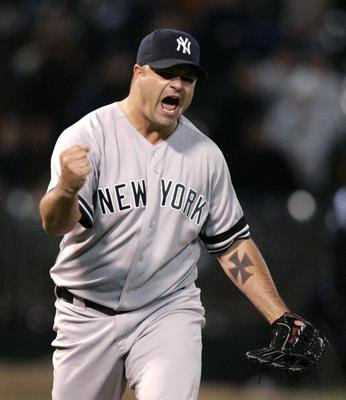
Andy Pettitte gets the start tonight, and he's a bit of a rubberband man himself. As Joe Girardi likes to say, Andy has a tendency to bend, but not break. Pettitte's had some ugly outings this year, yet his record sits at 7-3 and the team is 10-4 in his starts. On May 18th, he picked up a win against the Twins despite allowing 12 hits over 6.2 IP. On May 29 in Cleveland, his back acted up on him. He allowed 10 baserunners in 5 IP, but he held the Tribe to just one run.

In his last start though, Pettitte had no such troubles. Friday against the Marlins Pettitte threw seven innings of one run ball, allowing just three baserunners and fanning seven. He even helped his cause with an RBI double. He looks to build on that tonight as he returns to the city that saw the greatest perfomance of his impressive career. Lifetime, Pettitte is 5-1 with a 3.13 ERA against the Braves in the regular season and has two big postseason victories in Atlanta.

The Yanks will be opposed by old foe Derek Lowe, who has been tagged with the loss in his last two starts. In his time with the Red Sox, Lowe made 15 starts and 24 relief appearances against the Yanks, going 8-10 with 6.07 ERA and 1.68 WHIP. I'll take more of that please. Lowe and Pettitte went head-to-head twice, both in 2002, with both pitchers taking a win and a loss each.

It was rumored that Alex Rodriguez might get his weekly day off tonight, but he is in the lineup, meaning he'll likely skip Sunday's Subway Series game in order to get back-to-back days off. Cody Ransom is in the lineup however, as Robinson Cano was a late scratch. According to Pete Abe, Cano's claims he's just getting a day off, but his wrist was also taped. Given that he was in the original lineup, it appears that the Yankee Cloak and Dagger game has returned for the second consecutive day.

Oh, and just for good measure, I'll throw this in too.


Hey y'all prepare yourself for the Rubberband Man
You never heard a sound like the Rubberband Man
You're bound to lose control when the Rubberband starts to jam

1999 World Series: Game 4

[With the Yankees squaring off against the Braves this week, we thought it would be appropriate to take a look back at the two World Series during which they faced off in the late 90's]

At 2:30 in the morning on October 27th, not long after the dramatic conclusion of Game 3, Paul O'Neill got the kind of phone call that everyone dreads. When the phone rings at that hour, it rarely brings good news. When he answered, he found out that his father, Chick, who had watched his health decline over the previous months had passed away.

With Game 4 only 18 hours away, there wasn't much time to grieve. O'Neill decided to take the field and not to tell any of his teammates about his father until after the game. However, the organization was already aware of what had transpired and Joe Torre called to extend his condolences to his player. The time from when he received that call until it was time to play must have seemed like an eternity for Paulie.

When Whitey Ford finally threw out the first pitch, he set the stage for two other pitching titans to clash.

Roger Clemens first regular season after being acquired from Toronto proved to be a disappointing one. Coming off of back to back Cy Youngs and twenty win, 230+ inning, 270+ strikeout seasons north of the border, The Rocket turned in only the third best season of the Yankee starters. He had a 4.60 ERA, went 14-10 and actually had a WHIP higher than Hideki Irabu's. John Smoltz had fallen from his peak as well, heading to the DL twice in 1999, but still pitched effectively (3.19 ERA) when he was healthy. He was still regarded as a big game pitcher and the Braves could have done much worse than to have him on the mound.

Clemens and Smoltz matched scoreless frames in the first and second and Roger sat down the Braves in order in the top of the third.

Against Smoltz in the bottom half, Chuck Knoblauch led off with a single and Derek Jeter followed suit with one of his own, putting runners on the corners with no one out. Paul O'Neill struck out, then with Bernie Williams up, Jeter put himself into scoring position by stealing second. Smoltz then intentionally walked Bernie, to create the potential for a double play, a decision which came back to bite the Braves. Tino Martinez singled down the right field line, scoring Jeter and Knoblauch and moving Bernie to third. Darryl Strawberry went down on strikes for the second out of the inning, but Jorge Posada knocked a single to right to put the Yanks up 3-0.

That cushion would be all that Clemens needed. He cruised through the Braves line up, allowing only three baserunners over the next 4 2/3 innings. He retired the first two batters of the eighth inning, his 16th and 17th groundballs of the night, but hit a snag. He allowed two singles to Gerald Williams and Walt Weiss, which prompted Joe Torre to call to the bullpen. Clemens received a rousing ovation and doffed his cap, because barring a bullpen disaster, Clemens had just given the signature Fall Classic performance he had always yearned for. Jeff Nelson did allow one of Clemens' runners to score, but Rivera got Chipper Jones to ground out, lining up Clemens to be the winning pitcher in the clinching game of the World Series.

Jim Leyritz added a solo home run in the bottom of the eighth to give Mo some breathing room, but it wasn't needed. The Braves went down 1-2-3, the final out coming on a fly ball to Chad Curtis in left field.

The Yankees became the first team to sweep back to back World Series since their 1938-39 counterparts and validated their torrid 1998 campaign with another division title and unstoppable postseason run. Joe Torre actually said that he thought the '99 Yanks were better than the '98 version because they had to walk in the shadow of a 114 win juggernaut. After the game, Sojo, O'Neill, Brosius and Clemens, who had lost his father at a young age gathered in a quiet room away from the celebration in a moment of both remembrance and camaraderie.

The Yankees didn't need the late 90's run to secure a place as the best team of the 1900's, but the three championships in 1996, 1998 and 1999 did bring their tally to an unmatched 25 titles.

1999 World Series: Game 3

[With the Yankees squaring off against the Braves this week, we thought it would be appropriate to take a look back at the two World Series during which they faced off in the late 90's]

Just before Game 3, Luis Sojo flew in from Venezuela to rejoin the Yankees. Just before the World series had begun, his father passed away unexpectedly. There was a tragic air around the 1999 Yankees and the World Series in particular. As Matt mentioned during the Game 1 recap, Darryl Strawberry was still recovering from cancer as the season began. Joe Torre was diagnosed with prostate cancer and Scott Brosius lost his father, Marty, after a long bout with colon cancer.

Further adding to the general gloom, on the travel day between Games 2 & 3, golfer Payne Stewart's death made national headlines. On the morning of October 25th, Stewart boarded a private plane flight out of Orlando, bound for Dallas and the season-ending PGA Tour Championship. While en route, the cabin lost pressure and everyone on board was killed almost immediately. The Learjet, presumably still on autopilot, continued it's journey, flanked by F-16's until it crashed in an unpopulated area in South Dakota. Just a month removed from the American's dramatic Ryder Cup victory at Brookline, and four months past Stewart's U.S. Open victory at Pinehurst (the first of Phil Mickelson's many seconds), the American sporting landscape had lost one of it's more iconic characters.

-----

The temperature at game time was an unseasonably warm 62 degrees with a steady breeze blowing out to right field. Lefties Tom Glavine and Andy Pettitte took the hill for the pivotal Game 3. Both had turned into two excellent starts thus far in the '99 postseason, but each stumbled out of the gate.

To begin the top of the first, Pettitte gave up a single to Gerald Williams and a double to Bret Boone. Williams was driven in on a groundout by Chipper Jones, but Pettitte avoided further damage. Chuck Knoblauch reached on an E9 and was advanced to third on a fly ball by Derek Jeter. A single by Paul O'Neill evened the score at 1.

After a scoreless second inning for both hurlers, Pettitte ran into trouble in the third. He gave up a single, two doubles and another single, and by the time he had recorded three outs, the Braves were up 4-1.

Already facing the top of the order for the third time in the fourth inning, Pettitte gave up a triple to Williams and a double to Boone, making the 1-2 hitters for the Braves 5 for 6 against Pettitte with three runs scored. The next batter, Chipper Jones, finally chased Pettitte with a single. Andy had put up another poor performance in the Fall Classic, getting tagged for 10 hits and 5 runs in 3 2/3 IP. Jason Grimsley mopped up nicely however, keeping the Yanks in the game with 2 1/3 innings of scoreless relief.

Meanwhile, Glavine rolled along up until the 5th inning, when he allowed a solo shot to Chad Curtis. He didn't allow another hit until he gave up another homer to Tino Martinez in the 7th. 5-3 Braves.

Jeff Nelson came on after Grimsley and also did his part admirably, pitching perfect 7th and 8th innings. The Yankees had clawed back to within two runs when Joe Girardi led off the bottom of the 8th. He singled to center, bringing up Chuck Knoblauch, owner of exactly one home run in 160 postseason at bats. He lofted one just over the short porch in right, tying the game at 5. Bobby Cox decided he had seen enough and brought in his closer, John Rocker to close out the frame. Despite the 5 runs, (4 earned) Glavine pitched pretty well, but like Pettitte, he would not factor into the decision.

With the Yanks having pulled even, Torre brought in his closer to try to keep it that way. Mo faced the minimum three batters in the top of the 9th, but Rocker sat down the side in order in the bottom half to take the game into extra innings.

Bobby Cox burned through three pinch hitters in the top of the tenth, but all he got in return was a two out single by Ryan Klesko, who never made it past first.

Since Rocker had already pitched two innings, Cox called on Mike Remlinger to extend the game. He did not. Chad Curtis hit his second home run of the game, brought the house down and gave the Yankees a seemingly insurmountable lead of three games to none in the series.

During his postgame interview with Jim Gray, Curtis informed Gray on live television that the Yankees were upset with his treatment of Pete Rose two days earlier and that they refused to speak with him. When asked by the media after the game, Joe Torre said that there had been no meeting. There in fact had been an agreement between the players only to which Torre was not privy and Tino Martinez informed the manager that was the case. Curtis, asked Torre to set the record straight since the mix up had shown Curtis in a bad light, but Torre never did. Curtis remained bitter about the incident and was traded to Texas during the ensuing offseason for Brandon Knight and Sam Marsonek.

Sitting on the verge of yet another World Series sweep, the Yankees would still have to traverse another loss, but not on the field.

1999 World Series: Game 2

[With the Yankees squaring off against the Braves this week, we thought it would be appropriate to take a look back at the two World Series during which they faced off in the late 90's]

Before Game 2 at Turner Field, Major Leauge Baseball presented its All-Century Team. During the 1999 season, fans were allowed to vote, from a predetermined list of the greatest players of all time, the top 25 players to comprise the team. There were six pitchers, nine outfielders and two players at each infield position. In addition, an oversight committee appointed five other players who they felt belonged to the time.

As FOTB Jason has consistently pointed out, fan voting is a terrible way to select the best players for any sort of team. Case in point, Mark McGuire made the All Century Team at first base, receiving more votes than Lou Gehrig and bumping out blank ink Hall Of Famers Harmon Killebrew, Jimmie Foxx and Eddie Murray. Futher evidence of the short sighted nature of fan voting is that Cal Ripken Jr. was the top vote getter at shortstop, while Honus Wagner had to be appointed by the committee.

Regardless of the nitpicks, it was quite the spectacle. Every living player nominated to the team was in the house, including Ted Williams, Sandy Koufax, and the ostracized Pete Rose. Rose was the subject of a contentious interview with Jim Gray, during which Gray immediately attempted to get Rose to admit to betting on baseball. Rose has since admitted to this very deed, but it was rather foolish for Gray to put him on the spot and expect that after years of denial, Rose would simply admit that he lied during the broadcast of the World Series to millions of viewers. The interview would become a hot topic again before the World Series was over.

After the All-Century ceremony concluded, of all the legendary players in attendance, Hank Aaron, who broke Babe Ruth's home run record while in a Braves' uniform was chosen to throw out the first pitch. Unfortunately for the fans in Atlanta, most of the excitement for them was contained to the pregame festivities.

Kevin Millwood, just 24 years old at the time, was actually the best pitcher on the Braves in 1999. Maddux, Smoltz and Glavine all had relatively off years, while Millwood pitched 228 innings to a 2.86 ERA, a .996 WHIP and went 18-7. Over three starts and one relief appearance in the postseason he had thrown 22.2 IP with an ERA of 2.87.

Things went south for Millwood as soon as he took the mound. He allowed back to back singles to Chuck Knoblauch and Deter Jeter to start the game then Paul O'Neill added another base hit to drive in Knoblauch. With men on first and second, Bernie Williams grounded into a 6-4-3 double play, which looked to be Millwood's stepping stone to getting out of the inning. However, yet another single, this time by Tino Martinez drove in Jeter. A walk to Ricky Ledee allowed Scott Brosius the chance to drive in O'Neill with the fifth single of the inning. Remarkably, without an extra base hit and while grounding into a double play, the Yanks managed to push across three runs.

After being staked to the early 3-0 lead, David Cone never looked back. He didn't allow a hit until the fifth inning, which was immediately erased by a double play. By then, Millwood had already been chased from the game in the third inning before he could record an out and the Yanks led 6-0. Cone did issue 5 free passes, but that single to Greg Meyers in the 5th was the only hit. He went 7 innings, struck out four and didn't allow a run.

The outcome of the game was never in danger but the Braves did get on the board in the ninth, scoring two runs against Ramiro Mendoza and Jeff Nelson. The Yanks had just flipped the script on the Braves. Unlike 1996, it was the Yankees who were heading home with a 2-0 series lead.

1999 World Series: Game 1

[With the Yankees squaring off against the Braves this week, we thought it would be appropriate to take a look back at the two World Series during which they faced off in the late 90's]

For the second time in four seasons, the Yankees and Braves matched up in the Fall Classic. In 1996 the Braves entered the Series as the defending champions; this time around the Yankees held that distinction. Neither team had missed the postseason since their last October meeting. The Braves were bounced from the NLCS in six games in both of those seasons, while the Yankees lost Game 5 of the ALDS in 1997 and swept the World Series in 1998.

Interleague play was introduced following the '96 Series. As a result, the Yanks and Braves had met every season since their last World Series match-up. In '97 the Braves took 2 of 3 at The Stadium. In '98 they split a two game set in New York then went to Atlanta where the Yanks swept two games. Finally, in July of '99 the Braves once again took two of three in New York, with both teams plating 20 runs over the course of the series.

The Yankees had posted the best record in the AL in 1999, at 98-64 (96-66 pythagorean) while the Braves had the best record in baseball at 103-59 (98-64 pythagorean). The Yankees had lost just one postseason game en route to the Series, the Braves three. The Yankees tied for the AL's best offense and had the second best pitching according to OPS+ and ERA+ respectively. By the same metrics, the Braves were roughly league average in offensive, but characteristically at the top of the heap in pitching.

In Chipper Jones the Braves had the eventual NL MVP, while Kevin Millwood was their ace of the year, finishing third the Cy Young race. Derek Jeter would finish third in the AL MVP voting, but was arguably the best position player in the AL, leading all batters in Win Probability Added. On the mound Mariano Rivera and David Cone finished third and sixth respectively in the AL Cy Young voting. In short, the two teams were very evenly matched.

Game 1 featured an outstanding pitching match up: Orlando Hernandez against Greg Maddux. It was a rematch of the July 16th interleague matchup in which both received no decisions but pitched poorly. El Duque went 4.2 IP, 8 H, 6 R, 6 ER, 3 BB, 3 K, 4 HR. Maddux was no better at 3.1 IP, 9 H, 5 R, 5 ER, 2 BB, 1 K

Despite that start, El Duque led the '99 Yankees in wins (17) and IP (214.1) and was second to Cone amongst starters in ERA (4.12). He started Game 1 in both the ALDS and ALCS as well as the clinching Game 5 of the ALCS. He came to the States with a reputation as a big game pitcher on the strength of his international resume for the Cuban national team, and his performance in the postseason showed that reputation was legit. He entered Game 1 having made five postseason starts, going 4-0, with a 0.97 ERA, 1.08 WHIP, and 30 K in 37 IP.

For the Braves, Greg Maddux took the mound. The 33 year-old led the Braves in wins, going 19-9 with a 3.57 ERA. By anyone else's standards he had an exceptional year, but by Greg Maddux' standards he had slipped a bit. His ERA+ of 125 was his poorest since '91. His 10.6 H/9 remains the worst of his now completed career and his WHIP of 1.35 was better than only his rookie season. But he looked like his old self in the postseason, going 1-1 in 3 starts and a relief appearance, and posting a 2.14 ERA in 21 IP.

Game 1 took place at Turner Field and despite the interleague debacle the previous summer, it proved to be a classic pitchers' duel. El Duque struck out the side in order in both the first and third innings, and worked around a walk in a hitless second. He gave up his first hit of the night on a solo HR to Chipper Jones in the fourth, but followed that with a perfect fifth, perfect sixth, and a seventh inning in which all he gave up he was a leadoff walk. By the time he was lifted for a pinch hitter in the top of the eighth, he had gone seven innings of one run ball, allowing the solo shot as his only hit, and walking two against ten Ks. It lowered his postseason WHIP to 0.98, raised his postseason ERA 1.02 and left him with 40 K in 44 IP.

Through seven, Maddux was nearly as good as El Duque, and benefited from not making the one big mistake Hernandez did. Maddux had faced four over the minimum. He registered perfect innings in the fourth and sixth, worked around singles in the first, third, and fifth, and around walks in the second and seventh. The two runners to make it as far as second base did so via a stolen base.

Just as it had in Game 6 in '96, one slightly poor inning did in Maddux, as the Yankees caught their break in the eighth.. Scott Brosius, with the World Series gods still smiling on him from the year before, led off with his third basehit of the night. With El Duque's spot due and desperately needing a run, Joe Torre called on Darryl Strawberry.

Just over a year earlier, Darryl Strawberry had been diagnosed with colon cancer. It knocked him out for the entire 1998 postseason. When spring training came around in February, Strawberry was in camp, but felt detached from the team, not participating fully and periodically leaving camp for chemotherapy treatments. The plan was for Straw to continue his recovery in Tampa and rejoin the team later in the sesaon. But as the team was breaking camp the isolation forced Straw to turn to old demons. On April 3rd he solicited what he thought was a prostitute only to find she was an undercover cop. While being arrested, he was found to be in possesion of cocaine. Major League Baseball handed down a 140 day suspension. Straw rejoined the team when rosters expanded in September and went on a tear, hitting .327/.500/.612 in 66 PA.

Strawberry drew a walk, an uncharacteristically high third free pass from Maddux on the night. Chad Curtis pinch ran for Straw and the lineup turned over with two on and no out. Entering the inning Bobby Cox sent Brian Hunter to replace Ryan Klesko at firstbase for defensive purposes. Klesko had made a costly error at first in Game 4 in '96, but it was not as costly as the errors Hunter was about to make. Chuck Knoblauch laid down a bunt, but Hunter misplayed it, leaving the bases loaded with no one out and the Yankees best hitter coming to the plate.

Jeter sent a single to left, tying the score and chasing Maddux. Bobby Cox called on Atlanta's inbred/racist/homophobe/moron/closer John Rocker. Paul O'Neill greeted Rocker with a single, plating Curtis and Knoblauch. Hunter committed another error on the cutoff, leaving two runners in scoring position. It was now 3-1 Yankees and still, no one was out.

Rocker intentionally walked Bernie Williams to load the bases, then fanned Tino Martinez and Jorge Posada. 1996 hero Jim Leyritz pinch hit for Ricky Ledee and walked to force Jeter home. Scott Brosius was then finally retired to the end the inning.

In the bottom of the inning the Yankees used Jeff Nelson, Mike Stanton, and Mariano Rivera to get an out each, stranding a Nelson walk at first. Torre's mixing and matching forced Bobby Cox to burn four pinch hitters for two plate appearances. Despite our most recent memories of him, there was a time when Joe Torre was a fairly brilliant tactician. He routinely managed circles around his counterparts in the 1999 postseason.

The Yankees went quietly in the ninth. In the bottom half of the inning, Mo retired the leadoff man, then allowed a single and a walk to bring the tying run to the plate with one out. But Mo struck out Brian Jordan and got Greg Myers to foul out to Brosius to end the game. The victory not only gave the Yankees a 1-0 lead in the Series, but ran their World Series winning streak to nine games, with five of the victories coming against the Braves, and four of them coming in Atlanta.

Brian Bruney Is A Renegade

No, I'm talking talking about the tattoo.

Brian Bruney is back from the DL, he's got a bad ass motherfuckin' mustache and he doesn't give a shit about that damn patch commemorating the first season at the New Stadium the fuckin' MAN is tryin' to get him to wear.

Brian Bruney does what Brain Bruney wants, thank you very much.

(Below: Where the patch should be, as displayed
by upright citizen Joba Chamberlain)

(And by the way, yes, we would have nabbed a shot of Mo batting if Jason didn't beat us to it.)

Say Goodbye It's Independence Day

Good morning Fackers. Today is a day for celebration, and not just because the Yanks notched a needed win last night. Our long national nightmare is over. Sixty days after he was added to the roster, and nearly seven weeks after he'd outlived whatever usefulness he offered, Angel Berroa was finally designated for assignment last night when Cody Ransom was activated.

Berroa made it into 21 games in his Yankee career, amassing 24 plate appearances and hitting .136/.174/.182, good for an OPS+ of -6. That's negative six. He is now .228/.270/.318, 52 OPS+ over his last 796 Major League PAs.

In the field he was ostensibly A-Rod's back-up at third, even though A-Rod has started all but five games there since his return. Berroa logged 63 innings at third, or 62 and 2/3 more than his career total entering the season. In his time there, he made 3 errors, good for a fielding percentage of 0.880 and a UZR/150 of -34.5. Once again, that's negative thirty-four point five.

From May 5th until spelling A-Rod this past weekend, he played in just 11 games, had only 5 PAs, and played just 18 innings in the field. Yet the team considered him more valuable than any of the other options at their disposal.

How and why he lasted that long is beyond me. It confounds me to even ponder why. Boggles the mind. Stupifies. Befuddles. Flabbergasts. The best I can come up with is the following list of National Independence Days:

June 12 - Philipines
June 17 - Iceland
June 26 - Madagascar
June 29 - Seychelles
June 30 - Democratic Republic of the Congo
July 1 - Canada, Burundi, Rwanda
July 3 - Belarus
July 4 - USA
July 5 - Algeria, Cape Verde Islands, Venezuela
July 6 - Malawi

There it is. Within two weeks in either direction of Berroa's release fourteen different nations celebrate their independence. Caught up in the spirit, the Yankees wanted to give us fans a holiday of our own in that time. So thank you Yankees. Thank you for thinking of us, and potentially sacrificing victory over the past several weeks so that we can now observe Angel Berroa DFA Day every June 24th, celebrating our independence from Berroa's tyranny of epic suckitude and worthlessness.

Four weeks ago I went on a diatribe about what I felt was the dead weight on the Yankee roster. Of the five players I highlighted in that post, Wang is moving back towards respectability and three are now off the roster. You're next Tomko.

The Yankees have ten days to waive, trade, or release Berroa. If they were able to move Jose Veras for cash considerations, what can they get for Berroa? Loose change?

A Shift In The Winds Of Fortune

The Yankee blogosphere and sports talk radio were abuzz prior to tonight's game. Brian Cashman joined the team mid road trip, a rare occurence. A line-up was posted that had Melky Cabrera in RF and Nick Swisher on the bench. Then the lineup was, as Walter Sobchak would say, unposted. Then Swisher went into a closed door meeting with Cashman and Joe Girardi. Then the lineup was reposted, with Swish and Melky switching spots. Speculation abound: was a trade in the works?

It was much ado about nothing. The only roster move was the merciful and long overdue DFA'ing of Angel Berroa to make room for Cody Ransom (more on that tomorrow). In typical fashion, everyone was left in suspense on that one until minutes before first pitch.

As for the game itself, it was much the same for the Yankees early on. The Braves were tossing a perfect game through five innings with the Yankees' best chance at a hit coming on a line drive off the bat of Joba Chamberlain. The comebacker grazed the neck of pitcher Kenshin Kawakami, knocking him out of the game, but Kris Medlin picked up where he left off, sending the Yankees down one by one.

The sixth inning started with the Yankees trailing 1-0 on a home run by human out machine Jeff Francoeur. Brett Gardner drew a leadoff walk, ending the perfecto but keeping the no hitter in tact. With the offense scuttling, the team down a run, Gardner being virtually unstoppable on the bases, and the eight and nine spots due, everyone in the ballpark knew Gardner was going to be running. Medlin knew as well, and before he threw a single pitch to Francisco Cervelli, he threw to first three times. On the third attempt firstbase umpire Bill Welke called Gardner out, though replays showed him to be undoubtedly safe. Girardi came charging out of the dugout, and I'm sure he was fixed on getting tossed. Welke obliged, and as has seemingly been the case with his past ejections, the Yankees responded after the skipper had been thrown out.

Cervelli pulled a 2-2 curveball over the left-centerfield fence for his first Major League home run. It ended the no-no, tied the score, and gave the Yankees their first run since Sunday's ninth inning. After Joba lined to second for the first out of the inning, Derek Jeter and Johnny Damon knocked consecutive singles to put runners on the corners.

When Medlin issued an unintentional intentional walk to Mark Teixeira, Michael Kay likely soiled himself in the YES booth. Boldly on his afternoon radio show and more tactfully on the YES pregame, Kay made it known that he strongly feels A-Rod needs to be dropped in the order while he struggles. Electing to load the bases to pitch to the slumping slugger must have been extremely gratifying to the play-by-play man.

Bobby Cox summoned flamethrower Jeff Bennett from the pen to face Rodriguez, and he quickly got ahead 0-2 as A-Rod struggled to keep up with his 94 MPH fastball. But when Bennett let one get too much of the plate, A-Rod lined a base hit to center, giving the Yankees a 3-1 lead, their first since the fifth inning Sunday. I know it's not the best metric, but A-Rod does have 4 BRI over his last 3 games. Baby steps. Nick Swisher hit a solo shot in the seventh to make it 4-1.

Aside from the Francoeur home run, Chamberlain had a very good start. Entering the bottom of the seventh he had thrown 85 pitches and allowed just five hits and no walks while whiffing five. A single and an error by Chamberlain put two on with one out. Joba then allowed an RBI single to bring the go-ahead run to the plate.

Tony Pena, managing for Girardi, called for Phil Coke. Coke retired both batters he faced on flyouts, the first being a sacrifice fly that featured a circus catch from Swish on the RF warning track. Joba's book closed at 6.1 IP, 7 H, 3 R, 2 ER, 0 BB, 5 K. He was in line for the win with the Yankees leading 4-3.

The Yanks added some valuable insurance runs in the eighth. Johnny Damon led off with what should have been a groundout, but miscommunication between Casey Kotchman and Eric O'Flaherty left him with an infield single. Teixeira singled, then he and Damon moved to second and third on a wild pitch. This time, it was A-Rod who was intentionally walked. Take that Michael Kay.

Robinson Cano followed with a potential doubleplay ball to first. Kotchman came home, forcing Damon out. Brian McCann then tried to double Cano at first. McCann made his throw from foul territory along the first base line. His throw tailed back towards fair territory, on a collision course with Cano's back. Replays showed that Cano's left foot may have been slightly inside the foul line. Burned by a bad call in the sixth, a non call in the eighth went in the Yankees' favor on a play reminiscient of the 1978 World Series and 1998 ALCS. As Kotchman simultaneously chased the ball down and pled his case, Teixeira scored and A-Rod moved to third. Bobby Cox came out to argue. After Girardi had been tossed the all time ejection leader somehow managed to stay in the game. A Swisher groundout plated A-Rod and made it 6-3. The Yankees would need the extra runs.

In the eighth, Brian Bruney struggled, in spite of his sweet 'stache and unique hat. He walked Chipper Jones leading off the inning. McCann struck out, and Garret Anderson grounded to first, moving Jones to second. Kotchman walked and Francoeur drove Jones home with an RBI single to make it 6-4, and that was it for Bruney. Mariano Rivera, who hadn't pitched since last Tuesday, was summoned in a relatively high leverage 8th inning situation. Mo fanned Kelly Johnson to end the threat.

The Yankees batted around in the ninth, scoring two more runs to make it 8-4. The ninth batter of the inning was Mariano Rivera, he of four career plate appearances between the regular and postseasons and none since striking out on June 20, 2006. One could question the relative wisdom of allowing Mo to bat in a four run game with three outs to go. But the Yankees needed a win and Mo needed some work. The whole team had a good laugh when he lined a shot to center that was caught for the final out of the inning.

Rivera struck out the side in the ninth to end it. For those of you scoring at home, that's a pitching line of eight days rest, four batters faced, four strikeouts and a batting line of 1,100 days rest, 1 AB, and one line drive that's probably amongst the top ten best batted balls by a Yankee over the past four games. Such is the wonder of Mo.

At long last the Yankees caught a few breaks tonight, and they capitalized on them to end a three game losing steak. Here's hoping the breaks and the wins keep coming their way.

Wednesday, June 24, 2009

Game 71: Hot 'Lanta

Daytime highs in Atlanta today were in the low 90's and by the time game time rolls around this evening, it should still be in the upper 80's. During the hottest stretch of the season thus far for the Yanks, a road trip through Miami and Atlanta, their bats have gone cold. Averaging fewer than 3 runs per game, they were held to one run by Josh Johnson on Saturday and the Marlins and shut out by Tommy Hanson and the Braves last night. Before that, they managed only 7 runs in three games against the Nationals.

It certainly hasn't been the pitching. Aside from CC Sabathia's early exit from Land Shark Stadium, the Yanks haven't allowed more than four runs in any game. Out of the past six contests, the Yanks have lost three of them while holding their opponents to three runs or fewer, something they hadn't done all season until that point. When pitchers struggle, it's easy to point the finger at one guy. When it's the offense that is faltering, the failure is more often projected on the team as a whole.

Over the last 13 games, the Yankees OPS leaders are Hideki Matsui (okay) and Brett Gardner (yikes) and they've combined for only 48 at bats. The least productive hitter with significant playing time? A-Rod at .486. That's an OPS that even David Ortiz can scoff at. If we gave A-Rod credit for energizing the team upon his return, he certainly deserves some blame for this recent slump. Unfortunately, as Tyler Kepner points out, there's no guarantee that he'll return to form.

The slumping bats have in turn put Joe Girardi back onto the hot seat. Local scribes have speculated that is Girardi fails to make the playoffs with a $200M payroll once again, it could be the very last time he gets the chance to manage in the Majors. There have been conflicting reports, but some have said that the decision to bench A-Rod came from the front office. The fact that Angel Berroa was on the roster that entire time, presumably ready to play in place of A-Rod, but was never used would seem to back that up.

Girardi getting overruled when it comes to the handling of the team's most valuable asset seems a bit like the Joba Rules being imposed on Joe Torre. If the front office needs to step in and make decisions because they don't trust the manager to, it probably doesn't bode well for Girardi's future as Yankee skipper.

Of course, with a dominant performance by the offense or Joba Chamberlain tonight, these issues could be temporarily swept aside. Joba had a respectable start last time out against the Nationals, going 6 innings and allowing three runs, but was still tagged with the loss. Given the way the offense has (not) produced recently, they might need to do better than that.

Tonight will be yet another chance for the Yankees to shake the notion that they can't hit pitchers they haven't seen before, as the Braves send Kenshin Kawakami to the mound. The Japanese rookie turned 29 on Monday and aside from Hideki Matsui who can't play the field and probably won't face him, he is completley new to the Yanks.

If you look at the MLB odds page on Bodog, the over/under for the game sits at 9 runs. Neither Kawakami or Chamberlain have allowed more than three earned runs in a start since the beginning of May, they are playing in a National League park and neither of the line ups have been able to manage much offensively as of late. All of these things would seem to portend another low scoring game. But baseball in funny like that... perhaps things are about to heat up.

1996 World Series: My Look Back

As I mentioned in my Dave Winfield post a couple weeks back, I began following the Yankees closely in 1988. In many ways, it was a watershed season for the Yankees. It was the last of Billy Martin's five tours of duty as Yankee manager and the last time Lou Piniella appeared in a Yankee uniform. It was the swan song for co-captains and longtime Yankees Ron Guidry and Willie Randolph - the last two connections to the glory years of the late 70s and early 80s, and essentially the last hurrah for Winfield as well. It was also Rickey Henderson's final full season in pinstripes.

Don Mattingly had another very good year, but it wasn't quite as good as the lofty standards he had set from 1984-87, and he failed to finish in the top ten in MVP voting for the first time since his rookie year. He would be productive again in 1989, but only show flashes of his former brilliance thereafter.

In the broadcast booth, Bill White was calling his 18th and final season of Yankee baseball with Phil Rizzuto on WPIX, leaving after the season to become President of the National League. On the cable side, it was the Yankees' final season on SportsChannel before moving to MSG Network the following year and ushering in a new era for baseball TV contracts.

On June 13, 1988, the Yankees were 39-21, playing .650 ball and leading the AL East by 3 games. They went 46-55 the rest of the way, finishing at 85-76, only 3.5 games out of first but fifth in the seven team division. For the next several years, that would be the highwater mark of my Yankee fandom, at a time when to me Yankee baseball was most important thing on the face of the planet.

1989 started a string of four consecutive losing seasons for the Yanks, lowlighted by an American League worst 67-95 (.414) season in 1990, the Yankees fifth worst winning percentage in their history and the worst since 1913. The only MLB team worse that year was the Braves at 65-97.

As I touched in the Game 6 recap, things began to change in 1993. General Manager Gene Michael and manager Buck Showalter had changed the culture of the team, bringing in character veterans like Key, O'Neill, Boggs, Mike Stanley, and Mike Gallego and fostering the development of young talent like Bernie Williams, Jim Leyritz, Sterling Hitchcock, and Bob Wickman.

The 1993 team spent a record 21 days tied for first place without ever being able to get ahead of the mighty Blue Jays. In the last season of the two division format, the Yankees finished with the third best record in the league, but were left to watch the postseason on TV.

In 1994 the Yankees were 70-43 with the best record in the AL and second best in baseball when the strike hit and Bud Selig and the recently retired Donald Fehr elected to leave the biggest black mark on the game's history since the Black Sox Scandal.

In 1995 the Yankees won the innaugural Wild Card and jumped out to a commanding 2-0 lead over Seattle in the best of five ALDS. They then lost three straight in Seattle, Games 4 and 5 in heartbreaking fashion.

That offseason the team changed drastically: Showalter and Michael were gone. Mattingly left the game, holding off on official retirement for a year. Stanley was traded to the Rockies. They were replaced by Joe Torre, Bob Watson, Tino Martinez, and Joe Girardi. The roster was peppered with young unproven players like Derek Jeter, Mariano Rivera, and Andy Pettitte. I wasn't quite sure what to make of this new guard.

But as the 1996 season unfolded, it became apparent that there was something special about the team. By the time the World Series rolled around I had just turned 16. While my suffering certainly wasn't as bad as what fans of other teams have had to endure, I was elated to see my favorite team in the World Series for the first time in my conscious memory. After a rain delay pushed Game 1 back a day, the first two games amounted to a beatdown and stomach punch. Suddenly the luster of just being there had worn off. But the Series was about to change, for the Yankees and for me.

On the morning of Game 3, Tuesday October 22nd, I boarded a plane for Washington, D.C. A teacher had nominated me to attend a leadership conference and my parents were insistent that I go. I was less than enthused about it to begin with, but now, as it interfered with my watching of the Yankees in the World Series, I was postively pissed about it.

Seeing as the conference entailed taking two hundred some horny teenagers and boarding them together for five nights, the organizers figured it best to have every moment of every day planned from roughly 7 AM to 10 PM, so as not to allow any time for extracurriculars. It didn't leave much time for watching baseball either. My memories of Games 3 through 5 are sketchy at best. I was able to catch a bit of the late innings. I remember the Boggs walk. I remember the dramatic catches by Tim Raines and Paul O'Neill to end Games 4 and 5, O'Neill screaming and slapping his hand against the fence in right-center, as his torn hamstring just barely held up. But I missed all of Game 3. I missed the Leyritz home run. My team was charging like a freight train and after waiting nine years for it, I couldn't even enjoy it.

Game 6 fell on Saturday night, my final night in D.C. I phoned my parents numerous times that day, making sure the VCR would be running. Meanwhile, the conference bussed us all off to some hotel in D.C. for a farewell dance. I kept sneaking out. I saw the Girardi triple while hanging out in the hotel bar. The chaperones came and pulled me out of there, but I snuck off again. I found the hotel's weight room. The door was locked, but miraculously the TV was on and it was showing the game. I stood there, peering through the window. I saw Grissom get thrown out at second and Cox get tossed. Shortly thereafter, the power to the weight room went out. As I wandered the hotel searching for another TV, I began considering taking to the streets of D.C., trying to find a bar or someplace where I could watch the game.

It wasn't to be. The pesky chaperones hunted me down again, and this time I was a marked man. Like a prisoner on suicide watch, I was brought back to the dance and placed under constant surveillance. There were no radios there, no TVs, and cell phones had yet to proliferate the earth. I was stranded.

Later in the evening, as Billy Idol's version of "Mony, Mony" played, the DJ dropped the volume and got on the mic. "I have some bad news," he announced, "The Yankees have just won the World Series". I erupted. I don't remember the specifics, but I know that I and a few less dedicated Yankee fans I had befriended over the week spent some time high fiving and yelling and such. To this day I can't hear that song without thinking of that moment. But it was odd, and in some ways sad. It was killing me not to watch; I should have home witnessing it with my father.

I watched the tape as soon as I got home, but it was anticlimactic. In a well-intentioned effort to better me, my parents and former teacher had robbed me of something far more valuable: seeing the Yankees win their first World Series in my lifetime. I was fortunate that just two years later, as I shipped off to college, the Yankees started a run of three consecutive championships, so that helped ease the pain. But they say you never forget your first, unless of course you never remembered it in the first place. To this day the Yankees have never won the World Series with me in my home state of CT. So if any of you would like to take up a collection to set me up with a nice place in Manhattan, let me know.

1996 World Series: Game 6

[With the Yankees squaring off against the Braves this week, we thought it would be appropriate to take a look back at the two World Series during which they faced off in the late 90's]

As the Yankees left New York following Game 2, they were trailing in the Series two games to none and had been embarassed in the two losses. Yet Joe Torre had assured George Steinbrenner they would win all three in Atlanta and take Game 6 in New York. Now, five days later and back in New York, Torre was 75% of the way to being prophetic.

Game 6 was a rematch of the last game in New York, Game 2, in which Jimmy Key and Greg Maddux squared off. The 1992-93 offseason was a critical juncture in the transformation of the Yankees from a losing franchise to a championship team. Bernie Williams had just finished his second consecutive half season with the Major League team, and was primed to become the full time centerfielder in 1993. Derek Jeter had just been drafted sixth overall and had made his professional debut that past summer. Mariano Rivera had finished the year in High A Ft. Lauderdale while both Andy Pettitte and Jorge Posada were transitioning from Low A Greensboro to High A Prince William.

Paul O'Neill was acquired in a trade for Roberto Kelly, opening up centerfield for Williams, and Wade Boggs was signed on the free agent market. But as good as both O'Neill and Boggs would be, neither filled the team's biggest need.

The Yankees were the winningest team of the 1980s, but all they had to show for it was the 1980 AL East title and the AL Pennant in the strike-shortened 1981 season. They were always good, but never great, and it was usually due to a lack of pitching. From 1988, the last Yankee winning season as they entered that offseason, through 1992, the Yankees pitching staff gave up more runs per game than the AL average every year, never finishing better than 11th in the 14 team league. So with a mouth-watering crop of free agent pitchers hitting the market that offseason, the Yankees were hell bent on fixing that problem once and for all.

The team first set their sites on David Cone and Greg Maddux. On December 8th, Cone signed with the Kansas City Royals for a suitcase full of Ewing Kauffman's cash. On December 9th, Maddux chose to sign with Atlanta for less than what the Yankees were offering. So on December 10th, the Yankees settled for Cone's former Blue Jays teammate, Jimmy Key, for 4 years and just under $17M. Key might not have been the pitcher Cone and Maddux were, but as Jay detailed yesterday, he was brilliant in pinstripes and earned every penny of that deal. The Yankee staff would find itself above league average every year of his time in pinstripes. Game 6 of the 1996 World Series proved to be Jimmy Key's final appearance for the Yankees, and it would be the cherry on top of an outstanding four year stay in the Bronx.

Key had it easy through the first three innings. He retired the side in order in the first, allowed just a walk in the second, and a one out double in the third that was left stranded.

In the bottom of the third, the Yankees knocked the air of invincibility off Maddux. Paul O'Neill and his gimpy hamstring led off with a double, then moved to third on a Mariano Duncan groundout to second. Girardi then knocked a triple to deep centerfield, over the head of Marquis Grissom. As O'Neill crossed the plate giving the Yankees a 1-0 lead, Yankee Stadium was literally shaking.

The lineup turned back over to Derek Jeter, who drove Girardi in to make it 2-0. Jeter stole second, then Wade Boggs popped out for the second out of the inning. Bernie Williams then drove Jeter home with a single for his 15th and final RBI of the '96 postseason.

Key gave a run back in the fourth. With one out, he walked Fred McGriff, then gave up back-to-back singles to Javy Lopez and Andruw Jones to load the bases. Jermaine Dye worked a five pitch walk to force McGriff home, but Key then got out of the jam by getting Terry Pendleton to ground into a doubleplay.

In the fifth, Key faced the minimum. Marquis Grissom managed a one out single, but he was erased at second when trying to advance on a pitch that squirted away from Girardi. Replays showed he was clearly safe, and Grissom lost it. He was fortunate he didn't get ejected, making repeated contact with umpires as he protested. Bobby Cox was not so lucky; he got tossed and watched the rest of the World Series from the clubhouse.

Key returned for the sixth and gave up a leadoff double to Chipper Jones. McGriff then grounded to second, moving Jones to third. Torre came out and got the ball from Key. He ended his Yankee career in line to be the winning pitcher in the clinching game of the World Series, the same way he ended his tenure with the Blue Jays.

David Weathers relieved Key. Like Graeme Lloyd, Weathers was atrocious to the tune of a 9.35 ERA in 17.1 IP after being picked up from the Florida Marlins at the July 31st deadline. But also like Lloyd, Weathers put it together in the postseason, working eight scoreless innings of four hit, five K ball in the AL Playoffs. He entered Game 6 having given up a run in 2.2 IP in the Series.

Weathers fanned Lopez for the second out of the sixth and then walked Andruw Jones to put runners on the corners and the potential tying run on base. Torre called on Lloyd to face fellow lefty Ryan Klesko and Lloyd completed his perfect World Series by getting Klesko to pop out.

In the seventh it was time for Torre's Formula. Mariano Rivera, the MVP of the 1996 Yankees, came in from the pen for the eighth and final time that postseason. After a leadoff walk to Pendleton, Rivera put down three in a row. He followed that with a perfect eighth.

John Wetteland, the other half of the The Formula, took the mound for the ninth. He fanned Andruw Jones, then gave up singles to Klesko and Pendleton. Once again, there were runners at the corners and the tying run was on first.

Luis Polonia pinch hit for Jeff Blauser and struck out for the second out of the ninth. But Marquis Grissom temporarly postponed the celebration, singling on the first pitch he saw to make the score 3-2, moving the tying run into scoring position and putting the go-ahead run on base.

Mark Lemke stepped to the plate. The New York native worked a full count. He fouled a 3-2 pitch off to the left side. Charlie Hayes, a defensive replacement for Boggs at third, gave chase and fell into the Atlanta dugout in a futile attempt to snag it. On the next pitch, Lemke popped another foul ball, just behind third base, over by the tarp. Hayes settled under it, hauled it in, and gave the Yankees their first World Series Championship in 18 years and 23rd overall. Wetteland had saved all four Yankee victories and was named the MVP of the Series.

Three years later, they would meet again in the Fall Classic.

1996 World Series: Game 5

[With the Yankees squaring off against the Braves this week, we thought it would be appropriate to take a look back at the two World Series during which they faced off in the late 90's]

Before Game 5 rolled around, Andy Pettitte didn't have the most spectacular resume as a postseason pitcher. In 30 2/3 innings he had given up 29 hits and walked 15 while only striking out 11. As a result, he had allowed 21 earned runs, translating to an ERA of 6.16. His one solid playoff start, an eight inning, two run effort against Baltimore in Game 5 of the ALCS had been more recently overshadowed by the runaway train that bowled him over in Game 1 of the World Series.

As was the case in that game, his opponent was John Smoltz, who was well on his way to establishing a postseason resume which might be the best of all time, behind Mariano Rivera. After what was his finest season as a starting pitcher, Smoltz had already notched wins in all four of his postseason starts, allowing 5 runs in 30 IP (1.50ERA).

Due to the Game 1 rainout, this was the fourth straight day on which a World Series game occurred. As your average armchair prognosticator might predict, this would weigh more heavily on the position players who had taken the field all four days than the starting pitchers, and set the stage for a classic October pitchers' duel.

Regardless of the outcome, Game 5 of the '96 series was going to be the final event ever held at Fulton County Stadium, which amplified the electricity even beyond a World Series game which would determine which team went ahead 3-2. Smoltz took the hill in the top of the first and struck out the side in order, sending the home crowd into a frenzy. Pettitte countered by getting Marquis Grissom and Mark Lemke to swing through strike threes and then retiring Chipper Jones on a long fly to left.

Smoltz and Pettitte both allowed baserunners in the second inning, but each avoided trouble with two groundouts and a punchout. Smoltz tallied his fifth and sixth strikeouts in the third inning while Pettitte worked around a walk to Marqius Grissom and stranded him at second after a stolen base.

Leading off the top of the fourth, Charlie Hayes poked a ball towards the gap in right center. It was placed directly in between centerfielder Grissom and right fielder Jermaine Dye. As the two converged, Grissom called Dye off, but instead of getting out of his way, Dye stepped in front of Grissom, creating an unintentional screen for his teammate. Grissom momentaily lost track of the ball and it bounced off of his glove. Grissom was charged with the error, although if you were to ask Jermaine Dye, he would probably accept the blame. It would prove to be a costly mistake.

After a Bernie Willaims ground out moved Hayes to thrid, the Braves brought the infield in for Cecil Fielder. Big Daddy smashed a one-hopper off the left field wall, driving in Hayes and leaving Fielder on second base. It was an unearned run, a designation which only matters on paper.

Pettitte allowed base runners in the bottom of the fourth, fifth and sixth innings but was helped out by a caught stealing and two double plays.

Smoltz did the same in the fifth through seventh using three strikeouts and a double play to avoid further damage. However, after those seven innings, Smoltz had already thrown 126 pitches. Mike Bielecki had been used for two innings the night before and instead of bringing him out in a game the Braves were losing, Bobby Cox opted to leave Smoltz in. It turned out to be a good decision and he mowed down the Yanks on nine pitches in the top of the eighth.

Pettitte, by contrast, had only thrown 88 pitches. He got behind all four hitters in the frame 1-0, but needed only two pitches for each of them. Jeff Blauser flew out to left, pinch hitter Mike Mordecai grounded out to short, Marquis Grissom singled to center but Mark Lemke grounded out to Charlie Hayes for the third out.

Mark Wohlers came in for the ninth and walked Paul O'Neill with one out. Paulie was erased by a Mariano Duncan force out. This brought up Jim Leyritz with Andy Pettitte on deck. Wohlers intentionally walked the catcher, and instead of using Wade Boggs or Tim Raines, Torre opted to allow Pettitte to bat so he could face Chipper Jones and Fred McGriff in the bottom of the inning. Pettitte hit a flyball to left and went back to the dugout to grab his glove.

He got ahead of Jones 1-2, but Chipper laced a double down the left field line to lead off the inning. Torre stuck with his plan and left Pettitte in to face McGriff, who grounded out and advanced the runner to third. Pettitte's night was done as Torre summoned John Wetteland to face Javy Lopez and try to get out of the jam. With Mariano Rivera at his disposal, Torre almost never called on his closer to get out of a tight spot in the middle of an inning.

Wettleland got Lopez to ground out to third base, holding the runner and putting the Yankees two outs away from living up to the seemingly impossible promise Torre made to George Steinbrenner after losing Game 2. Cox pinch hit lefty Ryan Klesko for righty Andruw Jones and Torre responded by giving Klesko a free pass and putting the winning run on base. He made another unorthodox decision that had the potential to look awfully foolish if the game did not go his way.

Jermaine Dye was due up next and to that point in the postseason was hitting .163 and had only drawn one walk. Cox summoned Luis Polonia and although he had yet to reach base in the '96 playoffs, had appeared in two World Series before. Polonia fouled off six straight fastballs from Wetteland, causing first base coach Jose Cardenal to shift the defensive alignment left, on the hunch that Polonia would be unlikely to pull the ball. Wetteland delivered another fastball up in the zone which Polonia redirected into the gap in right-center. With the runners going on contact, Klesko would have likely scored from first base had the ball landed. However, due to the keen repositioning by Cardenal, O'Neill tracked down the ball just in time, and made the catch before his momentum carried him into the wall.

The only run of the game was unearned, an unfortunate occurrence that had only befallen three other teams in World Series history: the 1905 Philadelphia Athletics, the 1921 Yankees and the 1986 Mets.

Amazingly, the two biggest plays of the game took place in almost the same spot on the field, both ending up, against all odds, in favor of the Yankees. If either of those go the other way, the Yanks would have been staring down 3-2 deficit on the plane ride home and would have had to take both games at Yankee Stadium. Instead the needed to win only one of them to clinch their first Championship in 18 years.

1996 World Series: Game 4

[With the Yankees squaring off against the Braves this week, we thought it would be appropriate to take a look back at the two World Series during which they faced off in the late 90's]

Joe Torre had held back David Cone for Game 3, believing it to be the most critical game of a series. That move worked like a charm. But the Yankees still trailed two games to one, making Game 4 nearly as critical. A win would even the Series, but a loss would push the Yankees to the brink of elimination.

The difference between Game 4 and Game 3 was that instead of handing the ball to the gutsy, tested David Cone, the start would go to Kenny Rogers. A native of nearby Savannah, Rogers had signed a four year, $20M free agent contract following the 1995 season, as he, Jack McDowell, and Ken Hill went on a free agent carousel that mirrored a three team trade.

Rogers had been a successful pitcher in Texas, spending his first four seasons as a reliever. Converted to a starter in 1993, Rogers performed well, going 44-25 with a 3.95 ERA (117 ERA+) in his final three seasons in Arlington. The Yankees always seek quality left handed pitching, but almost immediately following the signing there were questions as to whether Rogers had the right mental make up for New York.

1996 got off to a rough start for The Gambler, taking a BP line drive from Tony Fernandez of his pitching elbow early in spring training. He recovered to make thirty starts, going 12-8. He posted an ERA of 4.68, which was actually below league average in a record setting offensive year, good for an ERA+ of 107. But he was a constant tightrope act, allowing nearly 1.5 baserunners per inning, and posting a K/BB of only 1.11. He had been a disaster in his three postseason appearances, allowing 6 ER in 5 IP and failing to make it to the fourth inning in either of his starts.

For Game 4 he was opposed by future Yankee and friend to streetwalkers everywhere, Denny Neagle. Neagle was a deadline pick up for the Braves, and he pitched poorly in his six starts for the Braves, going 2-3 with a 5.59 ERA. But he had been dynamite with Pittsburgh earlier in the year and his final line for 1996 was 16-9, 3.50 ERA 126 ERA+. He had yet to register a decision in the '96 postseason, but entered Game 4 with a postseason ERA of 2.63 over 13.2 IP.

Rogers worked a perfect first, inducing three groundouts. He was an utter disaster thereafter. The Crimedog led off the bottom of the second with a solo shot. Rogers then issued free passes to Javy Lopez and Andruw Jones. Lopez moved to third on a Jermaine Dye flyout to right, then scored on a bunt single from Jeff Blauser. Neagle sacrificed the runners to second and third, then Marquis Grissom cleared the bases with a double. A Mark Lemke groundout ended the inning, but the damage was done. Rogers had spotted the Braves a four run lead.

Rogers returned to the mound for the third, but threw only seven more pitches, yielding back-to-back singles to Chipper Jones and Fred McGriff to put runners on the corners. As he had in Game 1, Torre turned to Brian Boehringer in the early going, and Boehringer faired far better this time around. He set down three in order to wriggle out of Rogers' jam, allowing the Braves fifth run to score on a sacrifice fly. Boehringer followed that with a perfect fourth.

Boehinger gave way to David Weathers for the fifth. He sandwiched two walks between two Ks, before allowing the sixth Brave run on an Andruw Jones double.

Neagle entered the top of the sixth up six runs and cruising. He had gone five scoreless innings, retired the first eight in a row, and allowed just two hits - one of them an infield single. His only hiccup came in the fourth when he walked three, but used a double play and his third strikeout of the night to get out of trouble. He had been close to untouchable, but his luck was about to change.

Derek Jeter led off the sixth with a single and moved to second on a Bernie Williams walk. Cecil Fielder and Charlie Hayes, starting against the lefty in place of Tino Martinez and Wade Boggs respectively, followed with back-to-back singles. An error by Jermaine Dye on the Fielder single allowed Williams to score, and Fielder to move to second then score on the Hayes single. That was it for Neagle; he exited leading 6-3 and responsible for Hayes on first.

The remainder of the sixth turned into a chess match. Terrell Wade relieved Neagle and walked Darryl Strawberry, making it first and second with no one out. Wade gave way to Mike Bielecki. As Jay pointed out yesterday, Bielecki wasn't the Atlanta closer, but he was their fireman. The veteran righty was in the second to last and best season of his 14 year career. He put out the blaze by striking out the side, getting Mariano Duncan and pinch hitters Paul O'Neill and Tino Martinez although it took him 15 pitches to do so.

The game stayed at 6-3 for the remainder of the sixth and through the seventh. Jeff Nelson worked those two frames for the Yankees, yielding no hits and a walk against 2 Ks. Bielecki was nearly as effective in the seventh as he was in the sixth, giving up just a walk and notching another strikeout.

In the top of the eighth the whole World Series changed. Bobby Cox turned to his closer Mark Wholers. Hayes and Strawberry led off with back-to-back singles. Strawberry was erased on a fielder's choice from Duncan, leaving runners at the corners with one out. Jim Leyritz stepped to the plate and was about to make a career for himself.

Leyritz had first come up to the Yankees in the disastrous 1990 season, making him the most tenured member of the team. It took him until '92 to stick for good, but one thing Leyritz never lacked for was confidence, even as he hit .182/.300/.221 in '91. His brashness rubbed some the wrong way, but also earned him a measure of respect amongst him teammates, as well as two good nicknames: Elvis and The King. He already had won a bit of a reputation for coming up big in the post-season, as his 15th inning home run ended Game 2 of the 1995 ALDS.

Leyritz had entered the game in the bottom of the sixth, after O'Neill pinch hit for Joe Girardi, and had to face the fireballing Wholers in his first plate appearance of the night. Wholers peppered Leyritz with fastballs approaching 100 MPH and Leyritz struggled to keep up with them. Then, Wholers inexplicably threw a 2-2 slider. He hung it, and Leyritz yanked it over the left field fence to tie the score at six.

Mariano Rivera took over in the bottom of the eighth and worked around a leadoff single to keep the score tied. Wholers made it interesting again in the top of the ninth, allowing three consecutive two out singles to load the bases, before getting Duncan to line out and end the threat.

In the bottom of the ninth, Rivera put two on with one out when Torre summoned Graeme Lloyd to face McGriff. Lloyd was absolutely awful after coming over from the Brewers in an August trade. His ERA was 17.47 and WHIP was 3.00 over 13 appeances. There were rumors that he was damaged goods and there was reason to believe that he was. The initial trade also had former Rookie of the Year Pat Listach going to the Yankees until he was found to be injured, requiring the Brewers to send Ricky Bones to complete the deal.

But as the fall dawned, Lloyd turned over a new leaf. He allowed just one hit and no runs over four appearances and 2.2 IP between the ALDS and ALCS and was perfect through 1.1 IP between Games 2 and 3 of the World Series, striking out three of the four batters he faced. Lloyd continued his superb October by getting a doubleplay grounder from McGriff to send the game to extra innings.

In the tenth, Cox replaced Wholers with Steve Avery. At the outset of the Braves postseason run in 1991 it appeared that Avery would be part of "The Big Three" with Glavine and Smoltz. He went 47-25 from '91-'93 and finished sixth in the '91 Cy Young Award voting. But Avery began slipping in '94 and by '96 he was a sub-.500 pitcher with an ERA slightly poorer than the league average. The arrivals of Maddux and Neagle had bumped him from the postseason rotation.

Avery recorded two quick outs. But Tim Raines drew a walk, followed by an infield single from Jeter that put the go-ahead run in scoring position. Cox elected to intentionally walk Bernie Williams to load the bases. Light hitting Andy Fox was due up, but Torre had one last bullet in his gun.

Wade Boggs was the last position player on the bench. Hayes had started at third with the lefty Neagle starting, and Torre had elected to use O'Neill, Martinez, and even Mike Aldrete for earlier pinch hitting duties. It was almost as if Torre was waiting for this opportunity to come around.

Boggs had suffered through the Red Sox collapse in the 1986 World Series as well as their beatdowns at the hands of the Oakland A's in the 1988 and 1990 ALCS. His arrival in New York was a big part of changing the culture of the organization, and he rewarded the team with two Gold Gloves and two Silver Sluggers in his first four seasons in pintstripes. But Hayes' arrival at the waiver deadline reduced Boggs' playing time. He had gone a combined 3 for 27 (.111) in the AL playoffs, but rebounded to go 3 for 8 between Games 1 and 2 of the Series.

Boggs pinch hit for Fox, and as he had done so often in his career, he worked a full count, then drew a walk to give the Yankees the lead. Cox pulled a double switch, putting Ryan Klesko at first and bringing in Brad Clontz to face Charlie Hayes. Hayes popped up to first, but Klesko made an error, giving the Yankees a two run lead.

Lloyd came back to the mound for the bottom of the tenth. He struck out Klesko leading off the inning, to run his World Series ledger to 2.1 perfect innings with four strikeouts. Torre then called on John Wetteland to get the final two outs. Wetteland gave up a single to Andruw Jones, then ended the game by getting both Dye and Terry Pendleton to fly out to left.

With that, the Series became a best of three.