Thursday, April 8, 2010

Off Night Viewing

The baseball season is just five nights old and already the Yankees have their second off night of the year. Such is life early in the season. If you're looking for baseball action tonight, the Mets have the Fish at 7:10, and MLBN will be carrying the Cubs at the Braves at the same time. Witness the wonder that is Heyward!

In other sports, the NHL regular season is winding down. The Islanders, long eliminated from the playoff hunt, play the Penguins in the final regular season game at Pittsburgh's Igloo. The Devils are at the Panthers, and the Sabres visit the Bruins in a game that has major implications for the Rangers slim remaining hopes of making the playoffs.

On the college side, the Frozen Four drops the puck tonight from Ford Field in Detroit. The unseasonably warm weather and high humidity may make for some interesting ice conditions on the makeshift rink at the football stadium. Interestingly enough, it's the same rink that was used at Fenway earlier this year for the NHL's Winter Classic and Hockey East's Frozen Fenway.

Both games will be on ESPN2. Cinderella RIT, with Connecticut native and big time Whaler fan Jared DeMichiel between the pipes, takes on mighty Wisconsin in the 5:30 game. In the 8:30 night cap, top overall seed Miami (of Ohio, not Florida) takes on Boston College.

Miami lost the National Championship Game in heartbreaking fashion last year, squandering a two goal lead to evil BU in the game's final minute before losing in OT. BC bounced the RedHawks from the tourney in each of the three previous years. Earlier this season, Miami student manager Brendan Burke, son of Toronto Maple Leafs (and former Whalers) G.M. Brian Burke died in a car crash. There are a lot of reasons to be pulling for Miami in this game, but you all know where my loyalties lie.

Whatever your choice for tonight, enjoy it. We'll be back with more baseball in the morning.

Why We Overvalue Relievers

Earlier this offseason, Joe DeLessio of New York Magazine did a countdown of the most important Yankee players. His number 1: Mariano Rivera.

Those of you who are sabermatrically-inclined probably just responded with a collective eye-roll. Wins Above Replacement ranked Rivera as only the 5th most valuable pitcher on the Yankees last season, behind CC Sabathia, A.J. Burnett, Andy Pettitte and Phil Hughes. When you include position players, Rivera drops to 15th, just behind Brett Gardner.

How is that possible? Dave Cameron explains:
While the quality of [relievers] work is very high, the quantity is low, which limits their total value. It’s nearly impossible to rack up huge win values while facing less than 300 batters per season. Yes, each of those batters faced are more critical to a win than a regular batter faced, but this is accounted for in WAR.
It's not to say that WAR is a perfect measure - I don't think anyone believes that Brett Gardner is more irreplaceable/valuable than Rivera - but if the numbers are even close, then it's clear that people (media, fans, etc.) tend to overvalue relievers. When you look at these numbers, it becomes clear that some front offices share this skewed view and are willing to overpay them as well.

Why is that? Perhaps a series like the one the Yanks just wrapped up can shed some light.

None of the six pitchers Joe Girardi and Terry Francona called upon to start the last three at Fenway games factored into a decision. Only Sabathia and Lackey were particularly close - both of them watching their lead evaporate under the watch of the man who relieved them. Therefore, each contest was decided by pitchers who entered the game via the bullpen.

Chan Ho Park was on both sides of that equation, taking the loss on Sunday night after allowing a two run homer to Dustin Pedroia and getting the win last night after throwing three scoreless innings while the game was knotted at 1. Jonathan Papelbon had a similar experience, converting a save on Friday and blowing one last night. Each played the role of goat and hero just a few nights apart.

While WAR can objectively weight the contributions of pitchers by leverage, we as fans can't hope to be nearly as unbiased. As a close game progresses, stress and anxiety in the attentive viewer build. Our joy and frustration are multiplied by those factors and relief pitchers are the one major variable in the equation. The lineups are essentially the same but as the stakes within the game increase, the faces on the mound change.

And that's why someone would try to make the case that Mariano Rivera is the most important player on the Yankees. He might not be the most important from a zero sum sabermetric perspective, but he is on a purely observational standpoint, if you have a rooting interest in the team, Mo is the man. CC Sabathia throws far more innings, but they don't seem to have as much on the line. Mark Teixiera plays in almost every game, but most of his contributions occur under ordinary circumstances.

When Rivera enters the game, as a fan, you can exhale. We've seen him do it so many times before, it's hard not to be confident. You trust that he's going to get the job does until he doesn't - and then you assume that he'll do it next time. Conversely, the three innings that Chan Ho park pitched felt significantly more tense and uncertain. The difference between them is in that respect more than commensurate with their respective abilities.

Of course, Mo did what he usually does during the past two nights. He gave up just one baserunner and the go-ahead run never came to the plate. A couple of late nights at the office and two saves in the book.

It might not show up in advanced stats or translate to as many wins above replacement as we would assume, but Rivera and other trustworthy relievers contribute greatly to the enjoyment of rooting for the team. If you spend enough time reading about and understanding the principles of sabermertics, you should realize that his importance is magnified in your mind. But when a save situation rolls around, he really does seems like the most important guy on the team.

Yanks Claim Huffman

Good morning Fackers. The Yankees filled the final opening on their 40 man roster yesterday, claiming Chad Huffman from the San Diego Padres, who had been DFA'd to make room for Matt Stairs.

Huffman is a soon-to-be 25 year old outfielder with four years of professional experience. He was San Diego's second round selection in the 2006 draft and rose to AAA for the first time last year. In 135 games at Portland, Huffman hit .269/.361/.469 with 20 HR. He's a career .289/.385/.474 hitter and has spent minimal time at first base in addition to the outfield corners.

Longtime San Diego GM Kevin Towers, now working as a special assignment scout for the Yankees, likely had a large say in making the claim. I'm sure Towers knows Huffman well, but I can't help but be a little a curious about the claim.

Despite being a right handed hitter, Huffman does not fair well against lefties, posting just a a .191/.308/.331 line against them last year according to minorleaguesplits.com. As such, he's not exactly a solid insurance policy should the Yankees decide to part ways with Marcus Thames. Further, his batting line last year, while impressive, is buoyed by the hitting friendly Pacific Coast League, and carries a Major League Equivalent of just .236/.310/.392 with 16 HR.

Huffman's presence also adds to the considerable log jam at Scranton. Jesus Montero will see the lion's share of playing time behind the plate, and may also DH on his days off. He's backed up by Chad Moeller, but P.J. Pilittere and Robby Hammock are also on the catching depth chart. Pilittere can also play first; Hammock can play both the infield and outfield corners.

In the infield, Kevin Russo, Reegie Corona, and Eduardo Nunez figure to rotate through second base, third base, and shortstop. Juan Miranda will man first, but Jorge Vazquez will see time at both infield corners and DH once he comes off the DL.

In the outfield, Huffman joins Jon Weber, David Winfree, and Colin Curtis as corner outfield options. Fellow 40 man roster member Greg Golson will be the center fielder. Outfielder Reid Gorecki is not listed any of the affiliates' rosters, but as of yet there has been no news of his release.

Scranton's season starts tonight against Buffalo, the Mets' affiliate. The official roster should be released at some point later today. Perhaps that, and these first few games will offer some insight as to how the line ups and playing time will shake out.

Game 3 Recap


1. Dustin Pedroia led off the bottom of the third with a double to left. After retiring Victor Martinez and Kevin Youkilis, Andy Pettitte surrendered David Ortiz' first hit of 2010. His base hit to right plated Pedroia to give the Sox a 1-0 lead.

2.
Scott Schoeneweis relieved John Lackey to start the seventh. Jorge Posada laced a one out double to center. Schoeneweis fanned Curtis Granderson for the third time in four career meetings between the two. Schoeneweis gave way to flame throwing Daniel Bard, but Nick Swisher was undeterred. He fouled off three straight fastballs, registering at 97, 97, and 99 MPH according to GameDay. On the fourth pitch of the at bat, Swisher pulled a single through the right side. J.D. Drew's throw was in time to get Posada, but Martinez could not handle it cleanly. After a less than graceful stumble past the plate, Jorgie went back to tag the dish and tie the score.

3. Leading off the top of the tenth, Granderson jumped on an 0-1 Jonathan Papelbon fastball and deposited it in the right field stands for his second home run as a Yankee.

4. Following consecutive walks to Brett Gardner, Derek Jeter, and Nick Johnson, Mark Teixeira hit a slow bouncer to short, allowing Gardner to score an insurance run on the fielder's choice.

IFs, ANDs & BUTs
  • After marathon sessions in the series' first two games, tonight's game, despite being an extra inning affair, was the shortest of the series at 3:21

  • Much of that had to with this being the lowest scoring game of the series, which in turn had to do with both Andy Pettitte and John Lackey, despite not factoring in the decision, turning in strong performances.

  • The Yankees got a scare on the opening play of the bottom of the first, as a collision at first base between Pettitte and Jacoby Ellsbury knocked Pettitte to the ground, skinning his elbow and banging his head against the turf. He recovered, and eventually settled down, to scatter nine base runners and allow just one run over six frames

  • Pettitte beaned Youk with a 90 MPH pitch in the bottom of the fifth. Derek Jeter took a 2-2 cutter in the elbow leading off the sixth. Neither was intentional, and the two plunkees and WBC teammates shared a laugh at first as Jeter took his base.

  • Despite the strong performances from the starters, the pitching star of the game was the recently maligned Chan Ho Park. Park allowed just one hit on only 36 pitches over three scoreless innings. I was afraid that running him out for the ninth was pushing the envelope a bit, but Park delivered. He made five relief appearances of three innings in 2009.

  • Despite his RBI, Mark Teixeira is now 0 for 12 on 2010. Nick Johnson is now 0 for 9. No word yet as to whether the media has questioned either about their horrendously slow starts.

  • Derek Jeter grounded out to short twice; he did the same in both of the series' first two games and added a seeing eye single by the shortstop in game one.

  • Randy Winn once again replaced Nick Swisher for defense, taking over in the bottom of the tenth. It annoyed me when this would happen last year as I felt Swisher was defensively superior to Johnny Damon. With Brett Gardner in left this year though, subbing for Swisher appears to be a prudent move, as Winn grades out extremely well as a right fielder.

Wednesday, April 7, 2010

Game 3: On To The Next One

Appropriately, the winner of the first series between the Yankees and Red Sox this season will be determined by who takes its third and final game. Each team has scored 13 runs so far (with the starting pitchers accounting for 9 of those and the bullpen the other 4), racked up 21 hits (6 going for doubles) and stolen two bases. The Yanks have hit three homers while the Sox have two and a triple. That's about as evenly matched as it gets.
The two teams won't meet again for another month so the victor of tonight's contest will get to hang on to the bragging rights for a pretty substantial amount of time.

The victim of several rainouts during Spring Training, Andy Pettitte won't have any weather-related issues in Fenway tonight. It was over 90 degrees in Boston today and although it will cool down by the time the first pitch is thrown, it will still be unseasonably warm. Pettitte's first appearance of the season
will be
his 35th start as a part of this unique rivalry and when asked about it earlier today had a hard time pretending he was especially excited for it.

On the opposite end of the spectrum, John Lackey will be taking part in the mania that is Yanks vs. Red Sox for the first time. Having pitched half of his games in southern California, the balmy conditions this evening should make Lackey feel right at home. Although he'll be getting eased into the rivalry as far at the weather is concerned, the 6'6" right hander is making his Sox debut against the Yankees and their best line up in front of a Fenway crowd with big expectations for their new highest paid player.

Lackey has faced the Yankees 7 times in the past 5 years between the regular season and the playoffs and has a 3.42 ERA with 40 strikeouts and 17 walks in those games.

For the first time in two years, Lackey will not begin the season on the DL. Despite the delayed debuts in '08 and '09, Lackey was still a valuable starter in those seasons, pitching a total of 340 innings with a 3.79 ERA. Lackey can probably expect his rate stats to take a hit as he settles into the AL East, but the biggest barrier to his success has always been his health and it appears he's off to a good start in that department.

So as Lackey dons a new uniform for the first time and turns the page to a new chapter in his career, the Yanks look to steal the final game of the set before moving on to face the Rays in Tampa. Let's do it.


-Lineups-

Yankees:

Brett Gardner makes his triumphant return to left field, after coming off the bench to go 1 for 2 last night. Curtis Granderson slides back down to 7th and everyone else is in their usual spots.
Jeter SS
Johnson DH
Teixeira 1B
Rodriguez 3B
Cano 2B
Posada C
Granderson CF
Swisher RF
Gardner LF

Red Sox:
Ellsbury LF
Pedroia 2B
Martinez C
Youkilis 1B
Ortiz DH
Beltre 3B
Drew RF
Cameron CF
Scutaro SS

Tuesday Links

Like Kevin Youkilis last night, these links probably contain at least one error, even if it wasn't scored that way.
Apparently Marcus Thames wasn't starting last night just because the Yankees were in Fenway. Brian Hoch reports that the righty is a "near-lock" to see time against lefties. So Thames track record matters when it comes to facing lefties, but Curtis Granderson's doesn't? And Gardner doesn't even get a fair shake? Got that? No? Me neither.

Over at Pending Pinstripes, Matt was one of eight writers who answered a bunch of questions on Yankees prospects. Here are parts One, Two, Three and Four of the octagonal table.

Greg from PP also gathered up the links to his top 30 Yankee prospect profiles.

More from the farm: here is Mike from RAB's Minor League Primer, wherein he posts and discusses the rosters for each level of the minors.

Ross from NYY Stadium Insider did an excellent two part series analyzing the resale market for Yankees tickets this year. Well worth checking out if you are planning on picking up tickets online.

Want to hear some Sawx fans whining about the umpiring last night? Probably not, but here's the link anyway.

The Yankees are checking in at 3-1 to win the World Series right now with the Sox and Phillies next best at 6-1. Any takers?

It turns out that Joba really admires John Smoltz. The former dominant starter and reliever told the youngin' to treat everything like a one inning game, regardless of his role.

Via Craig at NBC, here is evidence that people have been complaining about the pace of play at baseball games since at least 1905. The only thing is, back then, 2:20 was apparently too slow.

Write something misguided about the Tampa Bay Rays and Jonah Keri just might write 4,000 words telling you how wrong you are. You've been warned.

Do you think if we told Joe Morgan that Hal McCoy was listening to the Sunday Night Baseball broadcast, he would stop talking?

Sky Andrecheck over at Baseball Analysts looked a how experts make predictions about baseball and developed a model that explains how it might be rational for people to pick teams that aren't actually the favorites. It was similar to what I started talking about here, except it goes about 10 times deeper.

Over at the Hardball Times, Geoff Young did something right up our alley by combining music and baseball. He watched the Yanks/Sox game last night on mute with Radiohead's OK Computer playing instead of the announcers. The results can be found here.

Walkoff Walk compiled a guide to the stadium grub that is new for the '10 season. Nothing new at Yankee Stadium but plenty to check out around the league.

Balls too slippery? Rub some mud on 'em.

Here is a professional poker player talking about how Major League Baseball is "complete garbage" and "totally, and insanely boring to me". He adds:
Teams like Tampa Bay occasionally have a miracle year with a cast of young players, but guess what happens when their contracts are up? They end up in Boston or New York.
Exactly. Like, you know... that awesome player who went from Tampa to the Yankees that one time. Cleveland would have probably been a better example.

Daniel Negraneau is fantastic card player and he makes some fair points, but I don't really care about what someone who is admittedly not a fan of the game thinks about what is wrong with it.

That's it for now. We'll be back with the preview for tonight's game in a little bit.

Today In Gross Overreactions

After last night's game, the Boston media questioned David Ortiz about his 0 for 7 start and asked if he was concerned that this might be indicative of another slow beginning for the slugger. Ortiz, unamused, justifiably responded unpleasantly:
"Shit happens. Then you guys talk shit. Two fucking games already. Motherfuckers are going crazy. What's up with that, man? Shit. There's fucking 160 games left. Y'all fuckers go ahead and hit for me."
Ortiz then threw a jar of his spicy mango salsa at the assembled writers and stormed off to continue his months-long quest to get the to bottom of his positive steroid test.

While I may have made up that last sentence, Ortiz brings up a very valid point. We're just two games into a six month-long season. There have been any number of things that have been overreacted to over the past three days, but in my opinion none has been more egregious than the hosannas thrown at Joba Chamberlain because he recorded two strikeouts in the eighth inning last night.

I'm tired of reading about Joba Chamberlain. For nearly three years now, every pitch he's thrown, every fist he's pumped, every start he's made, every trot from the bullpen, every fastball that's fallen short of our expected velocity has been overanalyzed to death.

I refrained from commenting when it was announced he would pitch out of the bullpen this year. It's not the role in which I want to see Chamberlain, but someone had to lose the competition, and I'd probably be just as unhappy if Phil Hughes were banished to the bullpen for another year. I still hope the Chamberlain will be a starter in the long haul, so perhaps my crankiness today is driven by those feelings.

But I'm absolutely stupefied by the sheer volume of things I've heard and read proclaiming that last night's performance signifies that 2007 Joba is back.

I've seen the picture of him roaring and fist pumping in about seven different places. I heard Jorge Posada use his post-game interview with Kim Jones as an excuse to get up on his soapbox and say he thought Joba belonged in the pen all along. I heard Kay, Singleton, and Leiter trot out the same old tired debate lines that have been beaten to death over the past two and half years. I heard the normally level-headed Jack Curry say on the post-game show that Chamberlain has to earn the eighth inning job and his performance last night did just that. I've read countless pieces this morning, both from the beat writers and the blogosphere, that have waxed poetic about Joba recapturing his former fire.

To which I quote David Ortiz: "There's fucking 160 games left!" Joba was great last night, there's no questioning that. But have we forgotten that he was horseshit on Sunday night? Did we forget that he needed 33 pitches to get four outs, that his fastball was sitting at about 92-93 MPH, and that he continued to nibble and not challenge hitters? Do we forget that Sunday's appearance reminded us of all the troublesome aspects of Joba's 2009 season that we've analyzed and debated and beaten into the ground over and over again? Or does that get thrown out the window because he had a great (2/3 of an) eighth inning last night?

I'm not trying to say that Joba can't or won't be a weapon out of the bullpen this year. I'm not saying that the bullpen isn't where his ultimate fate lies. I'm not saying that we shouldn't be happy with his performance last night. But before we go lionizing him like it's August of '07 all over again, before we declare him The Eighth Inning Guy, before we go plastering his mouth agape, fist pumping picture on another post, could we please, please just step back for a minute and realize that last night was just one game and that it doesn't guarantee that the rest of Joba's 2010 campaign will play out like the final two months of the 2007 season?

Last Night In Funny Euphemisms

Good morning Fackers. We're just two games into the 2010 season, and we already have an early contender for line of the year.

In the bottom of the ninth last night, Mariano Rivera caught Jacoby Elsbury looking at strike three for the second out of the inning. Instead of busting the lefty in on the hands as he usually does, Mo dropped his cutter over the outside corner for the final strike.

In the YES booth, a discussion ensued about Mo's use of the backdoor cutter. Ken Singleton dropped this gem on us:
"When he decides to go back door they just stand there and take it"

Whoa, easy there Kenny. He must have spent the Monday off day watching the complete series of Oz on DVD.

I don't think Singleton's line last night tops Michael Kay's "He dropped a deuce on him" from last year, but it's the early leader for best line of 2010.

Game 2 Recap


1. After reaching base on a high pop up that probably should have been fielded by Marcus Thames in the bottom of the first, Jacoby Ellsbury took off for second base in an 0-1 count. Jorge Posada's throw to second sailed wide right and Ellsbury ended up taking third base. He scored on a sac fly by the next batter, Kevin Youkilis, to put the Sox up 1-0. Giving away three free bases will do that to you.

2. Nick Swisher tied the game in the top of the second by driving in Robinson Cano on a double to right. The Yanks loaded the bases with one away but Curtis Granderson struck out and Derek Jeter grounded into a force play to end the inning.

3. In the bottom of the third, Ellsbury reached base again, this time leading off with a legitimate double. Two batters later, Victor Martinez took A.J. Burnett deep for a two run homer on a 0-1 fastball that caught too much of the plate before ending up in the Sox bullpen in right-center.

4. The Yanks came back in a big way, loading the bases against Jon Lester with no one out in the 5th. They plated three runs in the frame, one each on a fielders choice by Mark Teixeira, a double by A-Rod and a sac fly by Robinson Cano. This put them them ahead 4-3.

5. That lead was short lived as A.J. Burnett lost another battle against Victor Martinez in the 5th. Dustin Pedrioa had singled in the previous at bat and scored when Martinez lofted a double high off the Green Monster.

6. Hideki Okajima had runners on first and second with two outs in the top of the 8th when Derek Jeter came to the plate. For what seemed like the 6th or 7th time already this season, Jeter grounded out to softly to short, except this time he was bailed out by a poor throw from Marco Scutaro that Kevin Youkilis couldn't quite scoop. With the bases loaded, Nick Johnson worked a 5 pitch walk and drove in his first run of the season to give the Yanks a 5-4 lead.

7. Joe Girardi got to tinkering in the bottom half of the 8th when he started the inning with David Robertson, pulled him after he gave up a single to Youk and brought in Damaso Marte to face David Ortiz. Papi flied out to center and Joba Chamberlain was called on with Adrian Beltre due up.

At that point, Beltre was 2-3 with a walk on the night, but Joba shut him down, inducing a swinging strike three on a ball well off the plate low and away. J.D. Drew was due up next and stuck out swinging, the at bat culminating with whiffs over two perfectly placed sliders. Joba was sitting between 94 and 96 with his fastball and responded with an emphatic fistpump when he got out of the inning.

8. Robinson Cano dropped his bat as soon as he made contact with an 0-1 slider from Scott Atchinson and sure enough and that sucker found the seats down the right field line, giving Mariano Rivera an extra run to work with in the bottom of the 9th.

9. Mo didn't need that cushion, although he did allow a double to Marco Scutaro that landed between Curtis Granderson and Brett Gardner in left-center. He recorded one strikeout (Ellsbury) and induced two fly balls from Mike Cameron and Dustin Pedroia, the latter ending the game and giving the Yanks their first win of the season. FINALLY!


IFs, ANDs & BUTs
  • Three times early in the game, Angel Hernandez declined to give time to hitters who asked for it in the box. This is likely related to the pace of play issue that the MLB is so concerned about.

  • Speaking of which, my theory from earlier today is not holding up very well considering this game clocked in a snailish 3:48. That makes it 2 minutes longer than last night despite the fact that it wasn't on a national network and fewer runs were scored.

  • Both starters were finished after 5 innings, each with 4 R. Only 3 of Burnett's were earned and gave up 7 hits, walked one and hit one batter. Lester allowed 5 hits, 3 walks and two HBP.

  • Of the 94 pitches Burnett threw, only 1 was a changeup (which he was supposedly fine tuning in Spring Training), according to MLB data. That pitch was 89MPH, probably isn't enough of a differential off of his fastball to make it an effective pitch.

  • Nick Johnson is hitting a perfectly stereotypical .000/.500/.000, the product of 4 walks and 1 HBP in 10 plate appearances.

  • Marcus Thames went 0-1 with a walk and a strikeout against Jon Lester. Brett Gardner entered the game in the 6th inning as a pinch hitter and went 1 for 2, that hit coming as a single off of the lefty Okajima.

  • Alfredo Aceves pitched two innings of relief and allowed just one baserunner (and that came on a throwing error by Derek Jeter).

  • Five relievers combined for four scoreless innings. I guess this means Phil Hughes can stay in the rotation.

  • The Yanks had three errors in total, the one I haven't mentioned yet came when Damaso Marte botched a pick off throw and allow Youk to advance to second.

  • Randy Winn replaced Nick Swisher for defense in the 9th inning.

  • When Mariano Rivera entered the game, he, Derek Jeter and Jorge Posada set a record as the only three teammates in any major American professional team sports to appear in a game together for 16 years straight.

Tuesday, April 6, 2010

Game 2: We Gotta Live Together

Coming off a tough loss in Fenway on Sunday night, the Yankees face an even tougher pitching match up against the Red Sox this evening. The true ace of the Sox staff, 26 year old left hander Jon Lester gets the call this evening while the Yanks counter with A.J. Burnett.

Lester is coming off of two straight seasons with 200+ innings and sub-3.50 ERAs. Although he started one fewer game in 2009 then in '08, Lester recorded 73 more strikeouts, jumping his K/9 from 6.5 to 10.0. Predictably, his FIP dropped almost an entire run from 4.08 to 3.13 as a result. There are a host of other factors of course, but the increased velocity he saw across the board probably helped generate more swings and misses.

During that same span, Lester continued to allow under one hit per inning and walk just under 3 per 9. Despite the dramatic increase in strikeouts, Lester's ERA actually increased a tick from 3.21 to 3.41 based mostly on an increase in his home run rate from an incredible 0.6 to a simply solid 0.9. As a lefty in Fenway, has done an admirable job of keeping the ball in the park, allowing significantly fewer long balls at home than on the road.

In order to combat the southpaw on the mound, Joe Girardi has elected to go with Marcus Thames over Brett Gardner.

Why this makes sense: The Green Monster makes it more likely that Thames' will do more damage on offense and less on defense. The small left field at Fenway means less ground for him to cover in the bottom halves of the innings and large, looming target for doubles and home runs in the tops.

Why it doesn't make sense: If anyone should be sitting against lefties (based on previous track records - which is clearly why Thames is getting the start), it should be Curtis Granderson. Gardner hasn't even had a chance to make a start against a lefty this year and Girardi is already sitting him. There is strong an argument to be made for playing both Granderson and Gardner because each can exploit the soft-throwing Victor Martinez if they get on base.

Perhaps Girardi will give Gardner some chances against lesser lefties or in parks with bigger outfields, but Thames gets his shot tonight.

While it might be advantageous to Thames, Fenway was not kind to Burnett last year as he gave up 22 runs in 12 2/3 innings over three starts. The last one of those was a 5 inning, 9 run shellacking on August 22nd that saw Burnett and Posada clash over pitch selection. Burnett was apparently intent on throwing his curveball while Posada thought the Sox hitters were waiting on it. Whether or not there was real animosity between them, Burnett made six more regular season starts and 5 in the postseason, none of which were caught by Posada.

This season, however, appears to be a different story. Burnett has been working with Posada all throughout Spring Training in an effort to get on the same page. Posada apparently endeared himself to Burnett by staying late to catch a simulated game after A.J.'s scheduled start against the Braves got rained out and together, they've been attempting to refine his changeup.

Burnett and Posada aren't the best match. Burnett's tendency to bury curveballs in the dirt doesn't mix well with Posada's 38 year old body. Apparently they have different ideas about what to throw to which hitters in certain counts. But now they Jose Molina is gone to Toronto, they've gotta do their best to figure it out how they can make their battery combination a successful one.


-Lineups-

Jeter SS
Johnson DH
Teixeira 1B
Rodriguez 3B
Cano 2B
Posada C
Swisher RF
Thames LF
Granderson CF

Red Sox:
Ellsbury LF
Pedroia 2B
Martinez C
Youkilis 1B
Ortiz DH
Beltre 3B
Drew RF
Cameron CF
Scutaro 2B

Shorter Yanks vs. Sox Games This Year?

The most common complaint about Yankees vs. Red Sox games - especially from fans of other teams - is that they take too long to complete. Those folks have a point. The average MLB game lasted 2 hours and 52 minutes in 2009 while Yankees games clocked in at 3:08 and Red Sox contests at 3:04. When the teams got together, it took them an average of 3:20 to declare a winner.

Major League Baseball, and in particular Bob Watson who is responsible for standards and on-field operations, has tried to tighten the screws on the teams in an effort to make the games shorter. Watson recently told Business Week, “We’ve created a monster. Will we ever get this under control? I don’t know”. (Of course, he isn't looking to cut back on the amount of time sold to advertisers which necessitates that commercial breaks last about two minutes and thirty seconds each, but that's a different issue for another day).

Might the Yankees and Red Sox have done Watson a favor with some of their offseason moves? Is it possible that because the way the teams are constructed this year, the games might naturally be a little shorter?

The reasoning for the games being shorter this year goes something like this: Both teams improved their starting pitching and defense. Better starting pitchers allow fewer baserunners which lead to fewer plate appearances. Solid starters also go deeper into games, meaning that there should be fewer pitching changes, each of which - if executed mid-inning - takes several minutes (unless it's Jonathan Papelbon, in which case it takes several hours). Improved defenses also turn more balls in play into outs, thereby eliminating at bats and conserving starter's pitch counts.

Of course, there are two sides to the equation. As the article Business Week points out, the Yankees and Red Sox saw the most pitches in baseball last year, largely as a function of the fact that they scored the first and third most runs in the game, respectively. The Yankees also added Nick Johnson who saw 4.36 pitches per plate appearance last year, third most in the MLB.

What the article didn't mention was the fact that last year's slate of Yanks/Sox games included a 5 and a half hour, 15 inning marathon and 9 inning games with final scores of 20-11, 16-11, 14-1 and 13-6. The Yanks scored 99 runs in those 18 games and the Sox plated 101, so it's not just mound visits, crotch adjustments and "talking to the ball" as Watson claims, that are taking up everyone's time.

Additionally, these games often air on national networks and the additional commercials on ESPN and FOX slow them down. God Bless America probably adds a couple of minutes to each game played at Yankee Stadium as well.

Sunday night's 3:46 affair was not the best start for my half-baked theory, but I'm willing to bet that there will be some regression towards the mean in terms of the duration of the games. I'm not sure if they will come all the way down to the Yanks' average mark of 3:08 but it's a good bet that the average length will be lower than 3:20 by the time all 18 games are in the books.

Today In Tabloid Hysteria

The Yankees have only played one game and there's not much in the way of meaningful conclusions to draw from it. Should we A) wait for the season to progress a little further and see which of the things we saw Opening Night actually develop into legitimate trends or B) start panicking because the Yankees bullpen is grossly inadequate and has an ERA of 13.50!?!1!??

Your move, George A. King III:
BOSTON - Could the Yankees regret Phil Hughes beating out four other arms to cop the fifth spot in the World Champions' rotation?
If you're asking if the Yankees will regret making the potentially catastrophic mistake of choosing the best pitcher for the open spot in their starting rotation, I think the answer is probably "no". Regardless of what happens this year, I think the Yankee brass is going okay with the fact that they picked the guy who was throwing the best during Spring Training. And of course, whether the decision turns out well or doesn't has nothing to do with how the bullpen performs and everything to do with how Hughes fares in the rotation.
But how good would Hughes have looked Sunday night out of the pen in that ugly 9-7 loss to the Red Sox in Fenway Park?
How good would True Yankee Set-Up Man™ Joba Chamberlain© have looked back there, with his blazing fastball and unhittable slider, back in his natural role as a reliever? Oh, that's right. He came out of the pen, needed 33 pitches to get through an inning and a third and gave up a run.

I've found that pitchers generally look better in your mind than they do on the mound. When you're just imagining them facing the other team, it's like "Pfffttttsssssssssss, zooooooommmmm, wooosssssshhhhhhhh! STRIKE OUT!!!"

/makes stupid faces and exaggerated pitching motions

Unfortunately, in real life, the batter has a say in what happens and he generally doesn't give a shit about how you think that pitcher should look or perform.
The "Argument That Never Ends" is supposed to be about Chamberlain's role. Now, maybe that same debate should center around Hughes.
Well, George, if you could take you own arguments to their logical conclusion, you'd realize that this debate still does involve Chamberlain. Both of them should be in the bullpen while one of two guys who are older and worse than them occupy a spot in the starting rotation? That's a terrible solution on two fronts because it's both ineffective and short-sighted. That's a tough trick to pull off. But what would you expect from the guy who said Aceves was "leading the race to be the 5th starter" three appearances into Spring Training?

It's a poor allocation of resources to put superior pitchers in the bullpen when they are capable of starting (not to mention the fact that neither Hughes nor Joba would even be the closer). They aren't going to get enough high leverage innings to justify their presence there. It doesn't make sense for the future of the franchise either, because the two pitchers who have the best chance of holding down spots in the starting rotation over the long term would be stuck in the 'pen. But other than that, the plan is GENIUS!

A Tale Of Two Hæywards

It's been said plenty of times, but one of the reasons that sports are so compelling is that they are unscripted. They aren't like a movie or play or TV show or even a documentary that has been produced, edited, watched and re-watched countless times before you get to find out what happens.

Sure, we put up with plenty of boring games where nothing particularly incredible happens, but every so often, one of them is so good that you would have thought it was too unrealistic had it been written, acted and played out for you in a movie theater. On the opposite end of the continuum, once in a while you watch something so close to perfect almost happen and wish that someone had the power to go back and change the script.

Yesterday, two 20 year old kids with homophonic last names found themselves on opposite ends of that spectrum.

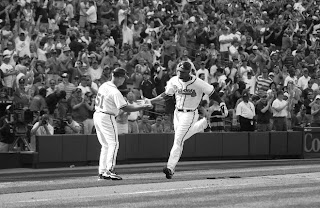
This spring, the front office of the Atlanta Braves decided that über-rookie Jason Heyward was so good, they couldn't afford to stall his arbitration clock by keeping him in the minors to begin the season. They may have sacrificed a year of team control and millions of dollars in the process because of it, but the phenom broke camp with the Big League club.

Yesterday afternoon in Atlanta, Heyward stepped in the box against the Cubs' Carlos Zambrano for his first Major League plate appearance. With his parents in the stands and the crowd chanting his name in between pitches, the level of excitement in Turner Field was tangible. The game was being broadcast on ESPN2, so plenty of eyes around the baseball world were focused in on the at bat.

Heyward took two 4-seam fastballs high for balls before connecting with a two-seamer low in the zone. The ball exploded off the bat and carried deep into the Braves bullpen in right field, good for a three run homer that put the Braves up 6-3. There was little doubt throughout the baseball community that Heyward was going to be a useful player right out of the gate, but as it so rarely does, the hype was justified immediately. It's not to say that this guarantees Heyward is going to have a great career, but that the fans in Atlanta didn't need to wait to see a glimpse of his considerable potential. Sometimes suspense is thrilling, but in this case it was the lack thereof that created the drama.

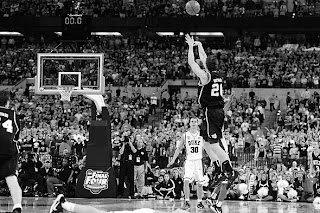
About 8 hours after Heyward's fairytale beginning, the best player on the Butler Bulldogs, Gordon Hayward, looked to complete a storybook ending to what was already a fantastic National Championship in his hometown of Indianapolis. It was one of just four times that the title game had taken place in the city that one of the schools called home and improbably, Bulter was keeping pace with Duke.

Hayward had struggled throughout the night, shooting just 2-9 from the floor in front of a very vocal and supportive crowd, but the Bulldogs hung in there. The game was neck and neck for the entire 40 minutes; the difference between the two teams never greater than 6 points. Since the battle was so tight, the end of it wasn't broken up by copious amounts of timeouts taken and fouls committed by a team trying to fight its way back into it.

With 13 seconds left on the clock in and Butler trailing by one point, Hayward started at the top of the key and began driving towards the basket, dribbling to the right. With about 6 ticks remaining, he planted his feet and pushed off parallel to the baseline, and lifted a high, soft 12 foot fadeaway. It wasn't a high percentage shot, but Hayward make a crisp release. As it began to descend from its apex, the ball was still perfectly on line with the hoop. However, it struck the inside of the back of the rim and ricocheted directly back towards the spot that Hayward took off from.

If the ball had carried just an inch less, Duke would have been down one with about five seconds to go. Instead, Duke's center Brian Zoubek pulled down the rebound and was fouled immediately, sending him to the free throw line with 3.6 seconds left. He made the first and after intentionally missing the second, the ball fell into Hayward's hands once again. The baby-faced sophomore only had time for a few dribbles and released the ball from half court just as the clock was expiring. It hit the backboard, deflected off the near side of the rim and fell to the ground as Duke became the National Champions.

Hayward came impossibly close, twice, to winning the game for a school that only shameless homer and alumni would have picked to be in the Final Four, let alone the Championship Game. The difference between those two shots going in or bouncing out is so small that no human being, no matter how skilled, could expect to control it. Concerning the last shot in particular, the disparity between hitting one of the greatest buzzer-beaters on the biggest stage possible in college basketball and going home empty-handed was the way that his neurons and synapses subconsciously fired over the course over several milliseconds.

Right or wrong, that's what we remember. We distill sports down to their most incredible moments, but don't often bother to think about the alternate outcomes and how close - literally fractions of an inch and hundredths of a second - they came to occurring.

Gordon Hayward is just a sophomore at Butler, so if he chooses, this doesn't have to be the end of his college career. But the odds against him leading a team that far into the NCAA Tournament let alone coming just thatclose to winning it are so long that they might as well not exist. Jason Heyward is likely just at the beginning of a long and successful career, but 5, 10, 20, 50 years from now, both of these athletes are going to be able to recall those two remarkable moments in incredible detail. Only one of them is going to bother to wonder what might have happened if it had turned out another way.